


Feeding greenhouse cucumbers starts with understanding where the roots are growing and how water reaches them. In a soil bed, some nutrients are supplied by the soil itself. In an inert medium, plants depend on the nutrient solution. Before buying fertilizer, identify the growing system, check root-zone moisture and irrigation, and review crop stage and previous applications. This sequence helps you decide whether separate feeding is appropriate or whether something in the greenhouse needs attention first.
Identify the growing system before choosing a feed
Soil beds under a fixed cover
Many small greenhouses have beds planted straight into the ground. Find out what was applied to the previous crop and during bed preparation. If tomatoes or cucumbers grew there last year, residual nutrients can influence the new crop's requirements. Count earlier compost, manure and other amendments in the same review. Organic and mineral inputs can both introduce soluble salts, so the history matters whichever type you used. Write down the product and the area to which it was applied if you still have the information.
A permanent roof excludes rain that would otherwise pass through the soil. If you have fertilized the same covered beds over several seasons without testing, ask a laboratory about acidity, available nutrients and soluble salts. Keep clearly different areas separate when sampling, such as a row near the door and a persistently wet corner. The guide to soil assessment before fertilizing explains how to approach distinct growing zones. Irrigation water from a well can also affect the results, so consider checking the water along with the soil when a problem keeps returning.
Grow bags, containers and inert substrates
If cucumbers are in a commercial potting mix, look for information on its ingredients and any starter charge. In an inert medium such as perlite or rockwool, account for all essential elements in the nutrient solution. Check the raw water and use the measurements appropriate to your setup. Electrical conductivity is an indirect indicator of dissolved ions. Temperature and solution composition affect the reading, which does not identify a specific nutrient shortage. Interpreting the conductivity of a prepared solution is different from interpreting a laboratory test of soil.
Directions that allow root application to soil or substrate describe the permitted way to use that particular product. A continuous programme for an inert system needs its own complete nutrient formulation and irrigation management. If you move plants from one setup to another next season, keep a record of where earlier observations came from. Similar-looking leaves in a soil bed and a perlite bag may call for different checks, even when the cultivar is the same.
Check how the bed is actually being watered
Walk the rows after an ordinary watering. Compare the moisture at root depth near the start and end of the drip line, then check a sunny edge and a shaded corner. The surface can be damp while the root ball remains dry. Heavy soil can show the reverse pattern, with a dry-looking surface over a persistently wet root zone. Check several emitters and look at the pattern of wetting next to the plants. A single functioning emitter near the supply is a poor basis for assuming the whole line is working evenly.
If leaves wilt near a sunny wall at midday, assess air temperature and soil moisture together. Leaves that recover after the heat drops provide a reason to check ventilation and irrigation in that zone. If just one plant stays limp in wet soil, examine the base and drainage near that plant. When a whole row is weak, look at shared conditions such as the water line and fertilizer history. These observations help you choose where to sample. They cannot by themselves establish a deficiency.
Use crop stage to guide the next decision
A young cucumber needs stable conditions for the roots to move into the surrounding bed and for new leaves to develop. After planting, check that irrigation actually reaches the original root ball. Note any starter nutrition that came with the transplant. The appearance of new growth is useful to record when deciding whether the plant is still adjusting or whether poor performance is continuing. When fertilizer directions distinguish seedlings from established plants, use the stage described for the relevant row of the label.
Water and nutrient demand changes as the vine flowers and begins to carry a regular harvest. Nitrogen and potassium are important in greenhouse cucumber production, but the need for a particular input depends on what the crop is already receiving. Strong growth of stems alone is insufficient reason to increase nitrogen. When fruit numbers are low, consider light, temperature, cultivar characteristics and plant management. If the margins of some leaves are yellow, look at roots and watering before changing products. Testing plant tissue or soil can help where the visible pattern is unclear.
One tunnel can contain batches of different ages. For example, an early row may already be yielding cucumbers while a newer row is still becoming established. Keep them separate in your plan even if both use water from the same tank. Work out which plants you can treat independently and how you will check the prepared volume. The guide to feeding cucumbers by growth stage covers the crop more broadly. Use it alongside what you observe in this particular greenhouse and bed.
For a few plants in indoor pots, see the separate guidance on feeding cucumbers on a windowsill. Only use practices in the greenhouse bed where the growing conditions match.
Adjust checks to your location and weather in Ukraine
An unheated greenhouse can warm quickly on a spring afternoon while the soil at root depth is still cool after the previous night. Check conditions in the morning and after ventilation, especially near the doors. On a summer day under a clear cover, the sunny edge of a bed can dry faster than the middle. Two neighbouring greenhouses may have quite different shade and air movement. Base the timing of work on the row you are treating and the weather it has experienced.
If you have a short working period before the greenhouse gets hot, spend it checking irrigation and gathering the observations you need. When you restore an emitter that was not delivering water evenly, monitor that part of the row separately. Changing irrigation and fertilizer at the same time makes it harder to understand what helped. If new symptoms spread rapidly, take both whole-plant pictures and close views of affected leaves and stems for more precise diagnosis.
Match the directions to the application method
Find the crop or crop group on the label, then check the correct stage and route. For a root feed mixed with water, read two quantities separately: the amount of concentrate to dilute and the volume of prepared solution for each plant. Count only the plants receiving the treatment. If you are also planning purchases for another row, do not combine the two counts until you have confirmed that the same instruction genuinely applies to both.
If the product also has a separate foliar direction, use that row only when spraying the leaves is the intended job. Soil application and foliar treatment are separate methods. Check that the container holds no residue of an earlier preparation. To decide what to order, compare the amount of concentrate you actually require with the pack size and review the storage instructions for any product that remains.
Root feeding for established cucumbers in soil
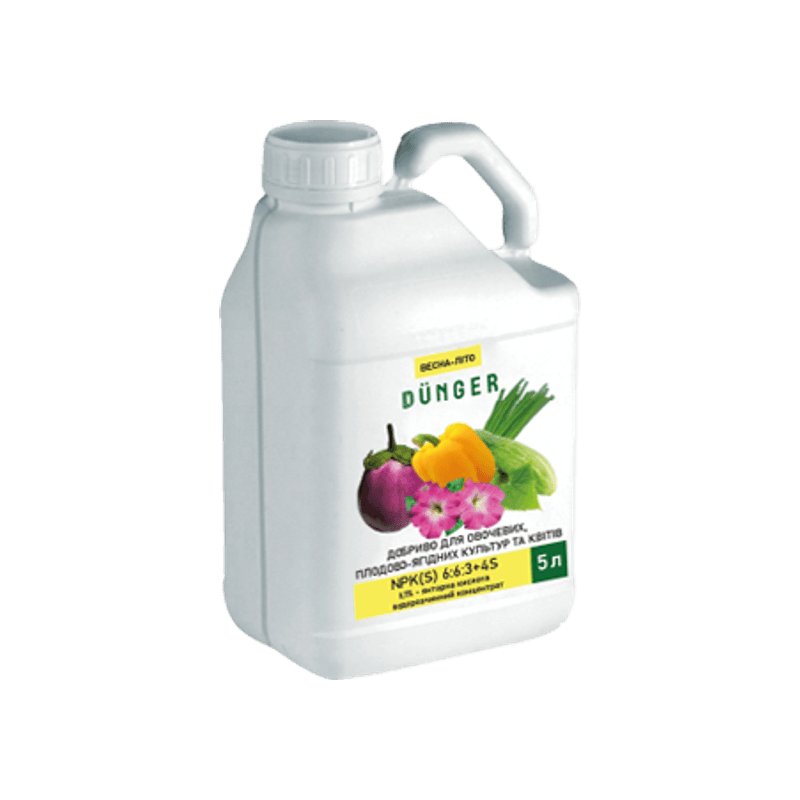
Complex fertilizer for vegetables, fruit and berry crops, and flowers
If irrigation is working, the cucumbers have established and the bed needs supplemental feeding, consider this concentrate. Use the vegetable root-feeding row for the soil bed.
Vegetables of all types, fruit and berry crops, flowers (root feeding): 50 ml/10 L of water (100 ml of solution /plant)
Seedlings have separate directions. The 5 L canister contains concentrate. Before deciding how many to order, compare the full application directions with the stage of your plants.
Questions about feeding greenhouse cucumbers
For a soil bed, irrigation and feeding are separate decisions. An extra watering on a hot day does not change the rate or method stated on the fertilizer instructions. In a soilless system, nutrient delivery follows a programme designed for that system. Start by identifying which setup you are managing.
A yellow edge is a reason to investigate. Compare old and young leaves, plants in different parts of the row and the moisture at root depth. Poor drainage, uneven watering and excessive salts can also affect the way the crop looks. Where the cause remains unclear, a soil or tissue test gives a firmer basis for choosing an input.
Count the plants covered by the same application instruction first. Use the stated volume per plant to calculate how much finished solution you need, then measure the concentrate using its dilution directions. Keep another stage or an irrigation setup with different requirements in a separate calculation.


