


Start with the growing situation: are the cucumbers in a bed or a container, what has already been added, how moist is the soil and are the plants actively developing? These questions separate planned nutrition from an attempt to correct cold conditions, lack of water or disease with fertilizer. Then choose a product and its relevant instructions.
Before feeding: soil, water and previous inputs
Cucumbers need warmth and soil that retains moisture while draining well. In cold conditions they can grow poorly even when nutrients are present. If growth stops after transplanting, check the environment and roots. Additional feeding cannot by itself correct an unsuitable planting situation or damage caused by cold. Establish what has changed before deciding on the next treatment.
For a garden bed, soil-test information and a record of compost, manure and fertilizer additions are useful starting points. A bed already supplied with nutrients should not automatically receive a regime intended for poor soil. Review earlier work so that each new fertilizer is considered as part of the total supply rather than as an unrelated garden task.
In containers, check the potting mix, any fertilizer already included and the directions that come with it. Nutrients can leave the pot with drainage water, making container feeding a separate planning task. Excess applications can also cause salts to build up. Monitoring a container more frequently does not mean you can make its fertilizer solution more concentrated.
Feeding cucumbers through their growth stages
Emergence and young seedlings
Check the medium in which the seedlings are growing and what it already contains. The appearance of a shoot is not a universal instruction to feed immediately. Young plants also need suitable light, warmth and watering. Before preparing a solution, find the seedling directions for your product rather than using only the rate given for established vegetable plants.
Seed leaves and true leaves represent different developmental stages. If the instructions tie first use to true leaves, assess that stage rather than substituting an arbitrary number of days after emergence. For the liquid fertilizer below, first application and the specific precautions for seedlings are described in a separate memo. Keep those conditions with the product when planning the work.
After transplanting into the final position
The timing of planting cucumbers depends on local conditions. They are a warm-season crop and frost can damage them. Handle the root system carefully during transplanting. Check moisture in the root ball and surrounding soil, together with drainage. Do not try to compensate for damaged roots by applying twice as much fertilizer or by combining several feeds immediately.
After planting, review the whole nutrition plan, including anything incorporated into the soil beforehand. A granular planting application and a later liquid feed do not automatically have to follow one another. Check each product's conditions and avoid overlapping several regimes simply because all the labels mention vegetables. Keep a record of the actual product and amount already used.
Leaf and shoot growth
Assess development as a whole: new leaves, the lower canopy, moisture and access to light. Wanting longer shoots is not enough reason to increase nitrogen. Excess nitrogen nutrition in vegetables can favour excessive leaf growth and delay fruiting. Select the composition and amount according to the requirement rather than a promise of rapid greening or the size of a neighbour's vines.
If leaves change colour, examine whether the change is uniform, spotted, concentrated along the edges or accompanied by insect damage. Different problems can look similar. Compare plants across the bed, inspect the underside of affected leaves and review watering. A single yellow leaf cannot identify the nutrient involved or establish the quantity of fertilizer the plant needs.
Flowering and the beginning of fruit set
At this stage, consider plant nutrition alongside the cucumber type and its pollination requirements. Some varieties need pollen transfer, while parthenocarpic types can develop fruit without pollination. Check the seed information. Do not treat every flower in the same way or assume that every flower should become a cucumber. The variety matters when interpreting what you see.
If flowering is plentiful but fruit set is poor, check the growing conditions and the variety's need for pollination. Fertilizer cannot replace that process. Potassium is important for flowering and fruiting, but the need for a particular formulation still belongs with soil conditions and earlier inputs. The first flower does not justify an improvised additional dose of feed.
Fruiting and regular harvest
Keep moisture reasonably consistent while fruits develop, checking the soil rather than judging by leaves alone. Distinguish ordinary watering from an application of nutrient solution. Follow the interval for the fertilizer you selected. A greater need for water does not mean that every watering should contain fertilizer. Containers deserve particular attention during warm weather because their growing conditions can change quickly.
Harvest according to the variety and avoid leaving cucumbers on the plant after they have become overlarge for their intended use. Regular picking supports further cropping. If the plant weakens, also assess foliage, roots and growing conditions. Another feed should not replace routine crop care or investigation of disease. Record changes rather than responding to every disappointing fruit with a different mixture.
Root feeding and foliar feeding are different operations
Root feeding is applied to soil or potting medium under the relevant instructions. Foliar feeding needs its own permitted concentration and application method. Do not carry a solution from one method to the other. A liquid product is not necessarily ready to use undiluted, and its physical form does not permit you to change the concentrate-to-water relationship yourself.
For ordinary cucumber watering, direct water towards the soil and avoid unnecessary leaf wetting. A separately planned application of a permitted foliar nutrient solution has different directions. Keep these operations distinct. Do not add several products to the same tank without confirmed instructions for that combination. The presence of a spray method on one label does not establish compatibility with other materials.
A DÜNGER liquid fertilizer for vegetable crops
Complex fertilizer for vegetables, fruit and berry crops, and flowers
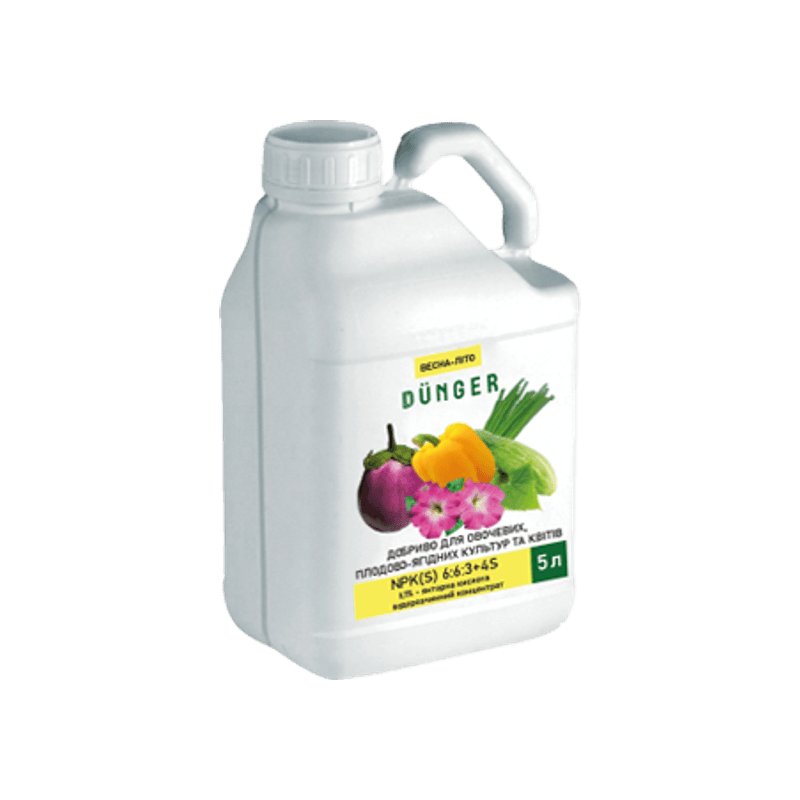
Cucumbers belong to the vegetable group covered by this concentrate's instructions. The product comes in a 5 L canister. Select the regime for seedlings or established plants and the relevant application method. The complete application method and periods are:
Used throughout the entire period of plant development and growth. For root feeding into the soil/substrate, dilute 50 ml of fertilizer in 10 L of water (100 ml of solution per 1 plant) and use at intervals of 10-12 days. For foliar treatment (spraying), dilute 25 ml in 10 L of water and apply with a sprayer, ensuring even coverage.
For treating seedlings, halve the concentration of the working solution!
Application memo
Feed plants with fertilizer in the morning or evening, avoiding hot weather. Fertilize the seedling substrate for the first time 10-14 days after pricking out or at the stage of 4 true leaves.
Remember that the solution for seedlings should be half as concentrated as the solution for mature plants. Do not use products whose instructions specify the same dosage.
These directions belong to this product. Do not transfer them to another liquid or granular formulation. Compare composition and other options in the vegetable fertilizers selection. Check the full product name, pack size and your requirement before adding it to the basket.
When to investigate instead of applying another dose
For advice, prepare photographs of the whole plant, both sides of affected leaves and the growing area. Add information about watering, weather, earlier feeding and when the symptoms began. This is more useful than a list of products you could apply immediately. Avoid layering new mixtures onto an unresolved problem before there is a reason for the next action.
Common questions
Do not equate water demand with fertilizer demand. The instructions for the selected product determine its interval and the appropriate regime. Check soil or potting-medium moisture and plant condition separately. Ordinary watering remains a different part of care even when the fertilizer is supplied as a liquid concentrate.
Growing conditions and previous nutrient inputs can differ. Greenhouse temperature needs attention, while containers also require checks of the medium and drainage. Assess the actual situation without independently altering the rate or method of the fertilizer you choose. Use plant stage and the product instructions rather than one date for every garden.
For planned nutrition, choose a known composition with instructions for vegetable crops. Do not make a household recipe a compulsory feeding step or a universal treatment for disease. Any material you apply needs a justified purpose, amount and method. A familiar ingredient name does not establish that it fits the problem affecting your cucumbers.

