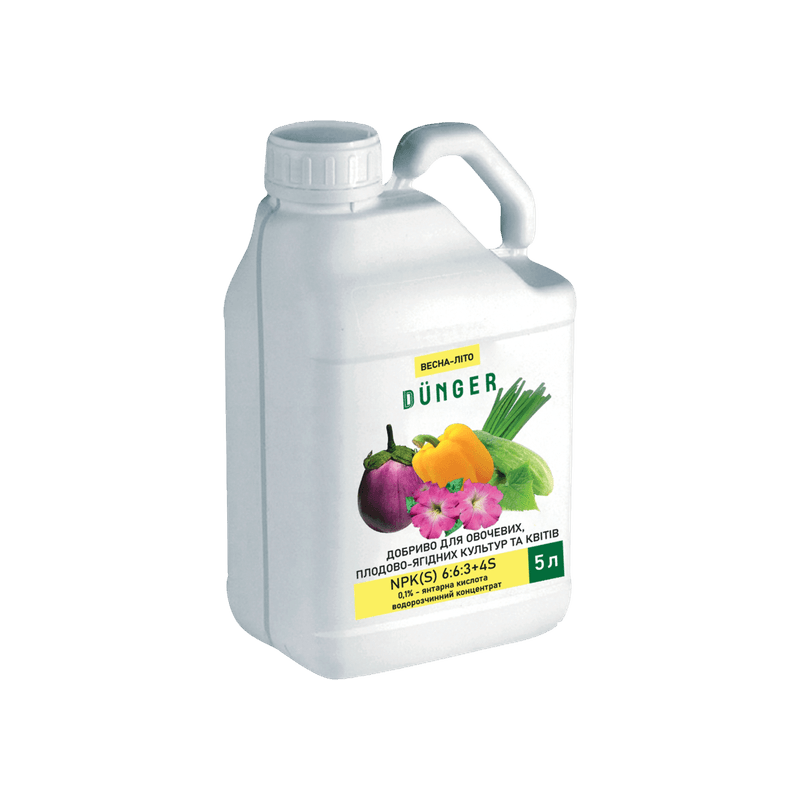
DÜNGER fertilizer for vegetables, fruit and berry crops, and flowers in a 5 L canister. View the product details, choose the number of canisters and order for your vegetable garden, berry patch or flower beds.
Greenhouse fertilizers
Concentrate for vegetables and seedlings, and DÜNGER granules for soil beds. Compare composition, pack sizes and supported application methods for your greenhouse. Delivery in Ukraine.
Concentrate for vegetable and seedling root feeding, and universal, organic-mineral and VIVO granules for soil beds. Choose by crop, irrigation method and earlier nutrition; check instructions, pack sizes and prices in the product cards.
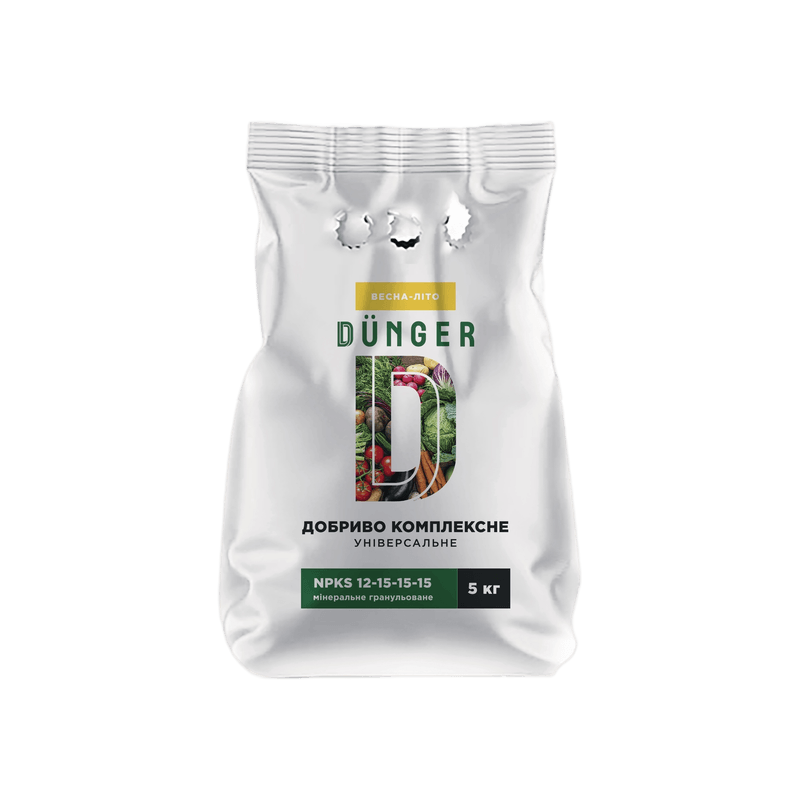
DÜNGER universal compound fertilizer granules for vegetables, legumes, leafy greens and ornamental plants. Available in 3, 4 and 5 kg packs.
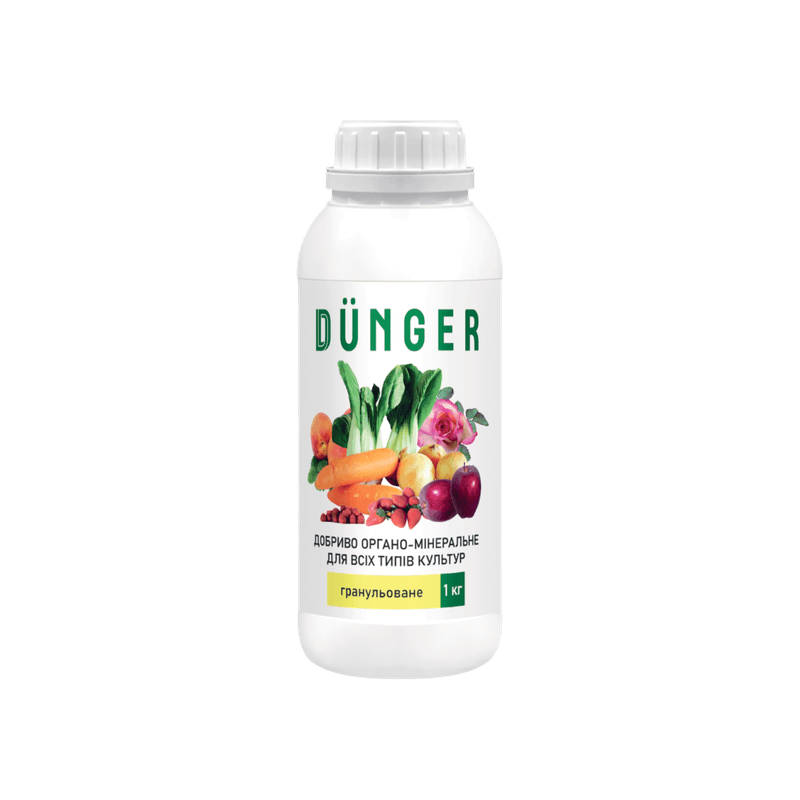
DÜNGER organo-mineral fertilizer granules for all types of crops. Available pack sizes: 1 and 5 kg. Select a pack, check its price and availability, and place an order for delivery within Ukraine.
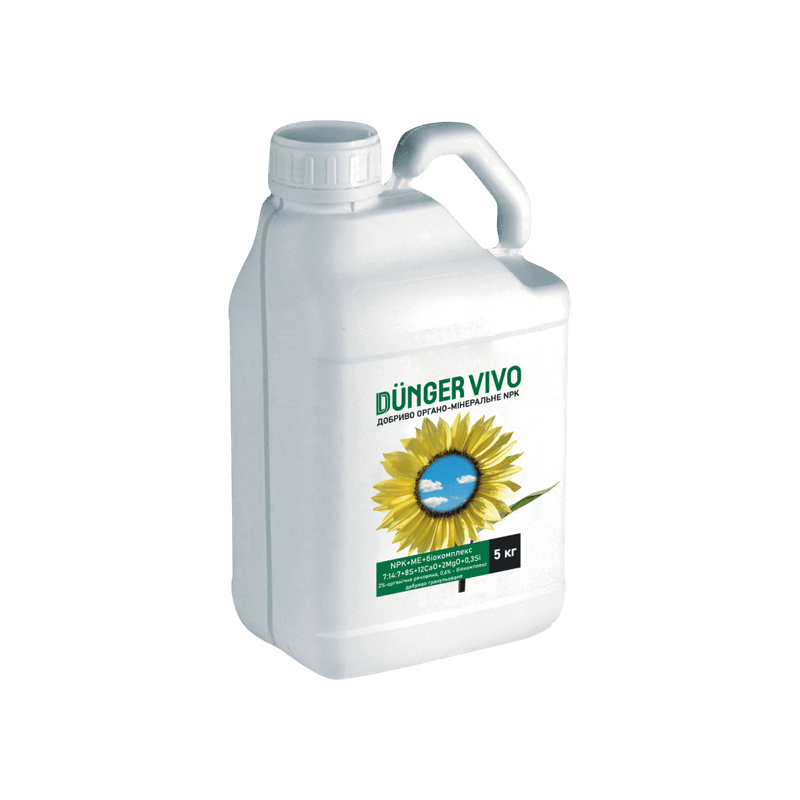
DÜNGER VIVO is an organo-mineral granular fertilizer for vegetables, berries, garden trees and ornamental plants. The 5 kg pack contains NPKS 7:14:7:8, calcium and magnesium, 2% organic compounds and 0.6% Agrinos A biocomplex. Apply to soil in spring and during active growth.
Plan your plant care ahead
Your season. Your plants.
Explore the seasonal calendar, prepare for the next stage and choose the pack sizes you need.
Choose a plant group or month. Coloured periods are planning guides for Ukraine, not application dates. Dashed lines require the actual plant stage.
Follow the plants’ growth stage
By growth stageThis group is for soil or a suitable soil mix. In a heated greenhouse, follow the crop cycle; in an unheated greenhouse, also consider temperature. For hydroponic systems, choose Hydroponics.
Your seasonal selection
Products for this plant group
DÜNGER fertilizer for vegetables, fruit and berry crops, and flowers in a 5 L canister. View the product details, choose the number of canisters and order for your vegetable garden, berry patch or flower beds.
DÜNGER universal compound fertilizer granules for vegetables, legumes, leafy greens and ornamental plants. Available in 3, 4 and 5 kg packs.
Indicative periods for Ukraine. Consider weather, growth stage and product instructions. This calendar does not prescribe rates or feeding frequency.
Choosing fertilizers for greenhouse vegetables
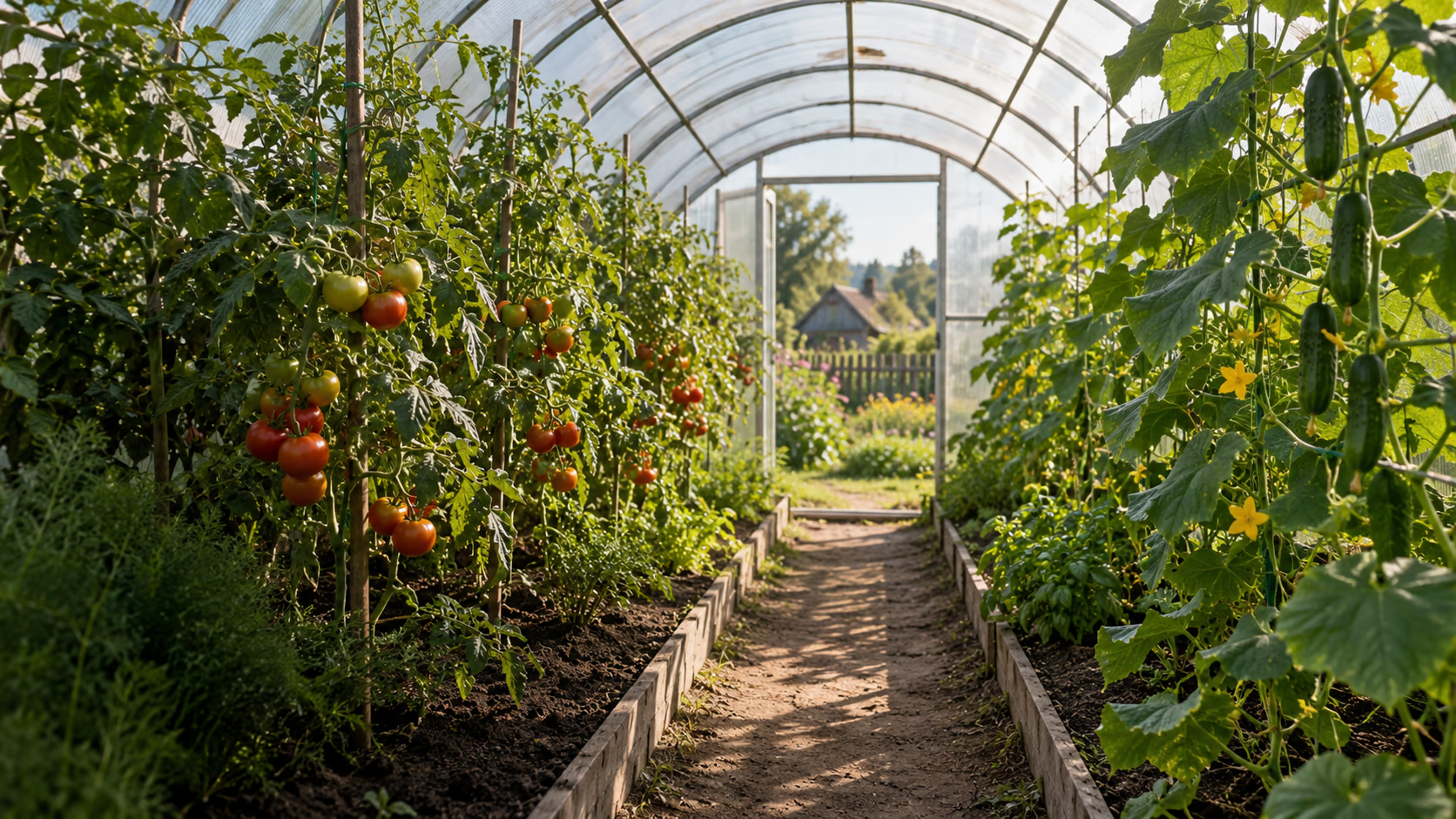
Choose greenhouse fertilizers according to the crop, the soil and the application method. Soil inside a greenhouse contains organic matter and microorganisms. Its nutrient reserves depend on earlier crops, compost and fertilizers already applied. A glass or plastic covering does not, by itself, mean that every plant needs feeding every week. First establish what the vegetables are growing in, what nutrients they have received and whether the root zone is evenly moist.
For feeding in solution, choose a concentrate with the relevant instruction. For soil-bed preparation or area-based application, consider universal, organic-mineral or VIVO granules. Compare the method with your irrigation system and nutrients already supplied to the greenhouse vegetables. There is a separate page for tomato fertilizers, while vegetable fertilizers covers the wider vegetable garden. This page focuses on protected cultivation, irrigation water and the limitations of different fertilizer forms.
Concentrate for vegetables and seedlings
The concentrate for vegetables, fruit and berry crops and flowers contains NPK(S) 6:6:3(4). A 5 L container is listed in the catalogue. Its instructions describe root and foliar feeding, with different concentrations for seedlings and mature plants. The table below lists root applications only. A spraying rate does not replace a watering rate, and the volume of concentrate is not the volume of the finished solution.
Universal granules for protected cultivation
Universal NPKS 12:15:15:15 granules are expressly intended, among other uses, for vegetables grown outdoors and under cover. The available pack sizes are 3, 4 and 5 kg. Distribute the granules in the soil according to the instructions, whether preparing a bed or feeding an established crop. Do not turn a rate in grams per square metre into a solution recipe: that is a different application method, which an area rate does not establish.
Organic-mineral options
Organic-mineral granules for all crop types combine mineral nutrients, organic matter and humic acids. The product is listed in 1 and 5 kg packs. Its description specifically includes greenhouse and seedling soils and soil mixes. Separate instructions cover vegetable feeding and preparation of a soil mixture. These applications should not automatically be added together without accounting for nutrients already supplied.
DÜNGER VIVO is an organic-mineral granular fertilizer with NPKS 7:14:7:8, supplied in a 5 kg pack. Its application table includes vegetables such as tomatoes and cucumbers. Apply it to loose, moist soil before planting or during active growth as instructed. An organic component does not remove the need to measure the product: excessive nutrient additions are still undesirable.
Application rates: soil, seedlings and working solutions
The table gives soil rates and concentrate dilutions from DÜNGER instructions. Select the entry for mature vegetables, seedlings or soil-mix preparation and use its quantity unit. Before applying anything, check the product name, composition and directions on the purchased package. Account for nutrients already present in the bed or supplied in a prepared growing medium.
| Fertilizer | Application | Instruction rate |
|---|---|---|
| Vegetable concentrate | Root feeding of mature plants | 50 ml per 10 L water; 100 ml of prepared solution per plant |
| The same concentrate | Root feeding of seedlings | 25 ml per 10 L water; 50 ml of prepared solution per plant |
| Universal granules | Vegetables in soil beds | 20-40 g/m² |
| Organic-mineral granules | Feeding vegetable crops | 45-50 g/m² |
| The same organic-mineral granules | Preparing a soil mixture | 60-80 g per 10 kg of soil mixture |
| DÜNGER VIVO | Vegetables, including tomatoes and cucumbers | 20-40 g/m² |
Measure the area of the beds receiving granules, excluding the paths. For example, applying a rate of 20-40 g/m² to 20 m² gives a calculation of 400-800 g of one selected product. This is not advice to choose the upper end automatically. The instructions, soil analysis and earlier applications determine whether feeding is needed at all. The rate of 60-80 g per 10 kg of soil mixture refers to the mass of the growing material, not to a bucket of water.
With a concentrate, both figures matter: the dilution and the amount of finished solution per plant. Do not give each plant the entire ten litres just because the dilution is described for that volume. Use a measuring vessel for liquids and scales for granules. Different spoons and bottle caps do not deliver consistent doses. Recheck the label when choosing a different formulation or pack.
Feeding tomatoes, cucumbers, peppers and leafy crops
Tomatoes: consider the stage after transplanting
For greenhouse tomato feeding, assess the seedlings’ condition and how the bed was prepared. After transplanting, a plant needs conditions that allow its roots to function, not an automatic increase in fertilizer. Record any compound fertilizer already incorporated before planting, or nutrients included in a prepared medium. At flowering and fruit development, consider the whole nutrition programme rather than assuming that nitrogen is no longer needed.
Cucumbers: coordinate feeding and watering
When choosing feed for fruiting greenhouse cucumbers, distinguish nutrient needs from water shortage or overheating. Check that the emitters deliver water evenly and that the root zone is moist. A stronger fertilizer solution does not compensate for uneven irrigation. For soil application, choose an appropriate granular product; for feeding in solution, choose a product with instructions that support that method.
Peppers, leafy vegetables and young seedlings
Do not transfer a mature tomato's application volume to a small pepper seedling or a tray of lettuce. The concentrate listed here has a separate root-feeding rate for seedlings. That does not mean that every other fertilizer should simply be mixed at half strength. Leafy vegetables need balanced nutrition rather than nitrogen alone. In small containers, pay particular attention to the composition of the prepared mix and the limited root volume. Different crops sharing a greenhouse do not necessarily need the same feeding schedule.
Water quality, salt accumulation and drip-feeding fertilizers
What to check in soil and water
Rain does not wash greenhouse beds in the same way as an outdoor plot. Excess applications and salts in irrigation water can accumulate, making soil and water analysis useful. The pH value describes acidity, while EC measures electrical conductivity associated with dissolved salts. Results depend on the measurement method: a soil-extract value cannot be compared directly with a nutrient-solution reading. Water alkalinity also matters and cannot be established from a pH reading alone.
There is no single EC range or acidity-correction recipe suitable for every crop and system. If salt accumulation is suspected, establish the cause and drainage conditions before attempting leaching. Do not add acid or baking soda by guesswork. Decisions based on analysis help avoid making the problem worse with another fertilizer application.
Soil granules are not automatically fertigation products
A drip system can supply water to a bed where fertilizer has been incorporated into the soil. However, delivering fertilizer through the irrigation system is a separate application method. It requires a suitable water-soluble product, an appropriate concentration and compatible equipment. A granular form, or gradual dissolution in soil, does not establish suitability for an injector. Hydroponics requires a separate nutrient programme: the soil rates on this page are not a ready-made recipe for a reservoir.
When leaves turn yellow or fruit develops unevenly
Yellow leaves, stalled growth and misshapen fruit do not identify a single nutrient deficiency without further checks. Examine the roots, moisture, temperature, distribution of symptoms and condition of nearby plants. Review recent applications. Adding several products at once makes it harder to establish the cause and judge the response.
Blossom-end rot in tomatoes and peppers involves calcium supply to the fruit, but does not necessarily mean the soil lacks calcium. Consistent watering matters. A calcium, magnesium or boron product should not be prescribed solely from a photograph of a mark. For recurring problems, consult an agronomist with test results and records of watering and feeding. Plant nutrition also does not replace diagnosis of pests and diseases.
Frequently asked questions about greenhouse fertilizers
How often should plants be fed?
The interval depends on the product and nutrients already supplied. The concentrate's instructions specify 10-12 days for mature plants, but this interval does not apply to the granules or to all greenhouse crops. Do not repeat feeding simply because a date has arrived if the soil condition and nutrition programme do not call for it.
What can I use to feed vegetable seedlings in a greenhouse?
For seedling root feeding, the concentrate instruction specifies 25 ml per 10 L water and 50 ml of prepared solution per plant. Measure concentrate and water, prepare the required volume and account for nutrients in the growing mix. For granules, choose their separate soil method using the bed area or mix mass and the appropriate product instruction.
How can I order and receive delivery?
Open a product card to check the current price, availability and pack size. Further choices are available in fertilizers for vegetable gardens and the mineral fertilizer catalogue. Read the delivery and payment terms. For help choosing, use the DÜNGER contact details and describe the crop, soil, irrigation method and earlier applications. This information makes it easier to select an appropriate option.
Dünger Fertilizer Delivery Regions Across Ukraine
Buy Dünger mineral and organo-mineral fertilizers with delivery to any region of Ukraine. Select your oblast - and get fertilizers direct from the manufacturer for your garden, farm or agribusiness. Delivery via Nova Poshta and Ukrposhta to all cities, villages and district centres. Produced in Rivne Oblast, Dunger LLC.
Fertilizers in Rivne and the region
Order & Inquiry
Get in touch

Order mineral and organo-mineral fertilizers directly from the manufacturer. We will help you choose the right product for your garden, farm or landscape.
Hello!
Let's get acquainted and help you
Press Enter to continue
By clicking the button, you agree to privacy policy