


Raspberry Fertilizers - Buy from Manufacturer Dünger
Raspberry is undemanding, but responds to correct feeding with dramatically higher yields. Three targeted feeds per season and one iron rule - stop nitrogen after July 1st - and your raspberries will produce large sweet berries and healthy strong canes. DÜNGER granular raspberry fertilizers - balanced feeding at every stage from bud break to end of fruiting. Delivery by Nova Poshta and Ukrposhta across Ukraine.
Raspberry: Biennial Cane Biology and Why It Shapes the Feeding Schedule
Raspberry has a unique biennial cane cycle. First-year canes (primocanes) grow and form buds. Second-year canes (floricanes) flower, fruit and die. At any given time, both young and fruiting canes coexist on the same plant. A correct feeding schedule accounts for both simultaneously.
Optimal soil pH for raspberries: 5.8-6.5. Below 5.5 - iron and manganese are blocked, canes yellow. Above 7.0 - phosphorus becomes unavailable, growth slows.
Raspberry responds well to mulching: an 8-10 cm layer of sawdust or straw retains moisture, moderates soil temperature and gradually enriches organic matter. Mulch does not replace mineral feeding but significantly improves its effectiveness.
Feed 1 - Spring: Nitrogen for New Canes
Apply the first feeding when soil warms to +5-10°C - typically March-April, immediately after removing winter protection. Goal: supply nitrogen to awakening young canes. Nitrogen N at this stage is critical: it determines the number and vigor of new canes, which means next year's harvest.
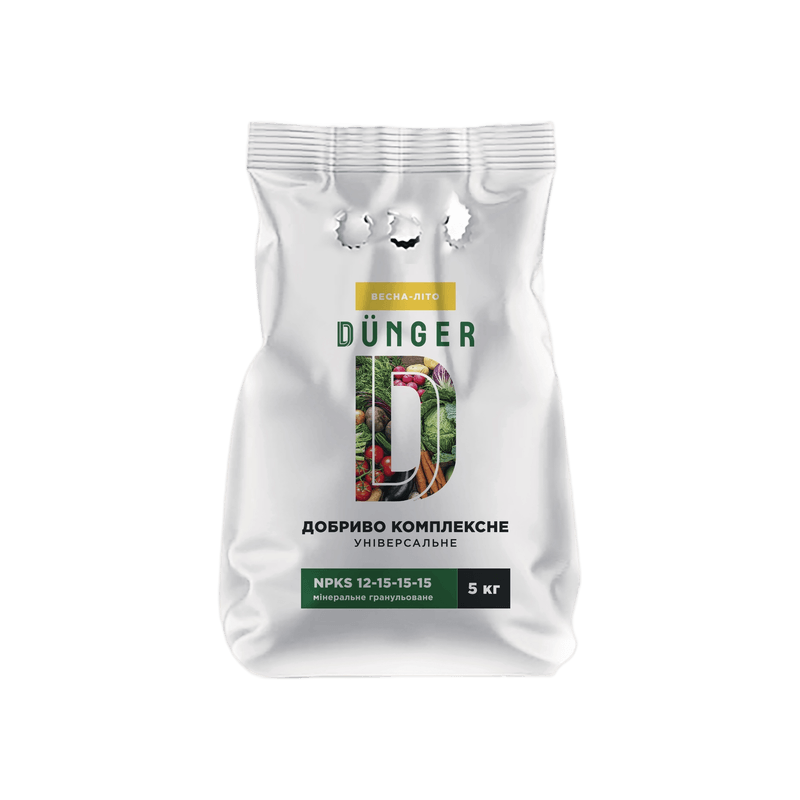
DÜNGER Universal (SKU 1) - formula N12-P15-K15-S15 - is ideal for the spring start. Rate: 20-30 g per linear meter of raspberry row. Scatter over the soil between plants, lightly rake in and water. Phosphorus P15 simultaneously stimulates root system development, and sulfur S15% enhances nitrogen uptake and protects against root fungal disease.
If canes were frost-damaged over winter - increase the SKU 1 dose by 20-30% to stimulate strong recovery. First-year plants: 15-20 g/m (half the adult rate).
Feed 2 - Pre-Flowering: Phosphorus and Potassium for Larger Berries
When the first buds appear on floricanes (typically May), it is time for the second feeding. Nitrogen now takes a back seat - the plant must direct energy toward berry formation, not leaf growth. Priority: phosphorus for maximum fruit set and potassium for berry size, sweetness and firmness.
DÜNGER Phosphorus-Potassium (SKU 19) - formula P23-K30 - with zero nitrogen. Rate: 15-20 g per linear meter between rows. P23 stimulates mass fruit set and increases berries per cluster. K30 increases berry size, sugar concentration and flesh density - berries hold shape better when picking and transporting.
Simultaneously, a foliar spray with boric acid 1 g per 10 L water during flowering is recommended. Boron (B) improves pollination and prevents 'empty' flowers without fruit set. Apply in dry weather in the evening to avoid scorching flowers.
The Iron Rule of Raspberry: Stop Nitrogen After July 1st
This is the most important raspberry rule and the most commonly broken. When nitrogen is applied after early July, young canes keep growing instead of hardening. The consequences:
- Soft, unhardened canes - freeze at the first frost. Next year's yield is lost along with the damaged floricanes.
- Increased susceptibility to bark diseases - Didymella applanata (purple blotch), Botrytis cinerea (grey rot) easily penetrate soft cane tissue.
- Flavorless berries - the plant spends sugars on cane growth instead of accumulating them in berries. Even large berries become sour and watery.
- Excessive cane density - uncontrolled late-season cane growth reduces airflow and light penetration, worsening disease pressure.
After July 1st, only phosphorus and potassium applications are allowed. SKU 19 (P23-K30) and SKU 601 (N5-P14-K21) are acceptable as they contain minimal or zero nitrogen.
Feed 3 - Post-Harvest: Preparing Canes for Winter
After fruiting ends (August-September), spent floricanes are cut out and young primocanes are left for next season. This is exactly when the plant forms flower buds for next year's harvest and stores nutrients in roots for winter.
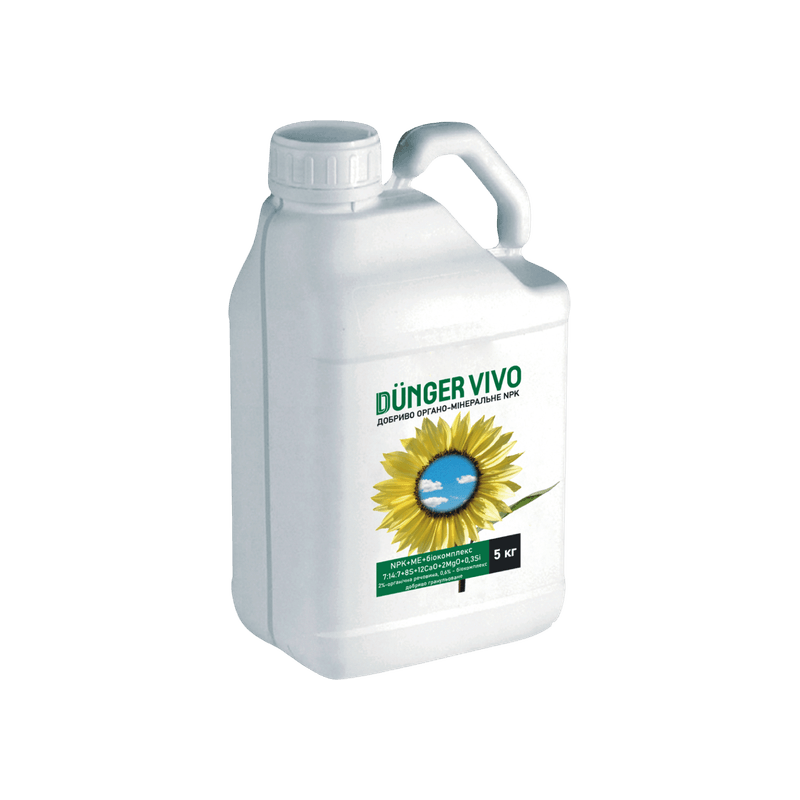
DÜNGER Autumn Complex (SKU 601) - N5-P14-K21-S6-Si0.3% - is optimal for this phase. Minimal nitrogen N5% does not trigger new growth. Elevated phosphorus P14 stimulates flower bud differentiation and carbohydrate accumulation in roots. Maximum potassium K21% strengthens cane wood and improves frost hardiness. Silicon Si0.3% densifies bark cell walls - canes become more resistant to cane rot and bark disease pathogens. Rate: 20-25 g per linear meter between rows. Apply September-October before hard frosts.
Autumn-bearing (remontant) raspberry varieties fruit in August-October and have a shifted season - apply Feed 3 after the second crop, in October-November before soil freeze.
Nutrient Deficiency in Raspberries: Signs and Solutions
- Thin, short canes, pale leaves across all plants - nitrogen (N) deficiency. Unplanned dose of SKU 1 at 20 g/m in first half of June. Do not apply N after July 1st.
- Young leaves yellowing between green veins - iron (Fe) or manganese (Mn) chlorosis at pH>6.5. Measure pH. Foliar with chelated iron or manganese sulfate.
- Small, dark-green leaves, stiff canes - phosphorus deficiency. Unplanned dose of SKU 19 at 15 g/m.
- Brown leaf margins, small sour berries - potassium deficiency. Unplanned dose of SKU 601 or SKU 19.
- Few fruit sets, flowers present but no berries - boron deficiency. Foliar boric acid 1 g/10 L during flowering.
- Interveinal yellowing on older leaves - magnesium (Mg) deficiency. Magnesium sulfate 20 g/10 L foliar or soil application.
Deliver DÜNGER raspberry fertilizers across Ukraine: Kyiv, Kharkiv, Dnipro, Odesa, Zaporizhzhia, Lviv, Kryvyi Rih, Vinnytsia, Poltava, Mykolaiv, Chernihiv, Cherkasy, Zhytomyr, Sumy, Rivne, Ternopil, Khmelnytskyi, Ivano-Frankivsk, Lutsk, Uzhhorod, Chernivtsi and other cities of Ukraine.
Raspberries producing small berries, diseased canes or frost damage? Call us and a Dünger agronomist will build a feeding plan for your variety and region. Free consultation.
📞 +38 (097) 671-53-83 - free consultation. Mon-Sun 8:00-20:00. Delivery from 0.5 kg.
Dünger Fertilizer Delivery Regions Across Ukraine
Buy Dünger mineral and organo-mineral fertilizers with delivery to any region of Ukraine. Select your oblast - and get fertilizers direct from the manufacturer for your garden, farm or agribusiness. Delivery via Nova Poshta and Ukrposhta to all cities, villages and district centres. Produced in Rivne Oblast, Dunger LLC.
- Order Fertilizers — Vinnytsia
- Order Fertilizers — Volyn
- Order Fertilizers — Dnipropetrovsk
- Order Fertilizers — Zhytomyr
- Order Fertilizers — Zakarpattia
- Order Fertilizers — Zaporizhzhia
- Order Fertilizers — Ivano-Frankivsk
- Order Fertilizers — Kyiv Oblast
- Order fertilizers — Kyiv City
- Order fertilizers — Kirovohrad
- Order fertilizers — Lviv
- Order fertilizers — Mykolaiv
- Order fertilizers — Odesa
- Order fertilizers — Poltava
- Order fertilizers — Rivne
- Order fertilizers — Sumy
- Order fertilizers — Ternopil
- Order fertilizers — Kharkiv
- Order fertilizers — Kherson
- Order fertilizers — Khmelnytskyi
- Order fertilizers — Cherkasy
- Order fertilizers — Chernivtsi
- Order fertilizers — Chernihiv
Fertilizers from Manufacturer in Rivne Region
Order & Inquiry
Get in touch

Order mineral and organo-mineral fertilizers directly from the manufacturer. We will help you choose the right product for your garden, farm or landscape.
Hello!
Let's get acquainted and help you
Press Enter to continue
By clicking the button, you agree to privacy policy