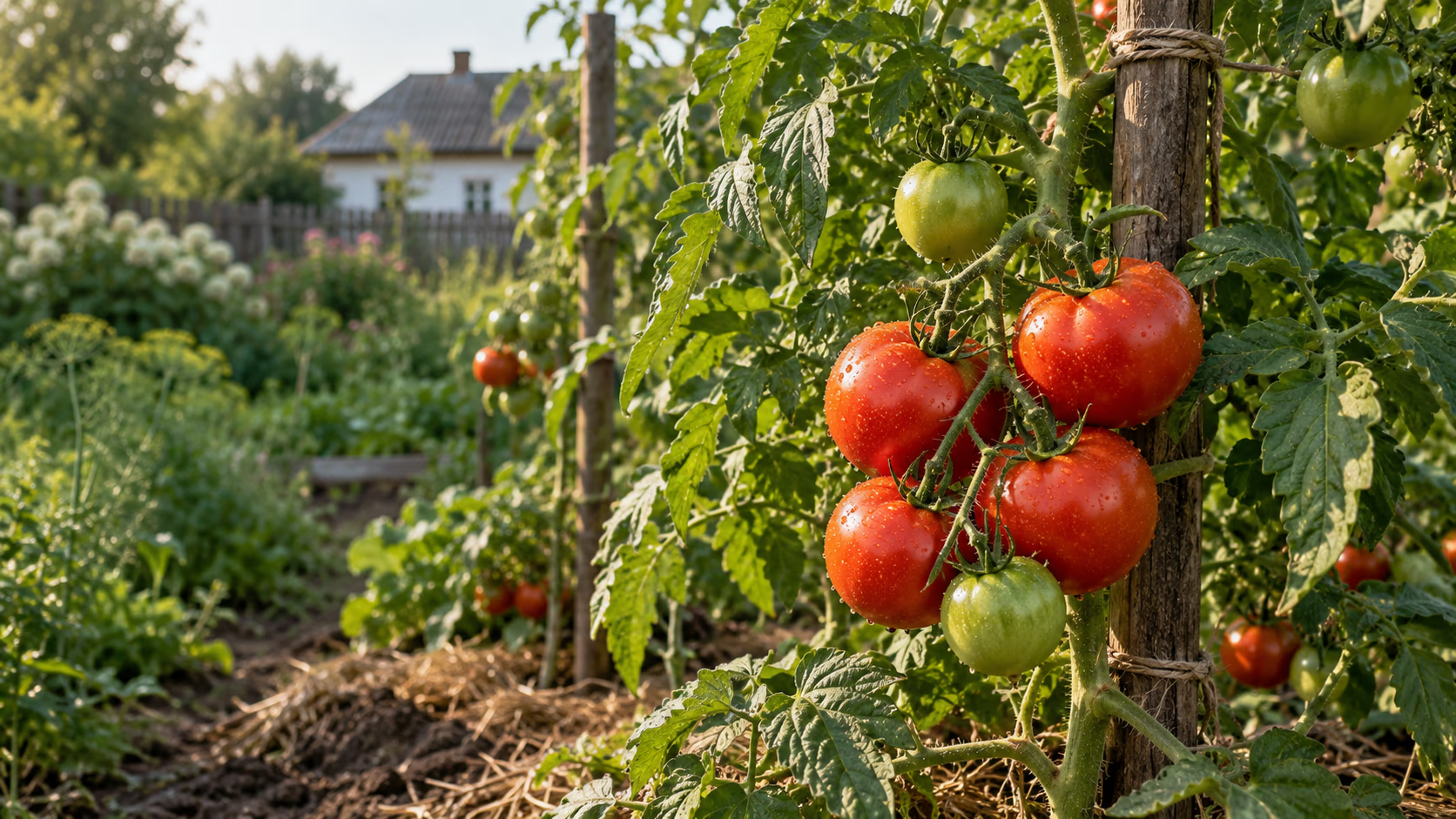
Red and green tomatoes on plants tied to wooden supports in a Ukrainian kitchen garden

Tomato fertilizers

For seedlings, greenhouses and outdoor beds, choose a DÜNGER concentrate or granules to suit your plants and application method. Compare nutrients, pack sizes and the stated rates for vegetable crops to find an appropriate feed for your tomatoes.


Four options for vegetable crops: a liquid concentrate, universal granules and two organo-mineral blends. Choose an appropriate product; applying all four together is unnecessary. The All products tab opens the full catalogue.

Best seller
For garden cropsOrganic-mineral fertilizer “DÜNGER VIVO” granulated

DÜNGER VIVO is an organo-mineral granular fertilizer for vegetables, berries, garden trees and ornamental plants. The 5 kg pack contains NPKS 7:14:7:8, calcium and magnesium, 2% organic compounds and 0.6% Agrinos A biocomplex. Apply to soil in spring and during active growth.

660.00 ₴

Plan your plant care ahead

Your season. Your plants.

Explore the seasonal calendar, prepare for the next stage and choose the pack sizes you need.

Today · November 19, 2026Ukraine

Care calendar

Plant groups: 1
All stages of the year

Choose a plant group or month. Coloured periods are planning guides for Ukraine, not application dates. Dashed lines require the actual plant stage.

Plants & growing method
Indicative seasonPreparation / autumn stageSelected monthBy growth stageCurrent month

Plan care throughout the year

Full year

Seedlings, direct sowing and outdoor transplanting are different stages. Timing depends on crop and soil warming. Autumn soil preparation is separate from feeding growing plants. For root watering with HUMIC, the soil must be moist; dilute the concentrate with water as directed.

Your seasonal selection

Products for this stage

8 products
Next periodPlanting or feeding per the instructions
Next periodSoil preparation per the instructions · During active plant growth · Autumn soil digging

Indicative periods for Ukraine. Consider weather, growth stage and product instructions. This calendar does not prescribe rates or feeding frequency.


Choosing a fertilizer for tomatoes

Choose tomato fertilizers according to your soil, previous applications and the stage of plant growth. A measured working solution can be convenient for small seedlings, while granules can be weighed out for a garden bed. First identify the task: feeding young plants, applying nutrients before planting, or supporting an established crop. These situations do not all require the same products or a fixed calendar.

The DÜNGER products selected here have vegetable crops listed in their instructions. They are alternatives with different nutrient contents and application methods, rather than four compulsory steps. P₂O₅, K₂O, CaO and MgO are the forms used in their declared composition. Their percentages should not be read as percentages of elemental phosphorus, potassium, calcium or magnesium.

Complex fertilizer for vegetables, fruit and berry crops, and flowers

Liquid fertilizer for tomatoes and seedlings

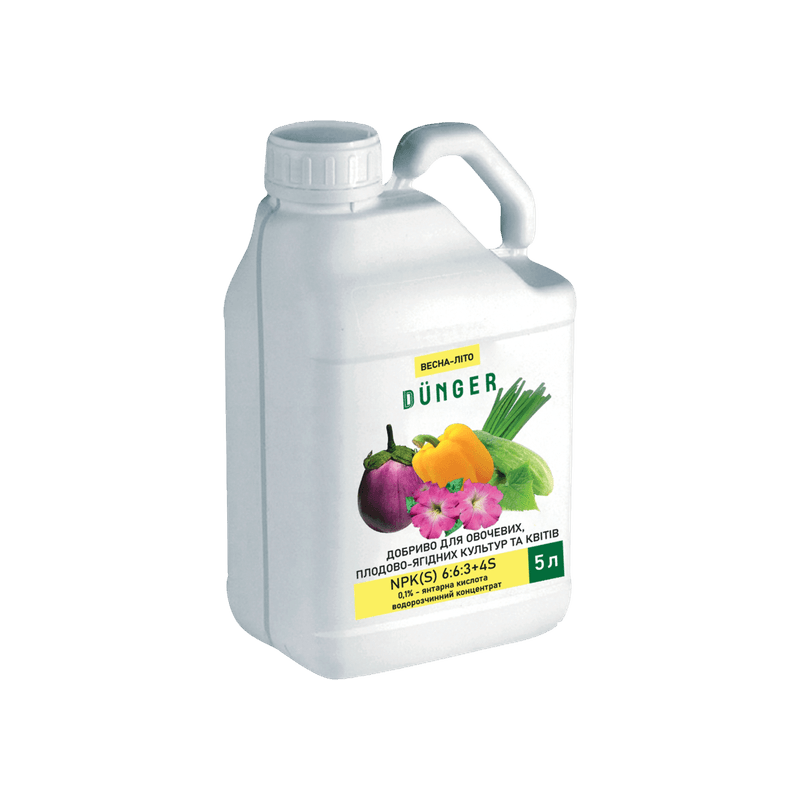
The concentrate for vegetables, fruit and berry crops, and flowers contains N6-P₂O₅6-K₂O3-S4. Dilute it for root feeding or foliar application, following the instructions for the chosen method. Seedlings require a lower concentration. It comes in a 5 litre pack. This option allows a small quantity to be measured accurately, but the amount of prepared solution per plant matters as well as the dilution.

Complex fertilizer universal granular

Universal and organo-mineral granules

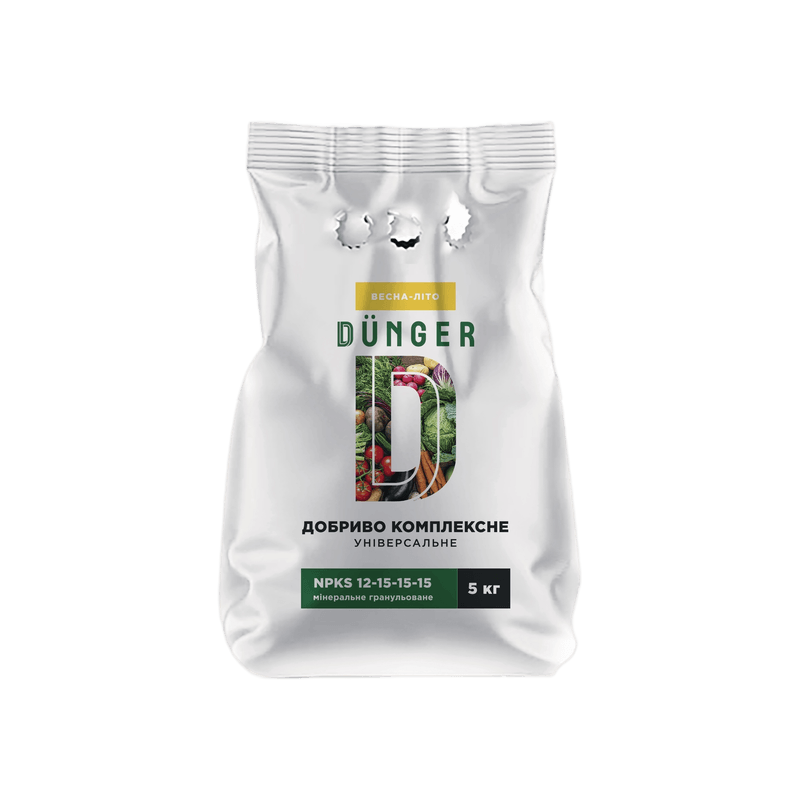
The universal blend, N12-P₂O₅15-K₂O15-S15, includes outdoor and protected vegetable crops in its stated uses and comes in 3, 4 and 5 kg packs. The organo-mineral fertilizer for all crop types contains N4-P₂O₅2-K₂O1-S12, CaO15, MgO0.5 and humic compounds, with 1 and 5 kg packs available. DÜNGER VIVO contains N7-P₂O₅14-K₂O7-S8, CaO12 and MgO2 and comes in a 5 kg pack. Its rate table explicitly includes tomatoes among vegetable crops.

These granules have different compositions, so do not automatically substitute equal amounts. Calcium in a blend does not make it a treatment for blossom end rot.

Application rates: grams, millilitres and bed area

The rates below come from each product’s instructions. They describe alternative applications and are not a combined feeding programme. Account for nutrients already in the soil or seedling compost, and check the label on the pack you buy before applying it.

ProductApplicationStated rate
Vegetable concentrateRoot feeding of established plants50 ml in 10 litres of water; 100 ml of prepared solution per plant
The same concentrateRoot feeding of seedlings25 ml in 10 litres of water; 50 ml of prepared solution per plant
Universal granulesVegetable beds20-40 g/m²
Organo-mineral granulesFeeding vegetable crops45-50 g/m²
DÜNGER VIVOVegetable crops, explicitly including tomatoes20-40 g/m² before planting or during active growth

For example, a 10 m² bed requires 200-400 g of the universal blend for one application at its stated 20-40 g/m² rate. This calculation is for an area, not for ten plants. Likewise, water used to dilute a concentrate and the volume of working solution per plant are separate quantities. A recipe using 10 litres of water does not mean pouring that entire batch beneath one plant.

Feeding tomatoes from seedlings to fruiting

Red and green tomatoes on plants tied to wooden supports in a Ukrainian kitchen garden

Seedlings and transplanting

Check whether the seedling compost already contains a starter fertilizer. If feeding is needed, use the rate for young plants. The liquid concentrate’s guidance places the first feed 10-14 days after pricking out or at the four true leaf stage. This is guidance for that particular product, rather than a compulsory starting date for every seedling.

The universal granules’ instructions separately allow up to 3 g per seedling at planting. The organo-mineral blend specifies 10-15 g per planting hole for vegetable seedlings. These rates should not be added together or automatically combined with a full area-based application. They do not apply to the concentrate or VIVO.

After planting, during flowering and fruit development

Plan feeding after transplanting with earlier bed preparation in mind. Record the product, amount and application date so that different names do not lead to repeated doses of the same nutrients. The concentrate specifies a 10-12 day interval for root feeding. That interval cannot be transferred to every granular fertilizer.

Nutrient demand changes during flowering and fruiting, but this does not justify automatically removing all nitrogen or adding the highest potassium dose available. Choose phosphorus-potassium products and individual micronutrients when there is a demonstrated need. Dropped flowers alone do not establish boron deficiency, and purple leaves alone are not a reason to add extra phosphorus.

Using fertilizers outdoors and in a greenhouse

Distribute granules as the product instructions direct. The organo-mineral products are applied to loosened, moist soil. Use scales for accurate measurements. A granular fertilizer is not automatically suitable for spraying just because it can be mixed with water. Foliar feeding requires a product whose instructions explicitly allow that method.

For established plants, the vegetable concentrate specifies 25 ml in 10 litres of water for foliar application. The root-feeding dilution is different. Its guidance recommends application in the morning or evening, avoiding hot conditions. Use separate seedling instructions for young plants and do not transfer an adult foliar concentration to young leaves.

In a greenhouse, consider ventilation, soil moisture and previous applications. Growing under cover does not by itself justify increasing the dose or feeding frequency by a fixed percentage. For potted tomatoes, a rate per square metre of bed cannot automatically become a rate per container. The volume and composition of the growing medium and its existing nutrient supply all matter.

Questions about tomato fertilizers

Will fertilizer cure blossom end rot?

Blossom end rot is a physiological disorder associated with insufficient calcium reaching the developing fruit. Irregular water supply can cause it even where calcium is present in the soil. Check watering and root-zone conditions; damaged fruit tissue will not recover. A fertilizer containing CaO does not guarantee a solution, and a photograph of a dark patch alone is not a reason to prescribe calcium nitrate.

What should I feed tomatoes with yellow leaves?

Leaf colour does not provide a conclusive diagnosis. Consider watering, temperature, root condition, previous fertilizer use and possible damage. If the cause is unclear, prepare photographs and details of the growing conditions for advice. Adding several fertilizers without understanding the problem can lead to unnecessary applications.

Can ash or a homemade feed replace a compound fertilizer?

A homemade mixture does not have a guaranteed nutrient composition or concentration. It is not a direct equivalent of an NPK blend, and its contribution must still be included when planning feeding. Do not add ash, boric acid or other substances to a working solution without confirmed compatibility and appropriate instructions.

Buy DÜNGER tomato fertilizers in Ukraine

Open the selected product page to check pack sizes, current price, availability and application instructions. For other vegetables, browse fertilizers for garden crops. The DÜNGER catalogue and the All products tab above provide the full range.

Check the store’s current terms for delivery within Ukraine and payment. For help selecting a product, describe where your tomatoes are growing, their age, bed area or container volume, and any fertilizers already applied. This information helps identify an appropriate product and pack size without unnecessary purchases.


Dünger Fertilizer Delivery Regions Across Ukraine

Buy Dünger mineral and organo-mineral fertilizers with delivery to any region of Ukraine. Select your oblast - and get fertilizers direct from the manufacturer for your garden, farm or agribusiness. Delivery via Nova Poshta and Ukrposhta to all cities, villages and district centres. Produced in Rivne Oblast, Dunger LLC.

Interactive map of Ukrainian regions

Fertilizers in Rivne and the region

Order mineral and organo-mineral fertilizers directly from manufacturer DÜNGER. The range includes products for vegetable gardens, orchards and farms. Choose a pack size and arrange collection from Nova Liubomyrka or carrier delivery to Rivne or another location in the region.

Order fertilizers

Order & Inquiry

Get in touch
Dunger

Order mineral and organo-mineral fertilizers directly from the manufacturer. We will help you choose the right product for your garden, farm or landscape.

2 hours
response time
Free
product advice
Personal
manager
Easy
to get in touch
Step 1 of 425%

Hello!

Let's get acquainted and help you

Press Enter to continue

By clicking the button, you agree to privacy policy