


Foliar feeding means applying a suitable fertilizer solution to leaves. It can address a particular nutritional task, but does not replace assessment of the soil and roots. Before choosing a product, check explicit foliar instructions, the crop, plant stage and corresponding rate. Not every liquid concentrate is intended for spraying. A yellow leaf alone is also insufficient evidence of which nutrient, if any, should be supplied.
Understand what leaves can receive
Leaves can absorb some nutrients from an applied solution, but uptake varies with plant species, leaf surfaces and conditions. That does not justify promising an equally rapid response in every crop. Movement of some elements from treated leaves to the rest of the plant is limited. An improvement in one treated area does not establish that the root environment has been corrected.
A plant's overall nutrient requirement cannot be transferred without limit to its leaf surface. Trying to compensate with a stronger solution raises the risk of injury. Assess foliar application as a specific method for an identified requirement, using a product and rate intended for it. The word fast does not tell you what concentration is safe.
Investigate the cause before choosing a spray
Inspect the whole plant: which leaves have changed, whether there is physical damage, how water drains and what is happening around the roots. Excess water, drying, an unsuitable medium or injury does not become a diagnosed nutrient deficiency because the colour looks similar. A persistent problem needs clarification, including soil assessment and, where appropriate, specialist-directed plant tissue analysis.
Start with assessing soil before fertilizing. Do not test different nutrients one after another while gradually increasing concentration. This can add injury to the original problem. Rapidly spreading symptoms or damage over much of a plant make identifying the cause more useful than choosing a sprayer for the nearest available concentrate.
Distinguish fertilizer, concentrate and working solution
Fertilizer supplies nutrients. Do not assign it to treat spots, rot or insects without a separate relevant basis. Treatment in a foliar instruction describes application, not automatically disease control. Investigate another suspected problem first and keep nutrition as a separate decision. A product name and a green plant picture cannot establish what caused damaged foliage.
Concentrate in a canister differs from working solution. Measure the first to prepare the second for the specified application. A large pack volume is not the amount to pour directly over plants. Compare forms and purposes in the fertilizer catalogue. Matching analysis numbers on different products do not establish identical application methods.
Root and foliar rates are separate instructions
One product may have separate rows for soil and leaves, mature plants and seedlings. Find the relevant case before measuring. Check whether a stated quantity refers to concentrate, water or prepared solution. Do not exchange those units or use a root-watering rate for spraying merely because the container is the same.
The separate guide to balanced fertilizer formulas explains the distinction between composition and application. Element content does not itself supply a safe foliar rate. For young plants, check their own restrictions. Readiness for one feeding method does not mean every spray method is appropriate at that stage.
A concentrate with explicit foliar directions
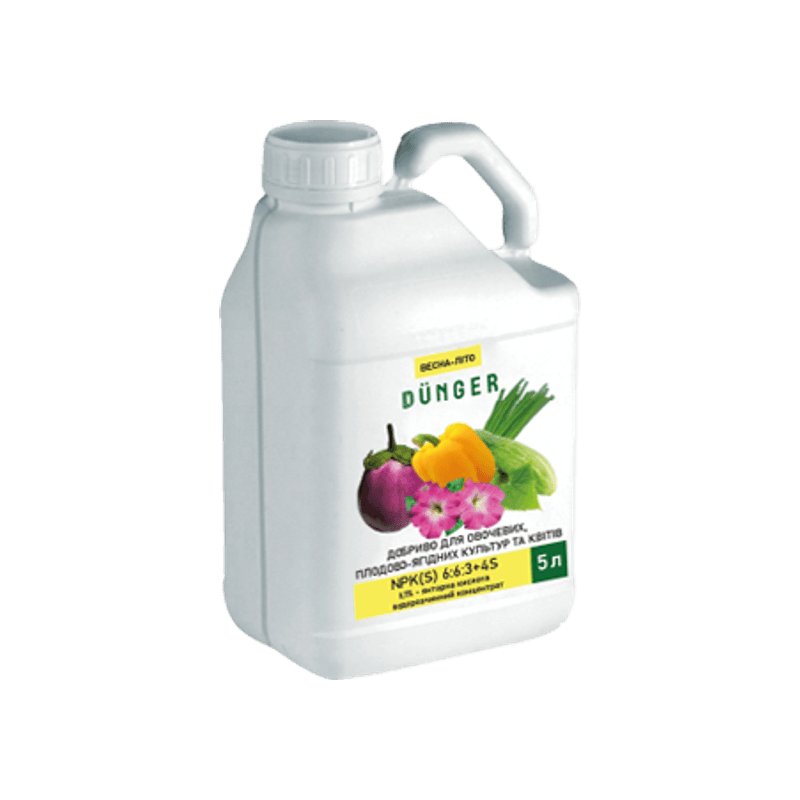
Complex fertilizer for vegetables, fruit and berry crops, and flowers
This product provides separate root and leaf methods. Select the crop, stage and route first. The mature and seedling foliar rows differ. The complete method and memo also cover root application and seedling substrate; these do not create a separate repeat-spraying timetable.
Used throughout the entire period of plant development and growth. For root feeding into the soil/substrate, dilute 50 ml of fertilizer in 10 L of water (100 ml of solution per 1 plant) and use at intervals of 10-12 days. For foliar treatment (spraying), dilute 25 ml in 10 L of water and apply with a sprayer, ensuring even coverage.
For treating seedlings, halve the concentration of the working solution!
Feed plants with fertilizer in the morning or evening, avoiding hot weather. Fertilize the seedling substrate for the first time 10-14 days after pricking out or at the stage of 4 true leaves.
Remember that the solution for seedlings should be half as concentrated as the solution for mature plants. Do not use products whose instructions specify the same dosage.
Vegetables of all types, fruit and berry crops, flowers (foliar treatment): 25 ml/10 L of water
All types of vegetable seedlings, fruit tree saplings, berry bushes, flowers (foliar treatment): 12 ml/10 L of water
The product comes in a 5 L canister. That is concentrate to measure according to the instructions. Check crop, method, pack quantity and ordering conditions on the product page. Another liquid product needs its own suitable foliar directions.
Assess weather and foliage before application
Choose suitable cooler conditions in line with the instructions and avoid heat. Rapid drying can concentrate residues on the surface and increase scorch risk. A warm southern Ukrainian site and a cool western garden may have different suitable times. Assess actual weather, leaf temperature and plant condition, rather than relying on a clock alone.
Do not start when wind prevents controlled application or rain could immediately wash away the solution. Follow the product's weather requirements rather than inventing a universal rainfast period. A plant suffering from overheating or drying needs assessment of that stress first. More solution does not make those conditions more suitable for feeding.
Prepare a controlled application
Identify crop and stage, select the correct row and prepare a clean suitable container and accurate measure. Do not use an unmeasured bottle cap for concentrate. Prepare the sprayer according to its instructions and check that coverage is controlled and even. With an unfamiliar crop or new conditions, assess tolerance on a limited part of the planting first while retaining the specified rate.
Even coverage does not mean large running droplets or repeated passes over already wet leaves. Do not add soap, household liquids, wetting agents or other products without explicit compatible instructions. Changing a mixture can change its effect on foliage. Advice about combining two fertilizers is not automatically permission to add a plant protection product.
Evaluate the next step after feeding
Keep the product name, chosen method, stage and actual conditions for your own reference. New damage after application is a reason to stop repeating it and investigate. Do not increase concentration because a rapid visible change is absent. Lack of immediate greening does not demonstrate a need for a stronger spray.
Continue providing suitable root conditions. Foliar feeding cannot remove compaction, waterlogging or unsuitable soil reaction. My Garden lets you specify zones, crops, measurements and a product plan. When buying, check whether the same planting is already included in another planned feeding method, and avoid automatically layering complete programmes over it.
Questions about foliar feeding
Foliar application does not replace water management or a complete assessment of root nutrition. Its usefulness depends on crop, nutrient and conditions. Maintain a suitable root environment and choose spraying only for an identified task under an expressly permitted method. A clean-looking spray film is not proof that the plant's overall requirements have been met.
Check its own instructions. Solubility does not establish a safe foliar rate or use on every crop. You need an explicit foliar method, suitable group and stage. Where these are absent, do not borrow another product's proportions, even if both are sold as soluble compounds for garden use.
Not automatically. Assess the earlier application and the product's requirements separately. Without an explicit instruction, do not add another treatment or increase concentration. A root-feeding interval is not automatically a foliar timetable either. Repeating an uncertain application does not resolve uncertainty about how much reached the plant.
Young plants have their own limits, and this product's instructions distinguish them from mature plants. Use the stated rate for the relevant stage. Do not increase it according to leaf size or replace an exact listed amount with your own recalculation. Check both the crop group and application route before preparing the solution.


