


This grade is often called balanced because its three numbers are equal. Equal numbers on a pack do not establish equal requirements for every plant. Choosing a fertilizer also involves what is already in the soil, the crop being grown and the intended application method. Establish those details before comparing products or deciding on a pack size for the garden.
Reading the three label numbers
The first number: nitrogen
The first number in conventional NPK labelling gives the nitrogen percentage by weight. In 20-20-20, that is 20%. Do not confuse the percentage in the product with the concentration of a prepared watering solution. The contents of a dry pack do not tell you how much water to add. Nor do these three numbers alone show the forms of nitrogen present; check the detailed composition.
The second and third numbers: phosphorus and potassium
Conventional fertilizer labels express phosphorus and potassium on a P₂O₅ and K₂O basis. The grade therefore should not be read as equal weights of elemental N, P and K. If an agronomic recommendation is expressed as elemental P or K while the label uses an oxide basis, reconcile the units first. Otherwise even careful multiplication compares different quantities and can lead to an incorrect application decision.
Look for other nutrients separately. The grade 20-20-20 alone does not establish that magnesium, sulfur, calcium or a particular collection of trace elements is present. An extra letter or abbreviation beside the grade needs to be explained in the composition. Powder colour, crystal size and the general word complex do not replace checking that information on the product.
Composition, ratio and application rate
As a label-reading example, consider 100 g of a product graded 20-20-20. Its declared analysis represents 20 g of N, 20 g of P₂O₅ and 20 g of K₂O in that amount. This example explains the label; it is not a recommended portion for a bed, pot or sprayer. The chosen example weight does not establish an application rate for any crop.
Grades 10-10-10 and 20-20-20 share a 1:1:1 ratio of the three declared components but contain different concentrations in the same product weight. Sharing a ratio does not make products fully interchangeable. Form, solubility, other components and permitted application methods may differ. A replacement requires checking the whole product rather than comparing one number or assuming that every other instruction can be carried across.
- Percentage describes the component's share of the product.
- Ratio helps compare NPK proportions.
- Rate specifies how much of a particular fertilizer is used for an area, plant or solution.
- Frequency concerns repeat applications under the relevant instructions.
When equal numbers may not match the need
A soil may already contain enough phosphorus or potassium while the need for another nutrient differs. Applying an equal grade to address one shortage adds the other components at the same time. For repeated use, a soil analysis with a crop-specific recommendation is therefore useful. The word universal does not reveal which nutrients have already accumulated in a particular bed.
Account for previous compost, manure, organo-mineral products and other fertilizers. A new feeding does not reset the nutrient record. Write down the date, area, product and amount of every input. Where several people care for the same garden, compare notes before another application so that work is not inadvertently repeated. Keep different beds separate where their previous treatment differed.
Seedlings, mature vegetables, lawns and ornamental shrubs should not share one feeding routine simply because their leaves look similarly pale. Crop, growth stage, soil or substrate and existing nutrient charge all matter. A pre-fertilized growing medium needs separate assessment from ordinary garden soil. Pot volume is also a different measure from bed area, so their units cannot be exchanged without an appropriate instruction.
Two examples of checking need
If a soil analysis shows sufficient phosphorus and potassium while the recommendation calls only for nitrogen, equal label numbers are not an advantage in themselves. Match composition to the recommendation so that nitrogen is not accompanied by unwanted components. Where all three nutrients are required, check the actual recommended proportions: three requirements do not automatically imply equal proportions. These examples explain selection, rather than establishing a rate for your garden.
Check acidity separately. A pH unsuitable for the crop can affect nutrient availability, so another pack of complete fertilizer may not address the reason for weak growth. A pH result is not a fertilizer weight. Decisions about changing acidity and supplying NPK each need their own justification. Do not use one as a substitute for the other without assessing the soil and the plant's requirements.
Distinguish a laboratory's measured soil concentration from its recommended application amount. A result in milligrams per kilogram of soil cannot simply be used as grams of fertilizer per square metre. Clarify the test method, crop and recommendation units. Keep the complete report rather than a photograph of one number, allowing its other results to be considered when selecting products.
Water-soluble powder, liquid and soil granules
The three NPK numbers do not specify an application method. A soluble powder, liquid concentrate and soil granules can have different instructions. Do not dissolve a soil granule for spraying merely because another product with a similar grade is used on leaves. Permission for root feeding does not automatically authorize foliar use, and a familiar crop name is not a substitute for checking the intended method.
For a solution, establish the product name, rate, water volume and purpose. For dry application, check the area or plant number used by the instructions. Do not turn millilitres of liquid concentrate into grams of powder without product-specific information. A household spoon with a different size or fill level is not an accurate substitute for weighing a specified mass.
If fertigation is planned, verify that the particular fertilizer is suitable for the system and check water and equipment requirements. An NPK declaration alone does not confirm suitability for drip irrigation. Equally, do not create a tank mixture from several products because their solutions have the same colour. Compatibility and mixing sequence need confirmation for the actual materials concerned.
A practical selection sequence
- Record the crop, growth stage and growing conditions.
- Compare soil analysis or substrate information with previous nutrient applications.
- Choose the required method: dry application, watering or an authorized spray.
- Read the selected product's composition, rate, units and season.
- Determine the area or plant number before calculating pack requirements.
Resolve an unfamiliar unit before using the product. Rates per area, litre of water and individual plant address different tasks. If a recommendation concerns another composition, do not simply replace the name in an old routine. A professional substitution must check the supply of every component. For home care, following the chosen product's appropriate complete instructions provides a clearer starting point than improvising a conversion.
A granular garden option: DÜNGER VIVO
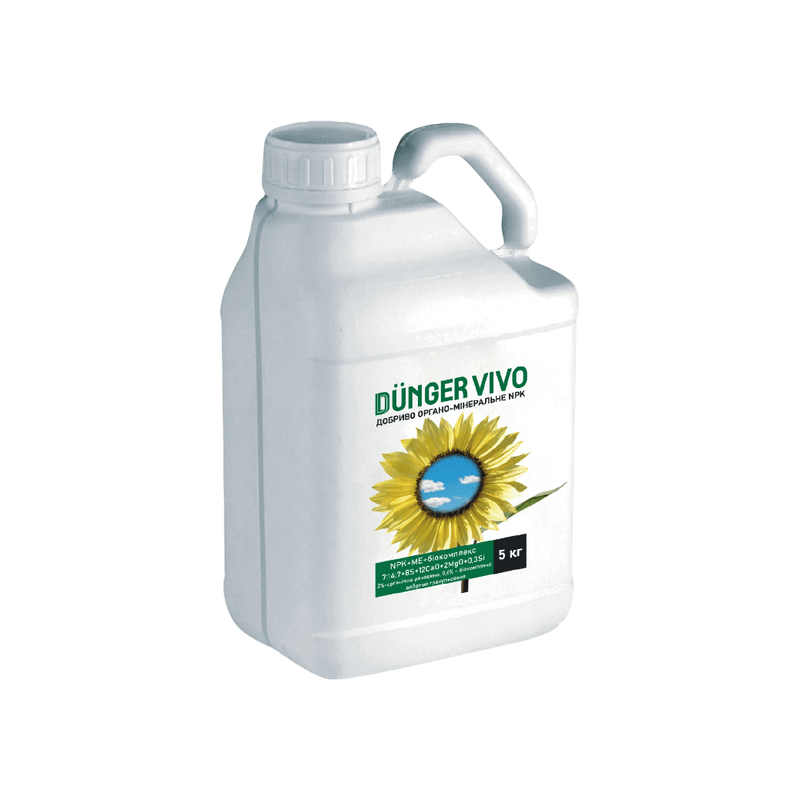
Organic-mineral fertilizer “DÜNGER VIVO” granulated
DÜNGER VIVO has an NPKS 7:14:7:8 formula and a 5 kg pack. Consider it where garden crops need granular soil nutrition, matching the composition to your care plan. When comparing it with 20-20-20, account for the different proportions and application method. The product's own instructions are:
The fertilizer is applied in spring (before sowing or planting) to activate microbiological processes in the soil. It is also used during active growth and vegetation to nourish and maintain overall plant health. Apply loosely over the area or to the root zone on loose, moist soil, as well as in planting holes when planting plants and seed material. Application rates are calculated depending on the type, characteristics, size, and age of the plants. Fertilization is recommended 2-3 times per season.
The flower and ornamental group has this application rate:
10-20 g/m² or 1-2 g/plant for flowers in containers or flower beds in spring and at the beginning of active vegetation
This rate concerns flowering and ornamental plants and this VIVO product. For vegetables, berries or trees, open the appropriate row in the complete instructions. Compare other formats among fertilizers for garden crops before selecting the method and quantity for each part of the site.
Checking the care plan afterwards
Keep the product name, date and actual amount used. Assess new growth alongside watering, light and weather, rather than judging only an old leaf's colour the next morning. If condition deteriorates, investigate the cause first. Avoid adding several fertilizers in quick succession to force a response: that makes the combined nutrient supply and the source of a problem harder to establish.
Common questions
The three numbers do not establish that rate. You need the particular product, crop, method and water volume specified in its instructions.
They share an NPK ratio but differ in concentration per unit product weight. Full interchangeability also depends on form, other components and application rules.
That depends on crop needs, soil and product instructions. Equal label numbers alone do not establish a seasonal feeding calendar.

