


Yellow garlic leaves do not automatically mean a fertilizer shortage. Start with when the colour changed, which leaves are affected and whether the whole bed looks similar. Lower leaves drying as bulbs mature, yellow tips on young plants after difficult weather and yellowing accompanied by decay at the base require different decisions. A single treatment for “yellow garlic” cannot replace that distinction.
Inspect before watering, feeding or spraying. Photograph the entire planting and a few representative plants. Changing several conditions immediately makes it harder to understand the original problem or assess an intervention. Your first task is to distinguish a clear moisture issue or approaching harvest from a problem that needs closer investigation.
Begin with the growth stage
As garlic approaches harvest, lower leaves dry while some upper leaves remain green. Check a sample bulb for developed cloves and intact wrappers. Do not wait for every leaf to dry completely, and do not try to restore ageing foliage with extra nitrogen. The bulb and the pattern of leaf decline should be considered together.
The same appearance in a young spring plant means something different. Establish whether the garlic was autumn or spring planted, when it emerged and how it compares with the same cultivar nearby. Gardens in different Ukrainian regions do not develop on identical dates. Compare plants and conditions, rather than treating a harvest photograph from another district as your timetable.
Map the yellowing before examining a leaf
Look across the bed first. Is the change present in every row, in a low patch, alongside a path or in scattered groups? This is a clue about what to compare, not a diagnosis. A yellow patch beside a runoff outlet, for example, makes it sensible to check moisture there and compare it with an unaffected area.
On individual plants, distinguish dry tips from whole yellow leaves, spots from lengthwise stripes, and older outer leaves from younger central growth. Include a healthy neighbouring plant in photographs. Avoid trimming every affected tip before inspection: the original distribution of damage provides more information than a freshly tidied leaf.
Check moisture below the surface
Garlic has relatively shallow roots and can experience moisture stress. Yellow tips may occur even where fertility is adequate. It also needs soil that drains. Move mulch aside and examine the root zone rather than judging a dry surface crust alone. Compare the affected patch with a place where the plants look healthy.
After prolonged rain, check whether excess water can escape. After dry, windy weather, check whether irrigation reaches the roots. Watering as a precaution can be inappropriate in an already wet bed. With drip irrigation, examine the actual affected section: a hose lying beside a row does not prove that water is arriving evenly along it.
A fixed watering calendar cannot account for every Ukrainian garden. Soil, rainfall, wind and crop stage all matter. Keep observations in your own care journal. When planning another planting, our guide to planting winter garlic and preparing its bed helps connect timing with site preparation.
Review cold weather and recent work
Garlic foliage that emerges early can suffer winter or spring cold injury. A cold night alone, however, does not establish the cause of every yellow leaf. Compare the timing of the change with the weather and the condition of newer leaves. An exposed hollow and a sheltered border can experience different conditions within the same garden.
Also review weeding, cultivation, fertilizer application, spraying nearby plants and changes to watering. Record the actual product and quantity where known. Do not label damage a fertilizer burn merely because the dates coincide, but include that information when seeking help. Specific observations are more useful than the assumption that the crop must be missing something.
When to examine roots and the bulb base
If a plant wilts, grows poorly or becomes loose in the soil, carefully lift an affected example with its roots. Pulling it abruptly can leave the useful evidence underground. Examine the roots, basal plate, outer wrappers and any soft tissue. Photograph them before cleaning, alongside an overall view of the bed.
Yellowing and wilting with basal decay, fluffy white growth and tiny black structures can be consistent with white rot. Mottling or stripes, particularly on young leaves, can accompany virus infection. These are reasons to investigate, not a reliable identification from leaf colour alone. Similar outward symptoms can arise from different causes.
Look for larvae or feeding damage as well. Onion maggot injury can cause yellowing and wilting. If a soil-borne infection is suspected, avoid carrying soil into other beds on tools. Fertilizer is not a treatment for rot or virus infection; the next action depends on establishing the cause rather than selecting a stronger feed.
A checklist before adding fertilizer
- Is the crop still actively growing, or is harvest approaching?
- Is the root zone adequately moist without standing water?
- Are roots and the bulb base intact, or are there suspicious lesions, growths or feeding injuries?
- Which fertilizers and organic materials have already been applied to this area?
- Is there a soil test that helps justify the proposed feeding?
- Which exact product, application method and units will you use?
Nutrient shortage is one possibility, but a yellow tip does not identify a requirement by itself. Previously applied compost and fertilizer contribute to the overall nutrient supply. Another application does not become useful simply because it comes from a different pack. Start with assessing the soil and choosing fertilizer on that basis.
Keep the purpose of the decision clear. You are checking whether nutrition needs adjustment, not testing products until a leaf changes colour. Where the evidence is incomplete, a soil assessment or a properly examined plant sample can answer a different question from another application. Record what is already known before choosing what to buy.
A fertilizer option after checking the need
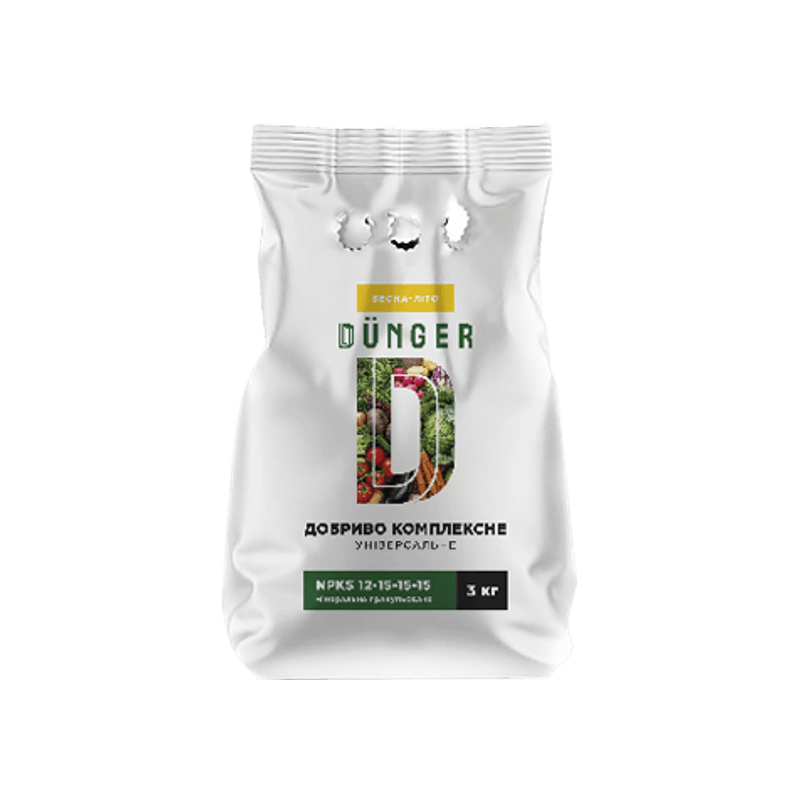
Complex fertilizer universal granular
If the inspection and soil assessment justify additional nutrition, this universal complex is an option for garlic within the vegetable group. Compare it with previous applications and your bed plan. It does not replace diagnosis of yellowing or act as a treatment for damaged roots.
DÜNGER universal compound fertilizer granules for vegetables, legumes, leafy greens and ornamental plants. Available in 3, 4 and 5 kg packs.
Apply fertilizer before sowing or planting, as well as for feeding.
Vegetable, legumes and greens: 20-40 gr/m²
The quoted rate is for the vegetable group and a measured soil area. Measure the intended treatment area without paths. My Garden supports crop and zone measurements for purchase planning. Keep previous applications in your own care journal. Choose a pack after calculating the requirement and check its details on the product page.
Assess the next stage of growth
After addressing an identified problem, compare subsequent growth and the condition of new leaves, alongside the older damaged tips. Use photographs from the same angle. If wilting intensifies, decay appears or an affected patch expands, do not continue an improvised series of feeds. Prepare a representative sample and seek help identifying the cause.
For the next season, separate observations from purchases. Keep the problem's history in your own journal, then plan the crop, bed area and products needed. Choosing garlic planting time for your site should reflect the growing method and local conditions, rather than repeat someone else's date without checking it.
Frequently asked questions
First examine crop stage, moisture and roots. Yellowing has several possible causes, and additional feeding near maturity does not replace checking bulb readiness. Decide on an application after considering the actual need and previous feeding.
Avoid rushing to apply a product, but inspect the plants. Check when the change started, whether young leaves are affected and whether moisture is appropriate. Early spreading symptoms or poor growth deserve more attention than unchanged older tips.
A photograph helps, but roots, the plant base, the whole planting and a description of care may also be needed. One symptom can have several causes. Gather that information before choosing a treatment for an unconfirmed explanation.
Determine the area of a justified application and the relevant product rate first. The number of yellow leaves does not determine how many packs to buy. For a small bed, also consider other suitable crops included in your purchasing plan.


