


Choose spring grapevine feeding according to plant condition, previous applications and soil needs. Spring does not mean that every vine requires the same mixture. A young planting, a vigorous mature vine and a winter-damaged plant have different starting points. Before buying, decide what job the fertilizer is meant to perform.
A potassium product is available for grapes, but it does not replace assessment of the complete nutrient plan. Strong growth is not a reason to keep adding products. With weak growth, first inspect moisture, the root environment and damage. Fertilizer cannot correct severe winter injury or an unsuitable planting site.
Gather information for each group of vines
Start with age, cultivar and growing position. Separate young vines from established plants, weak areas from vigorous ones and a wall-trained vine from an exposed row. One overall assessment can conceal important differences between these situations. Avoid using the best or worst plant as a representative of the entire vineyard.
Review last season's growth and earlier applications using your own notes, labels and remaining packs. The actual quantities and areas treated matter alongside product names, including organic materials already added. Supplying the same nutrient twice can be easy to miss when the products have different trade names.
Inspect the vines after winter. Are neighbouring plants developing similarly? Are there damaged sections or standing water in the root zone? Avoid labelling slow early growth as a shortage of one particular element. A struggling plant first needs an explanation of the problem, rather than an automatically stronger feed.
Connect timing with weather and growth stage
Development in southern Ukraine, a sheltered courtyard and an open Polissia plot will not begin together. Even within one town, a wall, slope or shade can change conditions. Look at the actual vine and soil. Do not copy a neighbour's feeding date without comparing cultivar, exposure and plant condition.
Plan work when you can carry out the chosen product's application method correctly. Frozen ground, standing water and a dry root zone need separate attention. Moisture affects nutrient uptake: more fertilizer cannot substitute for a suitable water regime. After a cold spell, do not combine several delayed operations into one concentrated application.
Pruning and feeding both depend on plant condition, but they are different decisions. Use the guide to grapevine pruning timing for the former. Sap bleeding from a cut does not, by itself, identify a missing nutrient. It cannot be used to calculate a fertilizer dose or select a composition.
What soil and tissue tests tell you
Soil testing can assess acidity, organic matter and the supply of individual nutrients. Tissue analysis shows the nutrient status within the plant. These are connected but different pieces of information. An element's presence in the soil does not necessarily mean roots can obtain enough under the current moisture and soil reaction.
Ask the laboratory how to sample: which plant part, at what stage and how it should be delivered. Avoid combining different cultivars, ages and clearly different sites into one sample. When investigating a local problem, discuss separate samples from affected and healthy areas. Poor sampling can make even an accurate laboratory measurement difficult to interpret.
In a home garden, begin with a soil assessment before feeding and a clear sketch of the plot. Mark different vine groups and areas that received previous materials. Interpret results using suitable local advice for the crop, rather than an unrelated table from another climate.
Decide what the inspection means
| Situation | Next step |
|---|---|
| Mature vines show strong, balanced growth | Review earlier feeding; an extra application is not compulsory simply because it is spring. |
| One plant is noticeably behind | Compare its root zone and any damage with neighbouring vines. |
| A problem follows one section of a row | Treat that zone separately when sampling and planning care. |
| There is a reason to supply potassium | Match the product, rate, treated area and application method. |
| The previous product's composition is unknown | Find its label or order details before planning another application. |
Understand the potassium product
A product's grape designation describes its intended use, while its composition needs a separate check. This product lists potassium and sulfur. It should not be assumed to cover every nutritional need or used as a reason to add other components at random. Compare it with the requirement identified during inspection or testing and with nutrients already supplied.
Potassium fertilizer for an identified need
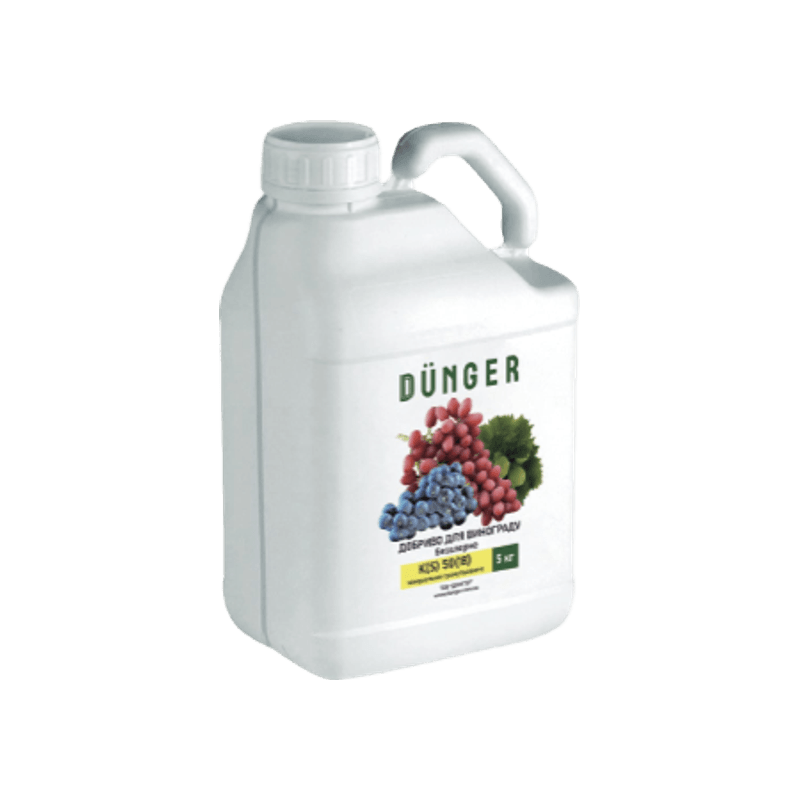
Complex fertilizer for grapes
Choose this granular product when potassium feeding is appropriate for your grapes. The grape-specific row is shown below. For young plantings or a programme involving several products, check the complete method and its suitability for your conditions before buying.
| Grape | 20g/10l of water/1m² |
|---|
The ideal time - early spring, before the flowering of grape leaves.
Pack sizes: 1 and 5 kg. Both contain granules. Choose the amount after establishing the treated area, rather than the other way round.
Every part of the rate matters: product weight, water volume and treated area. A bucket of solution does not automatically represent one vine. Establish the application area and follow the full method on the product page. Do not convert root application into foliar spraying merely because water is used in preparation.
For several rows, prepare separate calculations and clearly identified containers. Measure the product with suitable equipment rather than judging a heap in an arbitrary spoon. If several fertilizers are needed in a wider programme, establish their purposes, total nutrient contribution and compatibility first. Improvised tank mixtures do not replace product instructions.
Carry out one planned application
- Identify the vines and area with a justified need for feeding.
- Check earlier applications and the complete product name. Do not rely on pack colour alone.
- Match the plant's stage and soil conditions with the instructions. Where conditions are unsuitable, address the site or moisture problem first.
- Measure the relevant area and calculate the product quantity using every unit in the rate.
- Prepare and apply according to the instructions without increasing concentration or adding unplanned ingredients.
- Record what was used and where in your own journal. Assess new growth and overall condition at the next inspection instead of repeating the feed because no immediate change is visible.
In My Garden, enter zones, the crop and measurements for a fertilizer plan. Keep application dates and laboratory results in your own records. Select the pack by the calculated product weight. If using the same product on another listed crop, calculate that crop separately using its own row.
Review the response without rushing to repeat
Compare vines from the same group under similar conditions. Observe fresh shoots, leaves and root-zone moisture, while recognising that fertilizer cannot restore tissue that has already died. If deterioration continues, return to diagnosis. Repeated feeding without understanding the cause makes it harder to track what the plant has already received.
Keep the label and confirm the chosen pack before ordering. Check price, availability and collection or delivery arrangements for that particular purchase. More practical guidance for other orchard tasks is available in the Fruit garden category.
Questions about spring grapevine feeding
Need depends on vigour, soil and previous feeding. A vigorous mature vine should not be fed automatically. A potassium product should not be called a nitrogen fertilizer simply because its instructions mention spring.
Find the reason for weak growth first. Limited moisture, an unsuitable root environment and winter injury require different responses. Increasing the concentration without diagnosis is not a justified solution.
No. Assess leaf appearance alongside soil conditions, water and the rest of the plant. Recurrent problems may justify testing and comparisons between zones, rather than selecting a nutrient from colour alone.
Do not assume so. The grape rate also specifies an area. Check all the units and the complete application method to avoid treating container capacity as the amount intended for a plant.


