


Hydrangeas do not automatically need autumn feeding simply because flowering has finished. As a shrub slows towards dormancy, first check moisture, earlier applications and shoot condition. Avoid continuing a summer routine by the calendar or trying to turn every ageing leaf green again. Nutrient need, a particular product's suitability and protection from cold are separate decisions. A sensible autumn plan can involve gathering information for the next growth period rather than adding another product immediately.
Autumn does not describe one stage for every shrub
A plant in an exposed bed may finish its season differently from one beside a warm wall. Following a dry summer in Ukraine's Steppe, cool air does not necessarily mean moist soil. Rain can leave heavier Forest-Steppe ground excessively wet. Check the actual root zone as well as the forecast. One November date cannot prescribe the same action for every hydrangea across Ukraine. Compare your site with its own history and recent weather.
A few remaining green leaves do not prove that another feed is needed. Roots and shoots respond differently to conditions, and previous inputs do not disappear when flowers fade. Consider slow-release fertiliser, feeding of an adjacent lawn and nutrient-containing material added to the planting zone. Keep their identities and quantities separate. Products do not become equivalent simply because they were used in the same season, and a neglected record can lead to repeated applications.
Why extra nutrition does not mean better winter survival
Excess feed can encourage soft leafy growth rather than the flowering you wanted. That growth can also be more vulnerable to frost. However, winter damage has other possible causes, including cultivar, exposure, weather and plant condition. Feeding is not general protection against low temperatures and cannot restore dead buds. Avoid interpreting a lush appearance in autumn as proof that the whole winter-care plan is correct.
An autumn label on another product does not remove the need to check its plant group, actual purpose, permitted timing and soil conditions. Avoid transferring advice from a different climate or composition to your shrub. Without a supported reason, gather information for the next season instead of adding something blindly. The guide to feeding hydrangeas discusses the wider nutrient decision. Here, the immediate question is whether the present stage calls for action at all.
Yellow leaves: compare the actual pattern
Leaves can change colour as they age before falling. That differs from persistent yellowing between green veins on young leaves during growth. Compare the timing, leaf age and distribution. Summer photographs may show whether the change is recent or has continued for months. One fallen leaf cannot establish a new fertiliser requirement. Likewise, a plant with attractive autumn colouring should not automatically be treated as deficient.
Rapid wilting, a dying section or standing water needs separate assessment. Fertiliser cannot correct waterlogging. If the pattern suggests unavailable nutrients, start with the guide to hydrangea chlorosis and a soil check. Avoid several remedies simultaneously: it becomes harder to understand the original problem and the amount already added. Keep images of the whole plant as well as close views of affected and unaffected leaves.
What a soil analysis can tell you
Acidity and nutrient content describe different parts of the root environment. A home pH reading does not replace a nutrient analysis. Ask the laboratory which measurements it offers and follow its sampling instructions. Samples must represent the soil where the shrub grows. Avoid combining distinctly different beds into one random sample. A neat single number is of little use if the sample does not represent the plant's actual location.
Keep the result with species identity, shrub size and earlier inputs. Ask how to interpret the units and whether the finding needs adjustment for this plant. Avoid converting a laboratory value directly into granule weight. If soil is frozen or too wet for proper sampling, arrange a suitable alternative time. Autumn analysis supports a reasoned plan; it does not require applying something on the day results arrive.
Flower colour does not set an autumn rate
In some bigleaf and mountain hydrangeas, colour depends on cultivar, soil acidity and aluminium availability. This does not describe every hydrangea species. A panicle hydrangea whose flowers age pink does not thereby need urgent acidification. Late-season fading alone does not identify a nutrient deficiency. Establish the species before comparing it with a blue-flowered plant from a photograph or a neighbouring garden.
If you want to alter the colour of an appropriate cultivar, first establish soil conditions. Avoid improvised mixtures of household acids, ash and fertiliser. Acidification and nutrition are not interchangeable, and excessive adjustment can damage plants. Choose a separate verified plan for the actual crop and product. One autumn treatment is not a reliable promise of a new colour, especially when the original soil and cultivar are unknown.
Useful checks instead of another feed
Moisture and the soil surface
Check beneath mulch and around the root zone. Where soil is genuinely dry and conditions allow, watering should replace missing moisture without creating standing water. Do not add water automatically after rain. Check drainage from a container and avoid water collecting in a saucer. A dry surface alone does not describe the entire root ball, so look beyond its appearance before deciding.
Mulch and buds
Suitable mulch helps limit moisture loss and soil temperature fluctuations. Avoid piling wet material against shoot bases or covering a plant without inspecting it. Some hydrangeas depend on buds on the previous year's wood for flowering. Indiscriminate hard autumn pruning can remove the flowers you hoped to support with feed. Choose protection for species and exposure using the guide to winter protection for hydrangeas.
If you already fed the shrub
Find the package and check product, composition, quantity and application time against its instructions. Avoid another product intended to balance an unknown addition. If you suspect an error, give the manufacturer or adviser these details, photographs and soil-moisture information. Do not flush a planting with large volumes of water without assessment: poor drainage can create another problem. Note which shoots changed and whether nearby shrubs look similar. Include adjacent-lawn feeding when describing the site.
Preparing the next purchase
Separate stable shrubs from plants needing a diagnosis first. Measure the relevant zone and check for overlapping applications. Container plants need their own product-compatible decision, rather than an automatic in-ground shrub calculation. Retain product names and earlier-use details until growth resumes. Clear information makes a smaller, more appropriate purchase easier than choosing a large pack simply because there are several hydrangeas in the garden.
A feed for the next suitable period
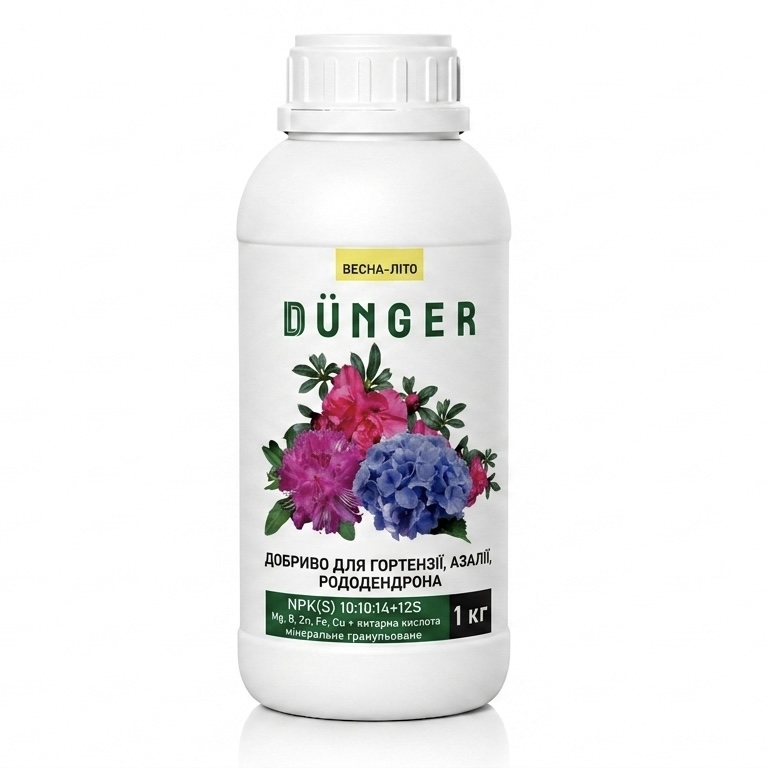
Complex fertilizer for hydrangea, rhododendron, azalea granular
For a healthy hydrangea with a verified nutrient need, consider this DÜNGER complex. Its full directions specify spring and summer use. Plan for the next appropriate stage, matching composition to need and previous inputs. Remaining green leaves do not justify moving that scheme into dormancy. Follow the intended method and amount, checking moisture and resolving drainage problems before application.
Packs are 0.5, 1 and 5 kg. Count the shrubs actually needing this care and consider age and size. Calculate total need from the applicable directions, then compare pack mass and quantity. A small and a large shrub are not equivalent. Compare price by equal mass and verify the selected pack and original product photo. My Garden supports crops and zone measurements for planning. Avoid using leftovers simply to empty the package.
Frequently asked questions
Do not use it just to empty the pack. Check timing, plant condition and need. Store the product according to its label.
Establish the cause first. Species, pruning, bud condition, light and moisture also affect flowering. Additional nutrients need a supported purpose.
Preparing protection does not establish a need for feed. Assess these decisions separately against species, weather, soil and the product's permitted method.


