


Assess homemade feeds for pepper seedlings by their composition, the plant's needs and suitability for a small volume of growing medium. Natural and homemade do not define a concentration or safe rate. If peppers stretch, turn pale or stop after transplanting, check light, temperature, moisture and roots first. A jar of extract does not explain the underlying problem.
The separate guide to feeding peppers after emergence covers planned nutrition. Here the question is whether replacing clear instructions with a kitchen recipe makes sense. An unknown mixture does not become complete fertilizer because it has enthusiastic reviews. Compare the actual material, seedling stage and conditions behind the claimed result before making a decision.
Four questions for any recipe
- Which nutrients, and what quantities, will enter the growing medium?
- Is the concentration suitable for pepper seedlings rather than adult plants?
- How might it affect moisture, salts and the reaction of the medium?
- Does the proposal account for the medium's existing feeding and previous additions?
A spoonful per litre describes preparation; it does not prove a plant's need. Equal spoonfuls of different materials contain different amounts of substances. With an extract, the starting composition also matters and is usually unmeasured at home. Numbers in a recipe are not enough to make the feeding programme accurate.
A photograph of a large green seedling does not identify what made it grow. Seed, growing medium, light and sowing time may all differ. A comparison is useful when those conditions are known. A random after-watering picture cannot demonstrate an additive's benefit. Avoid testing an unverified recipe across the entire batch intended for your future garden.
Yeast and sweet mixtures
Foam or bubbles in a jar do not report its available nitrogen, phosphorus and potassium. That visible activity is not a pepper feeding rate. Without an established composition and directions for seedlings, do not use it as a replacement fertilizer. Do not add sugar to a working solution merely because it appeared in another online recipe.
Separate research on a defined preparation from mixing kitchen yeast. Testing a material in a particular medium at another growth stage does not establish a dose for your tray. Keeping unmeasured mixtures out makes subsequent care easier to assess: you know what was applied and can choose the next step without layering more unknown additions.
Ash involves more than potassium
Wood ash changes the reaction of the growing environment and contains soluble salts. Its composition varies, while most nitrogen is lost in burning. It therefore does not provide complete seedling nutrition. Do not reproduce a practice used across a large outdoor bed in a small plug cell, especially close to germinating seeds.
If ash has already been added, avoid immediately prescribing another mixture to balance it. Establish the amount and condition of the medium, stop further random additions and assess the plants. Do not judge soil reaction by taste, colour or fizzing in a kitchen experiment. The decision needs an appropriate measurement, rather than another recipe.
Peels, kitchen scraps and extracts
Nutrients present in a food scrap do not establish that soaking it will make a balanced solution. Banana peel does not automatically meet a plant's whole requirements. There is no basis for substituting it for a defined seedling fertilizer programme. The liquid's colour and smell do not determine its nutrient concentration or suitability for peppers.
Distinguish composting from watering a tray with an extract of fresh scraps. They are different processes and materials. If you want to recycle kitchen organic matter, plan appropriate composting for its eventual use. Do not turn each seedling pot into a disposal point for peelings. Young plants and their limited root volume need controlled growing conditions.
Iodine, peroxide and disinfection promises
Do not treat recipes with these ingredients as complete feeding instructions. Fertilization, disinfection and treatment of a plant are separate decisions. Without verified directions for the particular use on peppers, a household product name or a number of drops in a video does not establish an application rate.
When seedlings collapse, show injury near the surface or rapidly lose leaves, random feeding cannot replace diagnosis. Set affected plants aside for inspection and examine the rest of the batch and its conditions. Seek a qualified assessment if the problem spreads. Adding several substances at once can make it harder to establish what happened.
What to check instead of another jar
Read the growing-medium packaging. Does it contain an initial fertilizer charge, and what is its intended use? A soilless mix and heavy garden topsoil behave differently in a container. Roots need water, nutrients and air spaces. Check drainage holes and remove water remaining in the tray rather than continually topping it up from above.
Examine light across the entire tray. Plants at its edge may experience different conditions from those in the centre. Insufficient light is associated with long thin stems, and more fertilizer cannot replace illumination. Assess temperature near the plants and medium, especially on a windowsill that cools at night and can dry rapidly during the day.
In Ukraine, early seedlings often grow indoors well before outdoor planting conditions are suitable. A sunny window, cool balcony and lit shelving unit are different environments. Do not transfer a foreign sowing or planting calendar across all regions. Plan moving peppers into open ground according to local weather, hardening and plant condition.
Keep the medium and fertilizer labels until the seedling stage is complete, so materials can be identified accurately if you need advice.
An option with defined seedling instructions
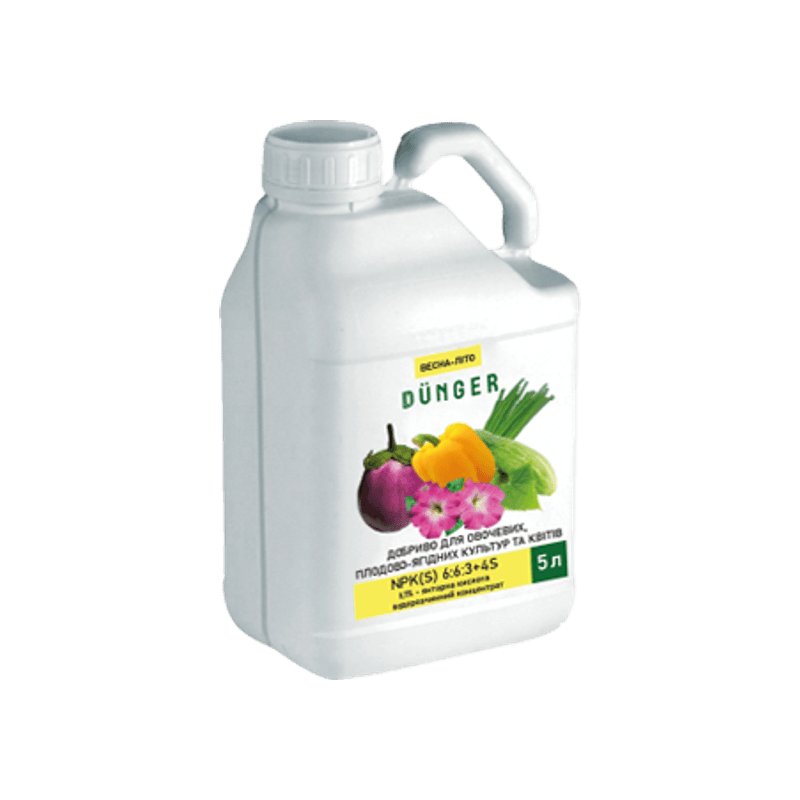
Complex fertilizer for vegetables, fruit and berry crops, and flowers
This concentrate has specific directions for young plants. For pepper seedlings, account for their stage, medium and previous additions.
DÜNGER fertilizer for vegetables, fruit and berry crops, and flowers in a 5 L canister. View the product details, choose the number of canisters and order for your vegetable garden, berry patch or flower beds.
Used throughout the entire period of plant development and growth. For root feeding into the soil/substrate, dilute 50 ml of fertilizer in 10 L of water (100 ml of solution per 1 plant) and use at intervals of 10-12 days. For foliar treatment (spraying), dilute 25 ml in 10 L of water and apply with a sprayer, ensuring even coverage.
For treating seedlings, halve the concentration of the working solution!
Feed plants with fertilizer in the morning or evening, avoiding hot weather. Fertilize the seedling substrate for the first time 10-14 days after pricking out or at the stage of 4 true leaves.
Remember that the solution for seedlings should be half as concentrated as the solution for mature plants. Do not use products whose instructions specify the same dosage.
Keep the lower concentration and specified starting stage. Do not derive your own seedling dose from adult-plant instructions. Use this as a separate product without homemade additions, and check pack size and ordering conditions on the product page.
When the previous care has become unclear
Gather the names and amounts of everything applied, distinguishing plain watering from feeding. Do not try to correct an unknown excess with another unknown mixture. Check moisture and drainage, light and the roots of plants available for inspection. Where needed, ask a specialist to assess the medium and advise on subsequent care.
For purchasing, separate seedling numbers from the future bed area. My Garden can hold crops, zones and measurements and help form a product plan. A canister of concentrate is not prepared solution. In the garden crop fertilizer catalogue, compare each product with its own instructions and pack size rather than treating all liquid products as equivalent.
Frequently asked questions
Seeds have initial reserves. Requirements change as true leaves develop and depend on the medium. Do not start a homemade recipe just because germination occurred. Check the specified stage and limitations for the chosen fertilizer before deciding whether feeding is appropriate.
Origin does not establish concentration or its effect on the growing environment. Even clean ash has an alkaline effect and contains salts. For young roots, quantity, method and medium condition matter more than a natural label in a recipe's name.
First assess light, crowding and conditions around the tray. Long thin stems can be associated with inadequate illumination. Do not replace the required change in conditions with an unknown mixture. Evaluate the plant's growth environment before deciding that more feeding is needed.
Do not add an unverified extract to the working solution. It changes the known composition and is not part of the instructions provided. Choose a clear method and count previous additions, rather than creating an improvised cocktail whose concentration cannot be established.


