


Feed carrots according to what went into the bed before sowing, how the plants are developing and whether moisture reaches their roots. Slow growth does not always mean a fertilizer shortage. Crowding, crusting, compacted ground and uneven watering can restrict the root even in a well-fertilized bed. Check those conditions before choosing a product and an application method.
Do not try to produce bigger carrots by continually increasing the dose. Carrots have modest nutrient requirements, and their shape also depends on variety and physical soil conditions. Another solution will not straighten a root that has already forked. Keep useful information about a troublesome area so that it can be prepared more effectively for the next sowing.
Start with the bed's history
Identify fertilizers and organic materials already applied, the timing and the treated area. Assess differently prepared sections separately. A complete pre-sowing application and later feeding should not automatically become two independent full programmes. Include fertilizer that may have reached the carrot row during work on neighbouring crops. A purchase plan is more useful when it starts with what is already in the soil.
Soil analysis helps separate a genuine requirement from an unnecessary purchase. Nutrient supply, reaction and physical condition all matter. A sample from a path or an old compost heap does not represent the whole carrot bed. Follow the laboratory's collection requirements and explain that the crop is a root vegetable rather than ornamental foliage.
Across Ukraine, soils, rainfall and drying rates differ. Moisture changes more quickly in a light bed, while compacted heavy ground can retain wet patches. However, a region's name cannot determine the need for extra fertilizer. Check your actual bed after real rain or watering, especially while the roots are enlarging. A sheltered raised bed may behave differently from the open ground beside it.
Seedlings, young plants and root enlargement
Freshly emerged carrots have small narrow seed leaves. Their characteristic divided true leaves appear later. Do not judge a young crop against a photograph of a mature row. Plant stage matters, and stronger feeding cannot replace suitable temperature or a workable seedbed. First establish whether the row is progressing normally for its own sowing and current conditions.
After emergence, check for a hard surface crust. Work carefully without injuring young roots. Thin according to the variety's eventual size, rather than using one spacing for miniature and large carrots. Crowded plants compete for room. Adding fertilizer does not remove the neighbouring root or provide the physical space needed for development.
The separate guide to spring carrot sowing and soil readiness covers establishing the crop. On an existing bed, focus on even development. Keep sowings at different stages separate in your care plan: an early row intended for summer use may have different immediate needs from a later storage crop.
Checks before another application
- Is the soil moist below the surface, in the layer used by the roots?
- Does water remain standing, and is the ground compacted?
- Is there enough space between plants, with weeds controlled?
- Do symptoms affect the whole bed or only a low spot or an exposed edge?
- What was already applied, and does the proposed method suit the plants' stage?
Inadequate water can reduce root quality and size. Examine the ground beside the row with a small trowel without cutting roots. A dark surface after brief watering does not prove that moisture has moved deeper. Equally, permanently wet soil is not a useful reserve for every situation. Assess the soil, weather and bed position together.
Sharp changes between dry and excessively wet conditions can favour cracking. Fertilizer cannot seal an existing crack. Improve the consistency of care for the remaining plants and check the variety's harvest stage. Do not use extra concentrate in an attempt to compensate for missed irrigation or to force a damaged root to recover its previous shape.
Keep cultivation and weeding shallow. Main-root damage, stones and hard clods can be associated with malformed carrots. Deep digging alongside an established crop may add further injury. Prepare the growing layer before the next sowing, while protecting the roots already developing now. Do not confuse careful surface maintenance with a reason to turn over the whole row.
Choose fertilizer without promising a result
Look for the relevant crop group and complete directions. A vegetables label requires reading the instructions, not transferring a tomato rate yourself. Distinguish concentrate, prepared solution and dry granules. Their units and methods are not interchangeable. Equal weights of different formulations also do not supply equal quantities of nutrients.
Do not choose solely on a promise of sweetness. Variety, plant condition, weather, moisture and harvest stage influence quality; a portion of potassium does not guarantee flavour. Yellowing also fails to identify a particular missing nutrient without other evidence. Spots, injury or isolated wilting call for investigation rather than an automatic whole-bed feeding.
For an uneven crop, compare two small representative sections. If a low spot stays wet while the edge dries, one extra dose will not explain the difference. Check irrigation coverage, plant density and compacted strips before changing fertilizer quantity. This helps identify the actual restriction. Plants of similar age under comparable conditions can then be assessed together with soil results and the earlier bed preparation.
An option for the vegetable bed
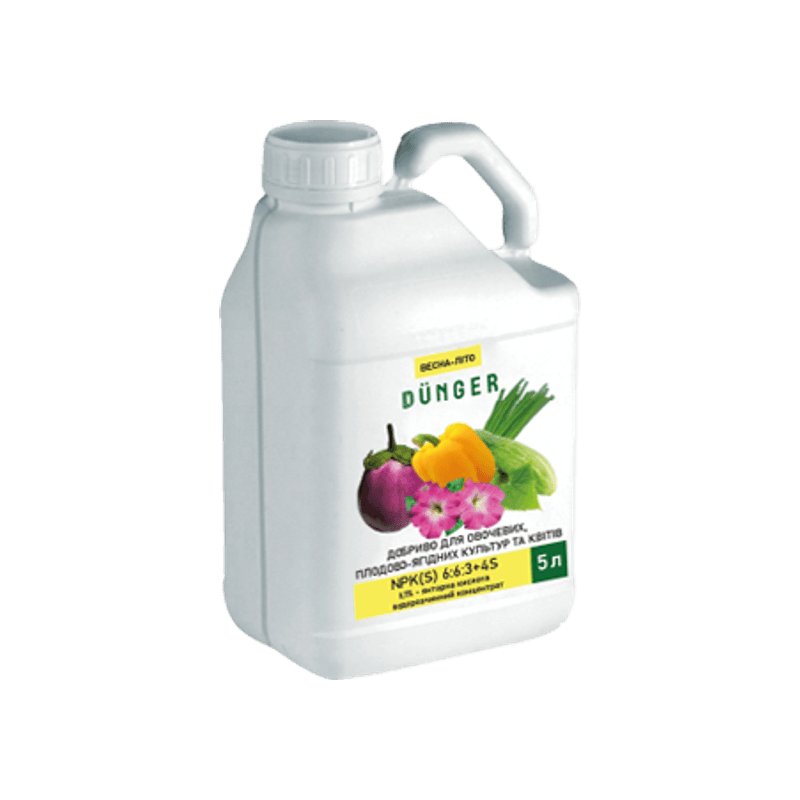
Complex fertilizer for vegetables, fruit and berry crops, and flowers
For carrots, consider a complex whose instructions include vegetables. The method below must be matched to the plant stage; canister size does not determine the concentration.
DÜNGER fertilizer for vegetables, fruit and berry crops, and flowers in a 5 L canister. View the product details, choose the number of canisters and order for your vegetable garden, berry patch or flower beds.
Used throughout the entire period of plant development and growth. For root feeding into the soil/substrate, dilute 50 ml of fertilizer in 10 L of water (100 ml of solution per 1 plant) and use at intervals of 10-12 days. For foliar treatment (spraying), dilute 25 ml in 10 L of water and apply with a sprayer, ensuring even coverage.
For treating seedlings, halve the concentration of the working solution!
Assess root feeding separately from foliar treatment for this task. Retain the seedling exception when dealing with young plants. The canister contains concentrate, so pack volume is not the volume of prepared solution. Check the bed requirement and ordering conditions on the product page.
Application and subsequent assessment
Measure the quantity for the selected method and intended volume. Use a clear measuring vessel instead of judging concentration by the colour of the water. Do not add ash, yeast, homemade extracts or another fertilizer to the prepared programme. Combining several products does not improve accuracy simply because each ingredient has a familiar gardening name.
Avoid spilling concentrate directly onto young plants. Consider soil condition and the weather limits in the instructions. Afterwards, assess new growth alongside the surrounding conditions; do not expect the root to change by the following morning. If the problem persists, revisit the original cause instead of repeating the dose immediately.
For purchasing, separate carrot areas by sowing and condition. My Garden can hold the crop and area measurements and help form a product plan. The area of the whole vegetable garden is not the area occupied by carrots. The guide to assessing soil before choosing fertilizer provides a useful starting point for broader preparation.
These decisions concern the crop's growing period. Autumn can be used to review the season, measure beds and plan soil testing; it does not make a spring feeding programme appropriate for an already harvested or finished crop. Ukrainian timing must follow the individual sowing, weather and stage, rather than one date for every region.
Frequently asked questions
First check variety, age, crowding and previous feeding. Large leaves do not prove a need for another dose. Compare a few representative plants and their conditions, rather than digging up the whole bed to inspect it.
Existing branches will not disappear. Check stones, compaction and possible root injury. Choose an appropriate variety and prepare the ground for the next season; for the current crop, maintain careful conditions around the remaining roots.
Only if its instructions include carrots or their applicable group and permit the intended method. Check composition, units and previous applications. The name of the neighbouring crop is not a reason to copy its entire feeding programme.
Do not make that an automatic step. Consider maturity, the reason for growing the crop and previous care. Once roots are ready, another dose cannot replace timely harvesting or guarantee better storage quality.


