


A plant that has just opened its seed leaves is different from a seedling with true leaves. Age in days does not establish fertilizer need on its own. Peppers develop under different conditions, and prepared growing media may already contain nutrients. Adding another product to every watering without checking these details is not an essential routine for healthy young plants.
What stage follows emergence?
The first leaves that appear are cotyledons, also called seed leaves; true leaves develop later. At the beginning of germination, the plant uses reserves stored in the seed. The appearance of a green shoot does not therefore establish an immediate need for nutrient solution. Watch for new leaf development and compare the stage with the particular product instructions before preparing a feed.
Do not count cotyledons as true leaves when following guidance based on leaf numbers. If emergence is uneven across a tray, avoid scheduling the same procedure for every plant solely from the date the first seedling appeared. Mark the later plants separately and assess their actual development. A shared sowing tray can contain seedlings at different stages even when all its seeds were sown together.
Check what the growing medium already supplies
Read the bag for the mix in which the peppers are growing. Check its intended use, any fertilizer already added and the manufacturer's advice about subsequent feeding. A medium containing an initial nutrient supply and a material without one need different planning. Last year's experience with a different mix does not automatically apply just because both products were sold for raising seedlings.
If you made the mix yourself, list the components and any fertilizers added. “A little compost” cannot describe its nutrient contribution precisely, but recording it still helps prevent adding the whole combination again without thought. When the composition is uncertain, do not begin with several concentrates at once. For a consultation, prepare the material names and photographs of their labels as well as photographs of the leaves.
The medium must also supply air to the roots and allow surplus water to escape. Heavy garden soil in a small cell can behave differently from a prepared propagation mix. Fertilizer does not physically loosen a compacted root zone or open blocked drainage holes. If the medium remains constantly wet, or is difficult to wet throughout, investigate that condition before treating the problem as a nutrient shortage.
Check light and water before selecting fertilizer
Long, thin stems are often associated with inadequate light. Check whether neighbouring plants shade the peppers, whether the whole tray receives light evenly and whether the lamp position follows its manufacturer's guidance. Trying to strengthen elongated seedlings solely with more concentrated fertilizer does not address their growing conditions. Assess nutrition together with the conditions under which the plants must use those nutrients.
Look at the position near the window. Conditions beside the glass, above a radiator and towards the middle of the room can differ. The room's air temperature does not automatically describe the temperature of the rootball. Check for cold draughts and overheating. Correcting an unsuitable position requires observation of the site rather than another fertilizer chosen for a promise of fast growth.
Before watering, check moisture inside the cell as well as at the surface. Light misting can wet the top while leaving the lower medium dry. Conversely, water left continually in a tray can cause waterlogging. Surplus water should be able to leave the container after watering. A nutrient solution is also a liquid; adding it to a flooded tray simply because a planned feeding day has arrived is inappropriate.
Choose a product with seedling instructions
Look for vegetable seedlings and the appropriate application method in the complete instructions. “For vegetables” on the front of a pack does not establish how to use a product on very young plants. A liquid concentrate has a working-solution concentration and a volume to apply per plant. Granules may have other units and methods. Those instructions cannot simply be substituted for one another.
For peppers in propagation containers, consider a product with a distinct seedling row. Do not use mature-plant rates out of habit or add the rates of different fertilizers together. Read the instructions again when changing products. A similar name, identical canister size or the same letters NPK do not establish the same concentration or application. Match the exact product and plant stage before measuring.
A homemade infusion is not a precise substitute for measured fertilizer when its composition and a suitable seedling application are unknown. Its colour or smell cannot show how much nutrient the plant will receive. For a small tray, clear directions, an appropriate measuring tool and a record of earlier applications are particularly useful. They make the chosen procedure reproducible and easier to discuss if problems arise.
DÜNGER liquid complex for vegetable seedlings
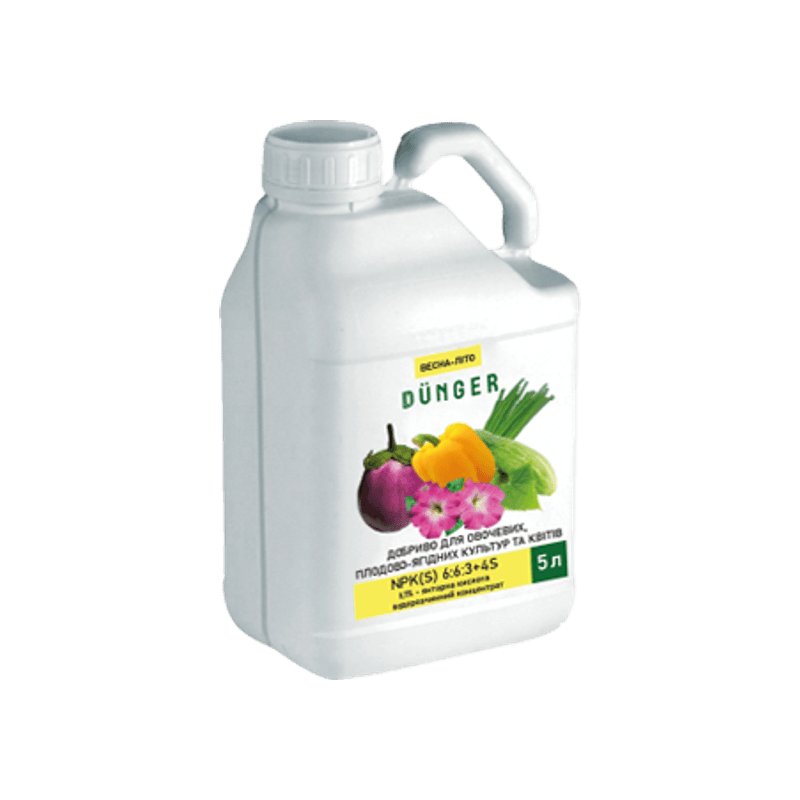
Complex fertilizer for vegetables, fruit and berry crops, and flowers
This DÜNGER liquid product in a 5 L canister has a separate vegetable-seedling application. Before using it, compare the plant stage with the product's own guidance:
Feed plants with fertilizer in the morning or evening, avoiding hot weather. Fertilize the seedling substrate for the first time 10-14 days after pricking out or at the stage of 4 true leaves.
Remember that the solution for seedlings should be half as concentrated as the solution for mature plants. Do not use products whose instructions specify the same dosage.
The seedling root-feeding row states:
25 ml/10 L of water (50 ml of solution /plant)
This is the rate for the relevant seedling group in the product details. Read the complete instructions and check that you are using the seedling row rather than the one for established mature plants. Root feeding and foliar treatment have separate rows. Do not transfer the solution shown above to another application method.
Organise a single feeding carefully
- Establish the stage of each seedling group and check previous nutrition.
- Inspect moisture, drainage holes and plant condition.
- Open the selected product instructions and choose the seedling row and method.
- Measure water and concentrate with an appropriate tool rather than kitchenware of uncertain volume.
- Record the date, product and application before the next decision.
Do not combine products in the same mixing container without confirmed compatibility and appropriate instructions. If you recently moved seedlings into another mix, account for that mix before feeding again. Repotting, watering and adding fertilizer should not become an automatic package of procedures performed together. Each action should respond to the actual condition of the peppers and their root zone.
When the container may be the problem
If plants have outgrown their cells, consider whether they need a larger container. Crowded seedlings compete for resources, and intertwined roots are harder to separate without injury. Extra nutrition cannot create physical space. Support the rootball during repotting rather than pulling a pepper by its stem. Plan space for larger plants in advance so that trays do not remain overcrowded until transplanting day.
Distinguish the concentrate, water used for dilution and finished working solution when measuring. These are related but different quantities. Find the unit associated with each one in the application row before starting. Check that the measuring scale is readable and that the container can measure the required volume. Do not judge concentrate quantities by water colour or a number of unmeasured capfuls.
What to observe afterwards
Assess new leaves, evenness of growth and the condition of the whole tray. Do not expect fertilizer to immediately reshape an elongated stem or remove every mark on a leaf. Compare plants of the same cultivar, age and growing medium. If you changed the light, temperature and feeding together, record all three changes; otherwise, linking a result to one particular action becomes difficult.
Moving peppers into an outdoor bed requires a separate assessment of the weather and preparation for outside conditions. Successful feeding does not mean the plants are ready for cold ground. This stage of care cannot establish one transplanting date for every region of Ukraine. Consider the location, actual temperatures and seedling condition when deciding when to move them outside.
Common questions
The appearance of cotyledons alone is not a reason to prescribe fertilizer. Check the medium and wait for the stage described in the selected product instructions. Suitable light, moisture and root conditions are the first requirements after emergence.
Check light, temperature, moisture and roots first. Slow growth is not a measurement of deficiency. Raising concentration without establishing need can create another problem rather than resolve the original one.
Use the separate seedling row in the complete instructions. Do not transfer a mature-plant rate or another product's rate. Check the exact product name, units and application method before preparing the solution.


