


Feeding dahlias starts with the soil, earlier applications and the condition of the plants. Dahlias need nutrients to grow and flower, but another portion of fertilizer is not the answer to every delay. A prepared garden bed and a container have different requirements. Check sunlight, moisture and drainage first, then choose a suitable product and follow its complete instructions. The aim is to support healthy growth without adding nutrients simply because a neighbouring plant has more flowers.
Give the roots suitable conditions first
Dahlias grow well in fertile, well-drained soil in a sunny position. The ground should retain available moisture without remaining waterlogged. If water stands around the planting area after rain, investigate drainage before feeding. Fertilizer cannot create the air that roots need in saturated ground, and continuing to add products makes it harder to identify the original problem.
Compost and other organic materials affect both soil structure and nutrient supply. A bed that has received these materials should not automatically receive the same feeding programme as an untreated, less fertile patch. Write down previous additions and consider them when choosing the next product. If the history is unknown, a soil test is more useful than guessing from leaf colour alone.
Our guide to assessing soil before choosing fertilizer explains the starting checks. If an analysis indicates that acidity needs attention, plan the adjustment from the results. Do not add lime or other amendments simply because they appear in someone else's dahlia routine.
After planting: distinguish rooting from hunger
A dormant tuber, a growing plant and an established cutting do not begin the season in the same condition. Check the planting material, soil moisture and warmth before assigning the same feeding routine to all three. A damaged or rotting tuber will not become healthy because granules have been added beside it.
Young shoots are vulnerable to frost. In Ukraine, use the local forecast and the actual stage of growth rather than one national planting date. Read about planting dahlias outdoors when deciding how to handle tubers and young plants. Suitable planting conditions matter more than attempting to compensate for cold with extra fertilizer.
Leaf growth needs balance, not a ban on nitrogen
Nitrogen contributes to building the plant, so removing it altogether because you fear excessive foliage is not a sound general rule. Too much nitrogen, however, can encourage vigorous leafy growth with disappointing flowering. Consider the nutrients already supplied and the fertility of the bed, rather than judging a new bag only by its first composition number.
If a bush is large and green but has few buds, also check light and crowding. A plant surrounded by tall neighbours may receive less sun than it appears to from the path. Compare plants of the same variety and similar age in comparable conditions. A compact border dahlia is not expected to match the height of a variety grown for tall cut-flower stems.
Make observations before changing several things at once. Record the watering pattern and earlier applications outside your garden plan. This gives you a useful reference when assessing progress, rather than relying on memory after another product has been applied.
Buds do not automatically mean extra phosphorus and potassium
Bud formation is a good moment to review care, but it is not an instruction to add a large phosphorus or potassium dose. The need still depends on the soil and previous feeding. Avoid combining several products marketed for flowering merely because their names differ. Their nutrient contributions may overlap.
The guide to choosing a potassium source for the garden helps distinguish products. For an individual bed, use the soil assessment and the complete instructions of the chosen fertilizer. A high concentration of one nutrient does not guarantee more flowers under every set of conditions.
Check moisture around the roots during flowering. Dry, hot weather may make extra watering necessary, while prolonged rain calls for a drainage check. One drooping leaf at midday or a dry surface alone is not enough to decide what the entire root zone needs. Inspect the soil before responding with either water or feed.
Support and flower care also matter
Tall varieties and large flower heads may need support. Rain can make blooms heavier and stems lean even when nutrition is adequate. Check ties and the position of the plant before interpreting bending as a deficiency. Where supports are needed, planning them early helps avoid damaging established underground growth later.
Remove spent flowers while retaining developing buds. Look closely before cutting: rounded buds and the remains of finished flowers can be confused. An ordinary garden display does not need every technique used for exhibition blooms, where some buds are deliberately removed to enlarge others. Choose care that suits how you want to enjoy the plant.
Potted dahlias need a separate decision
Container roots have a limited volume of growing medium, and moisture can change faster than in a bed. Check whether the mix already contains fertilizer, what duration is stated on its packaging and whether drainage holes remain clear. Account for this initial supply before adding several products together.
Use a container application and dose explicitly covered by the chosen product's instructions. Do not convert an outdoor square-metre rate into an arbitrary spoonful for a pot. Watering and feeding are different decisions: a dry container needs its moisture checked, not automatically another nutrient solution every time.
Fertilizer for dahlias in a flower bed
Dahlias belong to the floral and decorative crop group. For the relevant soil application, a universal granular product with this group in its instructions is an option. Consider the condition of the bed and previous nutrient inputs before use.
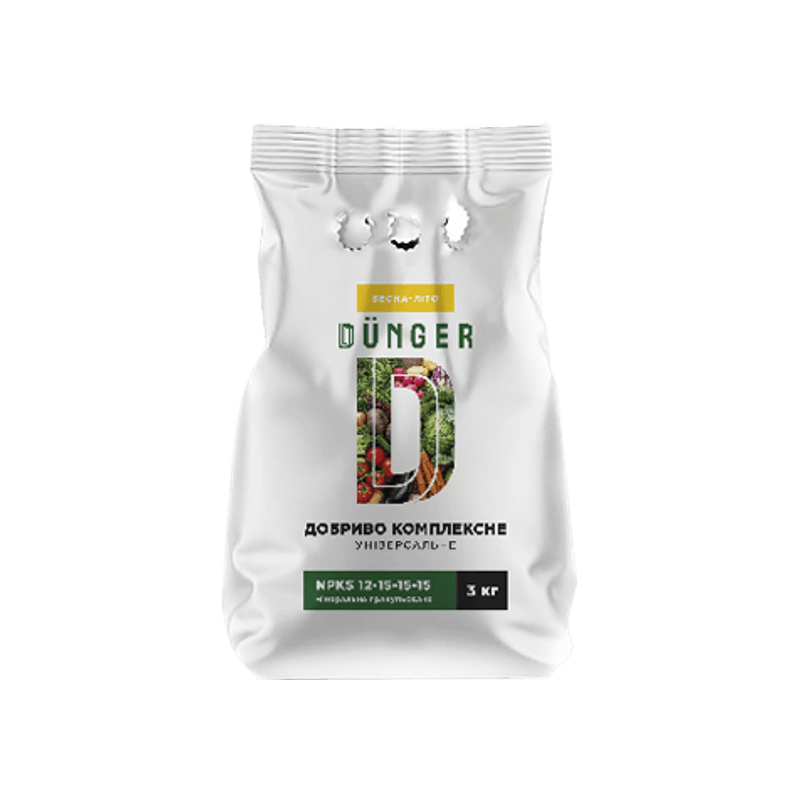
Complex fertilizer universal granular
DÜNGER universal compound fertilizer granules for vegetables, legumes, leafy greens and ornamental plants. Available in 3, 4 and 5 kg packs.
Floral and decorative crops: 30-40 gr/m².
This is the stated group rate. Read the complete application method on the product page. Do not add a surface rate to another application method as though a second portion were always required. Use the actual planted area for your calculation, leaving paths out.
- Measure the flower bed or separate dahlia planting area.
- Check earlier applications and the selected method.
- Measure the required mass rather than estimating by eye.
- Distribute the product according to its complete instructions and check watering conditions.
Save dahlias as a separate zone with its dimensions in My garden. This helps calculate the required amount and choose packs for this bed alongside the other growing areas in your garden.
When the growing season ends
Do not continue a summer feeding routine automatically when active growth is finishing and frost approaches. Follow plant condition, local weather and the product instructions. Preparing healthy tubers for frost-free storage is a different job; a final stronger dose does not replace that protection.
Review which plants flowered well, where watering was difficult and where the soil remained problematic. Keep separate notes for next season. Improving an unsuitable position or care routine can be more useful than increasing the amount of fertilizer in the same troubled patch every year.
Frequently asked questions
There is no single interval for every planting. Consider soil or growing medium, previous applications, plant condition and the chosen product's instructions. Do not automatically copy a container routine onto an outdoor bed.
Possible causes include insufficient sun, shading, the plant's development stage and excessive nitrogen feeding. Check conditions and earlier applications before adding another fertilizer.
Fertilizer does not treat rot. Examine the planting material and moisture conditions, keeping plant health problems separate from nutrition. Increasing the rate cannot compensate for damaged tissue.


