


Feed cauliflower according to the soil, earlier applications and the plant's stage, rather than the size of its head alone. A small or missing curd can reflect temperature, moisture, transplant quality or a variety unsuited to the growing season. Fertilizer is useful when additional nutrition is needed, but a stronger solution does not compensate for drought or prolonged heat. Start with the conditions around the roots before choosing a product.
Cauliflower is not a headed cabbage
A cabbage head consists of tightly folded leaves. The edible cauliflower curd is an immature flowering structure, so instructions about making cabbage leaves close cannot simply be transferred. Cauliflower needs a well-developed leaf canopy, but large leaves alone do not guarantee a good curd. If you also grow headed cabbage, use the separate guide to feeding cabbage and head formation for that crop.
In Ukraine, match the variety to the intended growing season. A spring planting that meets persistent heat while forming its curd faces different conditions from a summer planting intended for an autumn harvest. Follow the description of the seed you actually purchased, local weather and the development of the plants. A single feeding date for every Ukrainian garden would ignore these differences. Do not assume that a winter variety grown elsewhere will tolerate your local winter.
Review the soil and previous applications
A fertile, well-prepared bed may not need another feed immediately. Count mature compost, other organic amendments and mineral fertilizers already added. Keep a simple note of their names, the area treated and when they were applied. This makes it easier to see whether another application addresses a need or merely duplicates an earlier one. Dark soil is not, by itself, a measurement of available nutrients.
If plants repeatedly struggle in the same bed, a soil test is more useful than a succession of unrelated products. It can help assess acidity and nutrient status before you choose an amendment. Liming or adding phosphorus and potassium should not be automatic steps just because the crop is cauliflower. Their necessity depends on the soil results. A rate recommended for someone else's plot may be unsuitable for yours.
Distinguish seedlings from established plants
A transplant in a small cell has a limited volume of growing medium. Before feeding it, check whether that medium contains starter fertilizer, how long the seedling has occupied the cell and whether it dries between waterings. The guide to growing media for seedlings helps with the separate question of choosing a suitable mix. Poor roots should not be challenged with an increasingly concentrated solution.
Overmature or stressed transplants can form very small curds prematurely. This does not automatically mean that feeding must be increased as soon as they are planted out. Examine the root ball and the conditions during transplanting. Young plants need gradual adjustment to outdoor exposure. When fertilizer is appropriate, use the product's seedling instructions instead of treating a recently transplanted young plant as a mature crop.
Water determines whether feeding can help
Cauliflower benefits from consistent moisture without prolonged waterlogging. After a brief shower, the surface may look wet while the soil underneath remains dry. Check carefully beside a plant without cutting its roots. A light soil and a heavy bed hold and drain water differently, so identical watering schedules do not produce identical root conditions.
If leaves wilt, check the moisture before mixing a feed. Drought, saturated ground and damaged roots require different responses. Fertilizer does not replace ordinary watering or repair poor drainage. Mulch can reduce moisture loss and weed competition, but leave space around the stem rather than packing material against it. Check beneath the mulch when judging whether the bed needs water.
Why a curd stays small or fails to develop
Premature production of a small curd is often called buttoning. Possible contributors include temperature stress, overmature transplants, insufficient water and inadequate nutrition. Excess salts and competition from weeds can also contribute. The appearance of one small head cannot identify the cause with certainty, and different problems can occur together.
Compare plants of the same variety. Is the whole row affected, only an exposed edge or a few planting holes? Look back for a shared period of drying, chilling or delayed transplanting. Inspect both sides of damaged leaves. Do not label every yellow leaf as nitrogen deficiency or every brown patch as a boron shortage. Suspected disease or micronutrient problems need a more specific assessment before treatment.
Choose a feed without making an improvised mixture
A product with instructions for vegetable crops can be considered for cauliflower. Check its formulation, application route and restrictions for seedlings. Root feeding and foliar spraying are alternatives to select deliberately, not two compulsory treatments to perform one after the other. The choice should follow the plant's need and conditions, rather than a desire to use every line of the label.
Do not independently add boric acid, iodine, ash or other materials to the prepared fertilizer solution. Micronutrients require a justified need and the exact instructions for the particular product. A household recipe does not provide either. Similarly, never transfer a concentration from a different bottle because its name sounds similar. Include earlier applications when deciding whether another treatment is needed.
A fertilizer option for the vegetable bed
If the assessment shows a need for additional nutrition, consider this concentrate for vegetable crops. It supplies nutrients; it is not a treatment for buttoning, heat stress or damaged roots. The product page separates instructions for mature plants and seedlings.
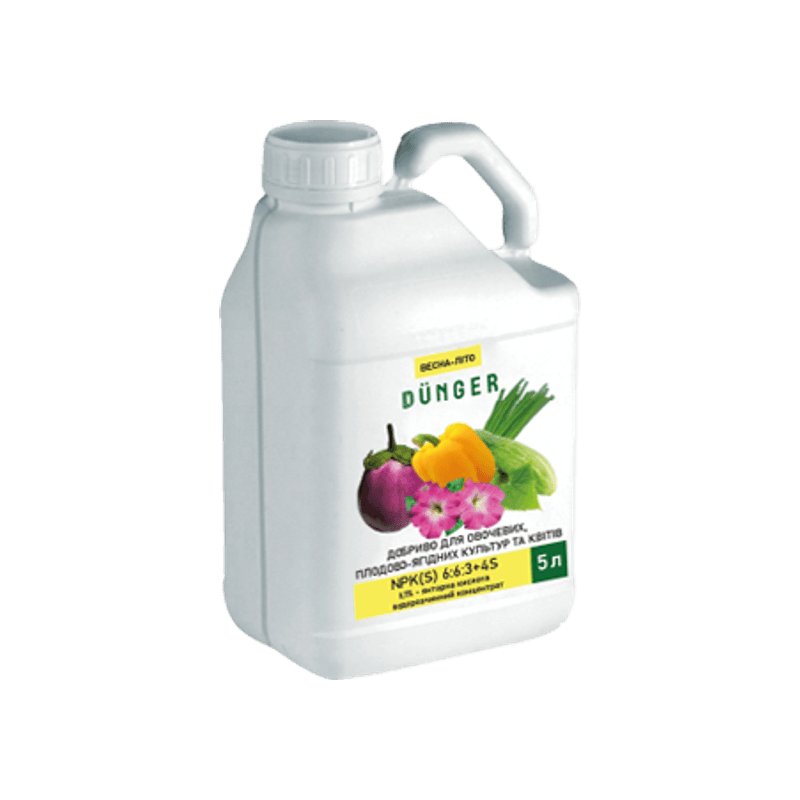
Complex fertilizer for vegetables, fruit and berry crops, and flowers
This liquid concentrate comes in a 5 L canister. Its complete instructions describe root and foliar application. The product's application method is:
Used throughout the entire period of plant development and growth. For root feeding into the soil/substrate, dilute 50 ml of fertilizer in 10 L of water (100 ml of solution per 1 plant) and use at intervals of 10-12 days. For foliar treatment (spraying), dilute 25 ml in 10 L of water and apply with a sprayer, ensuring even coverage.
For treating seedlings, halve the concentration of the working solution!
The stated interval is not a requirement to feed every bed regardless of its condition. Choose the appropriate route and follow its rate. Measure the concentrate with a measuring container and do not apply it undiluted.
In My Garden, create a separate vegetable zone, enter its measurements and plan the fertilizer quantity and pack sizes. Having concentrate left in the canister is not a reason to increase the rate.
A practical sequence for your bed
- Identify the growth stage and check the root-zone moisture.
- Review previous applications and any soil-test results.
- Check for overheating, transplant stress and obvious plant damage.
- Choose one suitable application route and the exact rate for that stage.
- Measure the required solution according to the plant number and instructions.
- Watch new leaf growth and curd development instead of introducing another treatment every day.
Keep bed boundaries and variety names clear when comparing results. Neighbouring varieties with different maturity periods need not form curds together. Once a firm curd is ready, harvest it rather than postponing cutting for one more feed. An overmature head can become loose or grainy as the flowering structure develops. Fertilizer cannot be relied on to restore its earlier compact form.
For the next planting, record which variety matched the season and whether moisture remained steady. This gives you a more useful basis for improving the bed than an isolated photograph of the final head. Separate observations about weather, watering and nutrition so that a change in one is not automatically credited to another.
Common questions
No. Growing this crop does not establish a deficiency. Brown areas can have several causes. Check the conditions, clarify the diagnosis and arrange testing if appropriate before applying a separate micronutrient product.
Looseness may accompany maturity, heat or interrupted growth. Extra fertilizer does not guarantee that the structure will become compact again. Harvest a mature, firm curd at the appropriate stage instead of delaying it for another application.
Sunlight on the curd can cause discoloration. Some white varieties benefit from protection with their outer leaves, while self-blanching varieties may cover themselves. Allow air to circulate when arranging leaves. Naturally coloured varieties should be judged by their own characteristics, not made white.


