


Chicken manure can supply nutrients and organic matter, but its use depends on the material's condition. Fresh litter, properly prepared compost and a processed packaged product are not interchangeable. Establish the source, preparation, composition and soil need before application. One dilution or bucket measure cannot describe every batch.
Identify what you actually have
Material from a poultry house can contain manure, feed residues, straw, sawdust or other bedding. Water and bedding content change its properties and the nutrient quantity within a given weight. The name chicken manure therefore does not describe a ready-to-use fertilizer with a known rate. Drying fresh material does not make it equivalent to mature compost.
Ask about source and processing when buying. Distinguish a pile that has simply aged, a controlled composting process and an industrial product with its own label. Old, natural and low-odour are not evidence of sanitary preparation. If the seller cannot explain composition and intended use, do not borrow an application rate from another material.
Appearance cannot establish the analysis
Manure contains several nutrients, but their proportions vary with the actual material. Testing a batch is more informative than a general number for all poultry waste. A wet bucket and dry granules do not deliver equivalent inputs. Do not transfer a rate by container volume or similar colour.
Some organic nitrogen becomes available gradually as microorganisms break material down. A high proportion of woody bedding in unfinished compost can temporarily reduce nitrogen availability. Weak growth after an application does not necessarily mean more manure is needed. understanding nitrogen fertilizers explains nutrient forms; the actual decision still requires soil and input assessment.
Natural materials still contain salts
Raw manure can contain substantial ammonium and soluble salts. Excessive inputs can harm growth, particularly around young roots. Do not place unknown fresh material directly into a transplant hole, heap it against a stem or use it as a ready-made seed medium. A mild smell cannot establish salt concentration.
Pay particular attention in greenhouses and containers, where soil volume and water movement differ from an open bed. Salts can accumulate, and adding more organic material is not a universally safe answer. If excess application is suspected, stop adding it and test the soil. Avoid attempts to correct the situation with an improvised acid, ash or other mixture.
Sanitary preparation is different from ageing
Raw manure can transfer undesirable microorganisms to soil and crops. This matters particularly for vegetables and berries that contact soil or are eaten uncooked. Do not add unknown raw material beside crops ready for harvest. Dilution does not establish decontamination, and a home-made liquid does not acquire a proven safe interval simply by standing.
Controlled composting involves managing the process and checking adequate treatment throughout the mass. An old pile may not have received the same treatment in its centre and at its edges. Neither elapsed months nor smell alone proves sanitary readiness. Ask about documented processing and permitted use, rather than inventing a harvest interval for edible crops.
Understand what finished compost means
Finished compost and undecomposed bedding require different decisions. Recognisable fresh ingredients or ongoing active heating are reasons not to assume readiness from dark colour alone. Conversely, a soil-like appearance is not a laboratory safety result. Ask how preparation was controlled, as well as how long the material has been standing.
A pile receiving fresh manure continuously can have layers at different stages. Do not treat material taken from any point as one uniform batch. For a small plot, an identified prepared product may be easier to assess. That is a question of known composition and instructions, not evidence that all granules are sterile.
Read the complete label on processed products
Commercial drying, composting and other treatments are not identical processes. Check the particular product's claims, analysis, permitted crops, method and rate. Pellet shape alone cannot establish origin or decontamination. Do not call an organo-mineral fertilizer chicken manure unless its declared composition establishes that raw material.
A packaged product's rate applies to that product, rather than raw litter from a farm. Do not transfer an outdoor-bed instruction to seedlings or containers. Check whether directions concern main soil preparation, active-growth feeding or making a soil mixture. Compare full names, pack weights and the required amount for the actual job.
Assess the soil before adding more
Repeated large manure or compost inputs can accumulate phosphorus and other nutrients. Meeting nitrogen demand from manure alone can add more phosphorus than the crop needs. Check acidity, nutrient status and soluble salts where appropriate. Include earlier organic inputs, particularly in a long-fed greenhouse, raised bed or small berry area.
Account for all nutrient sources, rather than only the latest purchase. Ash changes nutrient inputs too; wood ash as fertilizer considers its separate properties. Do not mix materials simply because both are natural. When tests show an excess, choose nutrition for the actual remaining need instead of spreading another layer of manure or compost.
A labelled organo-mineral feeding option
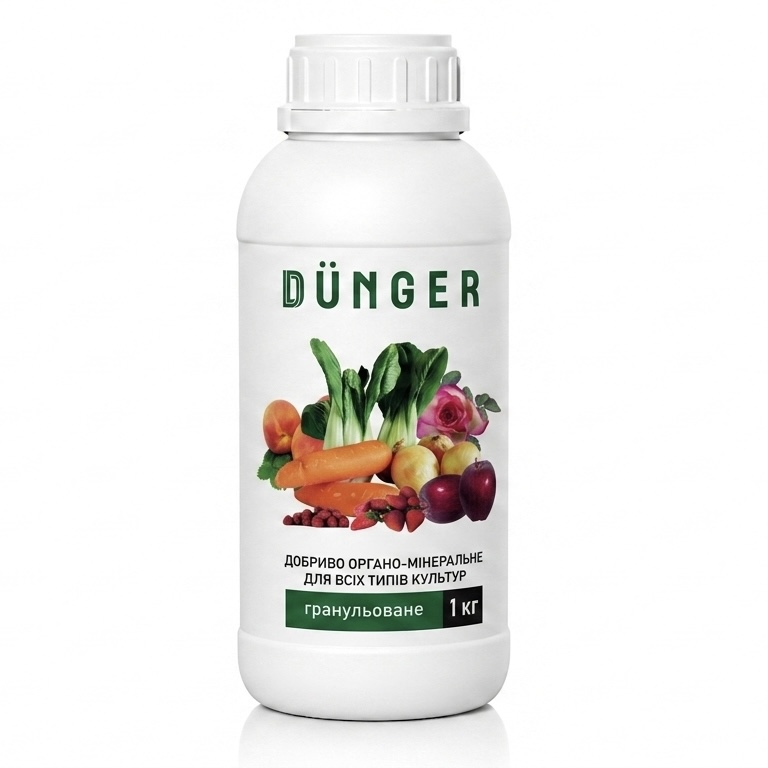
Organo-mineral fertilizer for all types of crops granular
This granular product has its own composition and instructions for different crops. It is a distinct organo-mineral fertilizer; its rate must not be transferred to chicken manure. Coordinate main application with soil preparation, and distinguish feeding during active plant growth.
Pack sizes are 1 and 5 kg. Compare the required amount with the selected option and confirm current price and delivery. In My Garden, set the zone, crop and measurements for product planning; keep earlier applications in your own records.
Consider the site and weather
No single Ukrainian month suits every manure material. Consider processing, soil readiness, crop and the interval before harvesting. A dry southern bed, wet ground in Polissia and a covered greenhouse require different assessments. Avoid snow-covered, frozen or saturated ground and rain likely to wash material away.
For a labelled fertilizer, distinguish main soil preparation from feeding a growing plant. Preparing an empty bed in autumn does not mean that every plant ending growth needs feeding. Compare garden-crop fertilizers according to need. Keep unknown material separate from harvested produce and clean tools, preventing its spread around the plot.
Questions about chicken manure
Do not put unknown raw material directly against young roots. Its salt and ammonium concentrations and sanitary condition are uncertain. Choose suitably prepared material with directions for the intended use.
Do not infer that from appearance. Establish the actual batch treatment. Drying, controlled composting and verified sanitary preparation are different matters.
There is no universal proportion for unknown material. Water does not establish its composition or safety. For predictable application, select a prepared product and follow its own instructions.
Only where the need is justified. Consider testing, earlier inputs and the crop rather than habit. Excess organic material can also cause problems, particularly in covered ground and containers.


