


Yes, ammonium sulfate can acidify soil. The effect is associated primarily with the transformation of ammonium nitrogen in the soil, rather than a rule that every fertilizer containing the word sulfate behaves in the same way. Its acidifying potential does not mean that it can quickly and safely bring any planting area to a chosen pH.
Ammonium sulfate remains a source of plant nutrients. Applying it solely to lower pH can supply more nitrogen than the plants need. Begin with two separate questions: does the crop need nitrogen, and does its root environment actually need a change in acidity? Answering one question does not resolve the other.
Where the acidifying effect comes from
Soil microorganisms can convert ammonium nitrogen into nitrate. This process produces hydrogen ions that contribute to acidity and is known as nitrification. For practical gardening, understanding the direction of the change is useful. Trying to predict the final result for an entire border from a chemical reaction alone is not.
Temperature, moisture and aeration influence the transformations taking place. Cold or waterlogged soil presents different conditions from warm, well-drained ground. The same response time should not be expected in every part of a garden. Our explanation of nitrogen fertilizers and their action helps distinguish the roles of nitrogen forms from the separate task of changing the environment in which roots grow.
Why the same amount gives different results
Soil can resist a change in reaction. This property, called buffering, is influenced by factors including clay, organic matter and carbonates. Two samples with the same measured pH can respond differently to an application. That is why a household instruction to add a particular quantity under every shrub cannot reliably guide soil-acidity correction.
Where there is abundant free carbonate, maintaining a lower pH may be difficult or impractical. Do not attempt to overcome that resistance by adding nitrogen fertilizer indefinitely. Discuss whether the site suits the intended plant, whether another location is available or whether container cultivation would be more manageable. Assess the ongoing work and cost before planting rather than after several unsuccessful attempts to acidify the ground a little more.
Test the soil and identify the plant's needs
Soil pH describes its reaction, but it does not reveal every nutrient reserve or the condition of the roots. A feeding decision should also consider the crop, growth stage, previous nutrition and relevant test results. Blueberries, rhododendrons, a vegetable bed and a lawn should not automatically receive the same treatment merely because they share a garden.
Follow the laboratory's sampling instructions. Areas with different soils or amendment histories should be considered separately rather than mixed into one average result. Explain what has already been applied, whether liming has taken place and which symptoms concern you. For blueberry plants, read about soil pH in the blueberry root zone: the actual environment around their roots matters more than a general impression of the whole property.
Solution acidity is not a forecast of soil pH
A measurement taken from fertilizer dissolved in a container does not predict the outcome for an entire border. Once applied, the material interacts with soil, water and living organisms. The volume of soil involved and its properties affect the result. Even an accurate solution measurement cannot replace an assessment of the soil surrounding the roots.
Do not use a home experiment as justification for repeated applications. Comparing results requires comparable samples and methods. A reading from a fresh solution, another from wet surface material and a laboratory measurement made by a different procedure may not describe the same thing. A difference between the numbers is not necessarily evidence that the whole root zone has changed.
When nitrogen becomes the limiting factor
Plants need nutrition in amounts appropriate to their requirements. Increasing ammonium sulfate solely to reach a desired pH can make nitrogen excessive before the soil has changed enough. Account for other fertilizers, organic inputs and the feeding already planned for that planting. Every new bag does not restart the nutrient calculation from zero.
Prepare a simple record of what was applied, the area or number of plants involved and the intended purpose. Products with different names may still supply overlapping nutrients. During a consultation, this is more useful than saying you have fed the plants a little at a time. Do not construct a combined programme from several instructions intended for different crops or application conditions.
Ammonium sulfate is not interchangeable with other materials
Elemental sulfur, ammonium sulfate and other sulfates differ in composition and in the processes they undergo in soil. Sharing an element in the name does not make them equivalent. Ammonium sulfate supplies nitrogen. A material selected specifically to alter soil acidity may have a different purpose and separate requirements. Do not transfer a rate between materials or substitute equal weights.
Likewise, a complex fertilizer for acid-loving plants should not automatically be treated as pure ammonium sulfate or as a guaranteed acidifier. Read the full product name, composition, intended use and instructions for the item you are considering. If the task is to modify soil conditions, choose that approach using soil-test information and consider plant nutrition separately.
What if the soil is already acidic?
Further acidification is undesirable for some plants. A lower pH does not automatically mean better access to every nutrient or healthier growth. Moving too far outside a suitable range can create new problems. Interpret the result in relation to the specific crop rather than assuming that more acidic is always better.
If testing indicates a need to raise pH, that is a different task. Our guide to liming acidic soil explains the direction of that adjustment. Do not add a liming material and an acidifier casually in an attempt to cancel one with the other. A sound decision needs the application history, actual measurements and an appropriate interval before meaningful reassessment.
A practical sequence for the garden
- Identify the plants and the separate growing areas that need attention.
- Check irrigation, drainage and the root environment before attributing everything to acidity.
- Collect the application history and obtain soil-test results suitable for the decision.
- Separate a nutrient requirement from a need to change soil reaction.
- Match the specific product to the crop and its complete instructions.
- Agree how and when to reassess, without adding another dose merely because an immediate visible response is absent.
Conditions can differ within a single Ukrainian garden. Imported soil beside a house, an ornamental border and an older vegetable bed are not necessarily equivalent. Focus on the exact place where an application is proposed. This helps you buy for a defined task instead of accumulating several materials for an unresolved problem. It also makes later observations more meaningful because you know which area was treated and why.
Nutrition for acid-loving ornamental shrubs
If the task is feeding hydrangeas, azaleas or rhododendrons, consider the DÜNGER complex intended for these plants. This is a separate granular product, not ammonium sulfate and not a promise to bring pH to a particular value. Review the composition, complete instructions and previous applications. Once the requirement is established, compare pack sizes and the quantity needed.
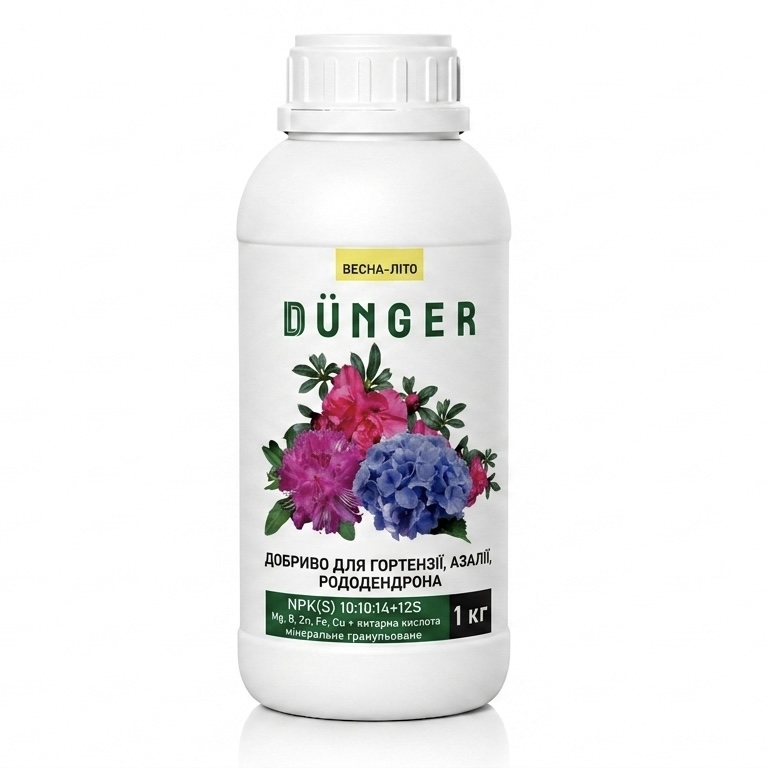
Complex fertilizer for hydrangea, rhododendron, azalea granular
DÜNGER compound granular fertilizer for hydrangeas, azaleas and rhododendrons. Choose a 0.5, 1 or 5 kg pack and review the composition and spring and summer feeding instructions.
To plan purchases by growing area, save crops and their measurements in My Garden.
Questions about ammonium sulfate and acidity
Do not expect a fast universal result. First establish the actual pH and the nitrogen requirement. Increasing the application solely for acidity can exceed the plant's nutritional needs. If a substantial change is required, discuss a separate soil-management approach based on the analysis rather than escalating fertilizer use.
Use comparable test results and the crop's requirements, not just leaf colour. Agree repeat sampling with the laboratory, taking previous applications into account. Avoid changing several conditions simultaneously if you want to understand the reason for improvement or decline. A useful target belongs to a particular plant and soil situation.
No. Colour changes can have several causes, including root condition, moisture and nutrient availability. Inspect the plant, assess the soil and review earlier care. The name of a fertilizer does not establish the cause of the symptoms, and adding more nitrogen is not a substitute for that assessment.
Not automatically. These are different products with different compositions and purposes. For hydrangea nutrition, match the plant's needs to the instructions for an appropriate complex. If changing pH is the goal, consider it separately and do not transfer application rates between products.


