


Feed garlic in spring according to the condition of the bed and the start of leaf growth. A bed that received enough compost or fertilizer before winter may not need another nitrogen application. Where feeding is justified, choose a product intended for vegetables and account for everything already added. Yellow leaf tips alone do not tell you which fertilizer to buy: water stress, nutrition problems and disease can produce overlapping symptoms.
Begin with an inspection. Look for new growth, compare different rows and check where water collects. Then decide whether feeding is needed now, which area needs attention and what to observe afterwards. There is no need to prepare several mixtures before you know what the plants require. A useful spring plan connects a specific condition with an appropriate action instead of treating the disappearance of snow as an instruction to fertilize.
Separate autumn-planted and spring-planted garlic
Autumn-planted garlic has already spent the winter outdoors; spring-planted garlic is beginning a different stage. Sharing a calendar date does not make the plants equivalent. Mark each planting, keep the cultivar name and record when the cloves went into the ground. If the planting material came from several batches, keep those observations separate too. Differences between rows may reflect their starting material rather than their fertilizer supply.
For overwintered garlic, compare emergence across the bed. For spring-planted garlic, distinguish soil preparation from feeding an established crop. Do not repeat the whole autumn fertilizer application simply because a new season has started. The guide to planting garlic before winter helps you reconstruct those earlier decisions. The planting history provides context; it does not automatically prescribe another application now.
Inspect the bed before choosing a feed
Walk along the planting and look at the pattern. One weak plant among healthy neighbours, uniformly pale leaves and a wet patch with poor growth are different situations. Photograph the whole bed and a few representative plants. Mark where leaves are damaged, where growth continues and where it has stalled. These observations are more useful for a later consultation than a close photograph of one detached yellow tip.
Check moisture beneath the surface rather than judging only a dry crust. Garlic benefits from soil that retains moisture while allowing excess water to drain. Adding fertilizer solution does not solve a waterlogged root zone. If the bed is dry, first establish how water will reach the roots. Equal bed dimensions do not mean sandy soil and a heavy, damp soil need the same watering volume.
Yellow tips do not prove a nitrogen shortage
Nitrogen matters for garlic growth, but water stress and disease can also cause yellow tips. Increasing the dose on colour alone is therefore an unreliable response. Remember when the change appeared and whether it followed wet weather, drought or other work. Examine the base of affected plants. Rotting tissue, an unusual smell or pronounced dieback calls for investigation rather than another mixture intended to make leaves greener.
You do not need to lift the whole bed to seek advice. Prepare photographs, the distribution of symptoms, cultivar information and a list of products used. Include whether neighbouring crops look healthy and whether every row received the same watering. Follow new growth and the overall direction of change. An old damaged leaf tip is not a useful reason to increase fertilizer every day while waiting for it to recover.
Match nitrogen to active growth
The spring nitrogen decision mainly concerns the period of active leaf growth. A late application cannot be treated as a way to recover every earlier setback: it may delay bulb development. In Ukraine, one fixed date does not describe a southern garden, cooler northern conditions and a different cultivar equally well. Use the crop's actual stage and the selected product instructions instead of a compulsory sequence of feeds for every garden.
Keep adequate nutrition separate from the expectation of producing the largest possible bulbs. Bulb size does not depend only on the pack you select. Late extra nitrogen does not correct shading, poor planting material or prolonged water problems. Once the plants move into bulb development, reconsider the plan before automatically repeating an early spring treatment. Record the change in growth stage alongside the date so that next year's notes remain useful.
Count compost and earlier fertilizer
A newly purchased mineral fertilizer is only one source of nutrients. List autumn compost, organic amendments, planting-time fertilizer and spring applications already made. An adequate earlier contribution can reduce the need for extra nitrogen. However, a bucket of one compost is not necessarily equivalent to a bucket of another in nutrient content. Without that information, treating the two as identical is an assumption rather than a calculation.
Soil testing is particularly useful where generous additions of compound fertilizers or organic materials have become an annual habit. Repeated high phosphorus inputs can build phosphorus up in the soil. Read how to assess soil before choosing fertilizer for a practical starting point. Tell the laboratory that the bed grows garlic and provide its feeding history. Keep an unusual wet patch separate from a differently managed bed when discussing sampling.
Water, weeds and working between rows
Feeding does not replace weed control. Weeds can overtake young garlic, whose root system is shallow. Work carefully around the plants to avoid damaging roots and bulbs. Mulch can help conserve moisture and suppress annual weeds, but the soil underneath still needs checking. Dry-looking straw is not a measurement of the root zone. Look beneath the covering before deciding that the entire bed needs another watering.
Prepare access to the rows, suitable scales and a container for the measured product. Set aside the amount intended for this particular bed so there is no temptation to empty the rest of the bag for convenience. If several people care for the garden, agree who has already applied fertilizer. A brief dated note with the product name helps prevent an accidental second application on the same day.
Fertilizer for a bed with an identified need
Where garlic needs a compound feed, consider this universal granular product through its vegetable group. If assessment identifies only a nitrogen requirement, first consider existing phosphorus and potassium: a compound is not a straight nitrogen fertilizer. Compare the instructions for Complex fertilizer universal granular.
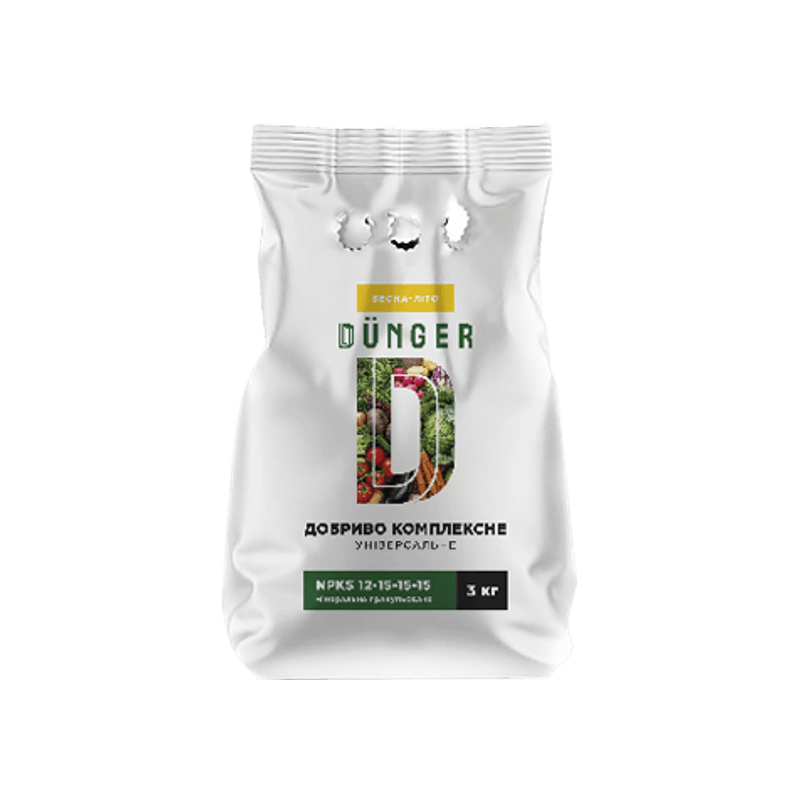
N 12%; P2O5 15%; K2O 15%; S 15%
Vegetable, legumes and greens: 20-40 gr/m²
This is the vegetable-group rate, not a separate garlic-only schedule. It is expressed per area, not per plant or per litre of water. Do not substitute the rates for other plant groups. Measure the required mass, account for earlier feeding and check the complete application method on the product page.
The granules come in 3, 4 and 5 kg packs; the canister also contains granules. Measure the actual treated bed area without paths before calculating packs. Save the bed area in My Garden. Keep earlier applications in your own garden notes.
To distinguish product composition from plant need, it helps to understand how nitrogen fertilizers work.
Common questions about spring garlic feeding
Colour does not provide a complete nutrient analysis, but it is also not a reason to add fertilizer without need. Consider growth, the history of the bed and soil information together. If plants are developing normally and nutrients have already been supplied, plan another inspection. You can calculate a future purchase without turning that calculation into an immediate application.
First account for the nutrients contributed by each product. A compound fertilizer contains nitrogen too, so a separate nitrogen fertilizer is not an unrelated addition. Do not mix products simply to save a watering trip. The application method and compatibility must be established for the particular products; a shared mention of garlic does not establish either one.
Record the condition before feeding and return to the same plants during later inspections. Compare new growth, soil moisture and the spread of symptoms rather than demanding a visible change within an arbitrary number of days. If deterioration continues, investigate the cause. Lack of an immediate improvement is not a reason to repeat the dose.


