


Growing roses from cuttings starts with keeping a piece of stem alive while it develops roots. Healthy material, an airy rooting medium and protection from overheating matter more at this stage than buying fertilizer. Begin with a small batch you can inspect every day. Judge progress by root development and the plant's ability to cope with normal air, rather than assuming that a new leaf means the job is finished.
What kind of rose will a cutting produce?
A cutting taken from the desired rose variety develops its own roots. A grafted nursery rose has a different arrangement: its roots belong to a rootstock. Your new plant may therefore grow differently from the parent, even when its flowers have the expected appearance. Successfully producing roots does not prove that the young bush will immediately match the size or resilience of the established grafted rose.
On a grafted plant, select material from the named variety above the graft, not from rootstock suckers. Locate the graft before cutting if you are unsure where a shoot originates. Label the variety or identify the parent bush immediately. Several short green stems can look remarkably similar once separated. Our guide to growing roses in the garden will help with the later choice of a permanent position, when mature size and light requirements become important.
Choose a growth stage, not one date for every garden
Softwood cuttings come from tender new growth and lose moisture readily. Semi-hardwood material is firmer, with developed leaves and a stem that has begun to mature. Hardwood cuttings use ripened growth during dormancy and usually require greater patience. These are different starting materials, so they should not all receive an identical routine. This guide focuses on managing a leafy cutting, while identifying the main differences for dormant wood.
In Ukraine, suitable timing depends on actual shoot growth, heat, frost and the conditions available for keeping pots. A sheltered propagation area and an exposed balcony may behave very differently during the same forecast. Prepare a safer location before taking cuttings if their cover will overheat by day or their leaves may freeze overnight. A late flush of soft growth does not automatically make an outdoor autumn garden suitable for a summer propagation method.
Select and prepare the stem
Inspect the whole parent plant first. Avoid shoots with blackened, damaged or dried sections and visibly unhealthy foliage. A healthy shoot that has become reasonably firm is useful for leafy cuttings; material from a stem that has recently flowered may be suitable. Postpone collection from a severely wilted plant. Keep fresh material cool and shaded while working, rather than leaving it on a dry bench while you search for equipment.
- Make a clean basal cut below a node, the point where a leaf joins the stem. Avoid crushing the stem with a blunt tool.
- Remove the flower or flower bud and the lower leaves that would be buried. Retain healthy upper leaves on a leafy cutting.
- Keep track of the base and the top. Orientation is particularly easy to lose when one long stem supplies several pieces.
- If using a rooting product, follow its own label. Granular fertilizer is not a substitute, and an extra quantity of rooting product is not automatically helpful.
- Make a planting hole in the prepared medium, insert the base and gently firm the medium around it. Keep the retained leaves above the surface.
Choose a container deep enough for the cutting without bending it or forcing its base against the bottom. Relate the length of your material to its nodes and the container. Keeping healthy tissues and correct orientation is more useful than making every piece look identical. Label each batch as you finish it. Trying to reconstruct the identity of several varieties the following day is an avoidable source of confusion.
Balance humidity with drainage
A leafy cutting continues to lose water before it has roots to replace that water. A clear cover helps reduce this loss, but it does not remove the need for drainage. Empty water collected in the saucer after watering. Heavy, persistently wet garden soil is not an appropriate choice simply because the mature parent grows in that soil outdoors. A small container holding an unrooted stem is a different environment.
Use bright indirect light and keep direct sun off the cover. A transparent bottle or bag can overheat. Look at the leaves, stem and rooting medium during inspection, and remove fallen dead foliage. Check moisture in the medium itself rather than judging everything by condensation on the cover. A slight change in the surface colour is not enough reason to flood the entire pot again.
Read the warning signs before changing the routine
- Leaves lose firmness. Check heat, drying and the cover. Wilted leaves above wet medium do not automatically mean more water is required.
- The base becomes dark and soft. Separate damaged material and inspect drainage and cleanliness. Feeding cannot correct a rotting base.
- The stem stays green but roots are not visible. Avoid dismantling the pot every day. Variety, stem maturity and conditions affect the time required.
- A new leaf appears. Continue careful management. Bud growth alone does not establish that the cutting is ready to transplant.
A label or separate notebook can record the variety, collection date and location. If a batch repeatedly overheated, its failure says little about how that variety might behave under suitable conditions. Correct the clearest problem first. Changing the medium, watering, location and every product simultaneously makes it harder to understand what went wrong and how to avoid repeating it with the next batch.
Move on only when roots have developed
Roots at the edge of a clear inner container can be observed without pulling the stem out. With other containers, assess development carefully and avoid breaking up the entire root ball for curiosity. A callus, the swelling of tissue at a cut surface, is not a branching root system. The plant needs developed roots before it can manage reliably as the cover is gradually removed.
Increase ventilation progressively and watch whether leaves remain firm. Do not move a newly uncovered pot straight into a sunny, windy position. Transfer rooted plants gently into individual containers, protecting their young roots. Choose outdoor planting conditions without frozen soil, waterlogging or severe drought. A weak plant may need further growing on before it is ready for a permanent flower bed.
Plan the first winter before cold weather arrives. A small pot is not equivalent to an established rose rooted in the ground. Consider the variety's hardiness, root development and available shelter. The parent's survival outdoors does not make an exposed balcony suitable for a young leafy cutting. Moisture still needs attention during cold weather; protection should not turn the container into a permanently wet sealed package.
Feeding after the young rose becomes established
Once the cutting has developed into an established bush, consider nutrition separately from rooting. Age, size, season and the growing medium all matter. Explore fertilizers for roses for the appropriate stage of care. Different products are choices to assess, not a list of ingredients that must all be applied together.
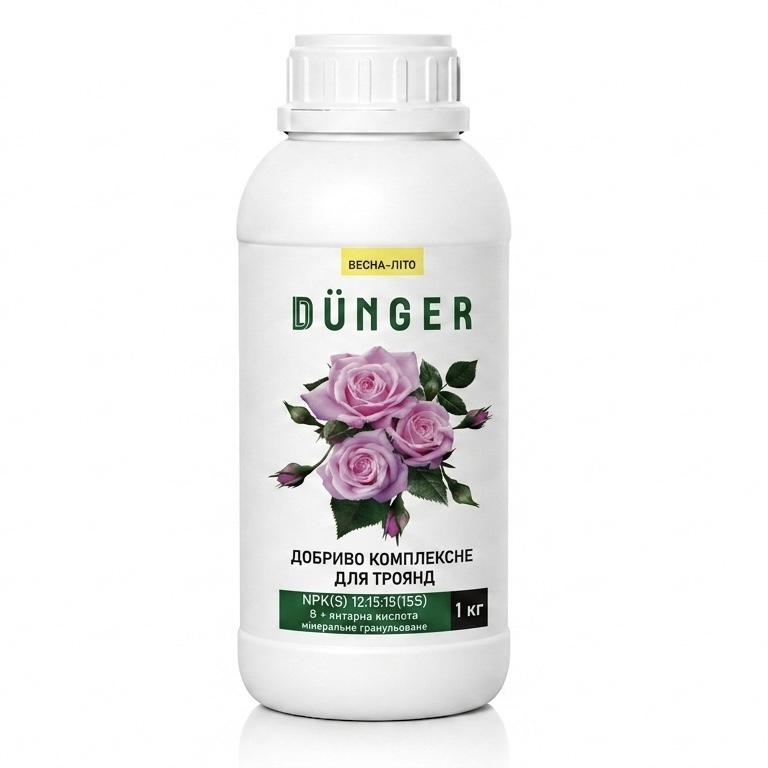
Complex fertilizer for roses granular
DÜNGER compound granular fertilizer for roses in 0.5 and 1 kg packs. Select the pack weight, check the price of that option and review the composition and instructions.
The instruction row for established bushes reads: Roses: 20-40 g under the bush. This is not a dose for an unrooted cutting or a tiny propagation cell. Do not invent a reduced dilution from it. Review the full application method and conditions on the product page before deciding how to use it.
In My Garden, you can save a zone for your established roses, its crop and measurements, and plan pack sizes. Do not count a tray of unrooted cuttings as mature bushes requiring fertilizer. Match the purchase to plants that are actually ready for the relevant care.
Common questions
You can experiment with a fresh, healthy stem, but the variety, storage history and suitability for an outdoor garden may be unknown. Material from a known healthy bush offers a clearer starting point. Rooting success alone does not establish winter hardiness.
None is needed for the method described here. Prepare an appropriate medium, drainage, indirect light and moisture control. If you choose a rooting product, follow its instructions without adding homemade mixtures.
There is no universal deadline. Root development and the leaves' response to ventilation guide the transition. Remove the cover gradually rather than following a fixed date or treating the first new leaf as proof of readiness.


