


Before buying, note the species and cultivar, planting location and measured soil pH. Then assess drainage and the mix composition. Deal with nutrition separately: soil, mulch and fertilizer serve different purposes. This sequence helps you choose material for a particular plant instead of collecting additives solely because their packaging shows a hydrangea flower.
Identify the hydrangea first
A garden may contain bigleaf, panicle, smooth and other hydrangeas. They should not all be assigned the same flower-colour treatment. In bigleaf hydrangea, Hydrangea macrophylla, and mountain hydrangea, H. serrata, the colour of suitable cultivars is related to acidity and aluminium availability. Panicle, smooth and oakleaf hydrangeas do not change flower colour in the same way in response to soil pH.
Consequently, asking which soil will turn a hydrangea blue makes sense only after identifying the plant. Blue flowers in appropriate bigleaf and mountain cultivars require acidic conditions, including pH below 5.5, and available aluminium. A number printed on a bag cannot guarantee the colour. If you are growing a white panicle hydrangea, do not acidify it simply in the expectation of blue flowers.
Test before changing the pH
Appearance cannot reliably establish soil acidity. A dark colour, needles on the surface or the words “garden soil” do not replace a measurement. Use a test according to its instructions or send a sample to a laboratory. Ask how to collect and prepare the sample, particularly when investigating a planting hole, a container or a garden containing several different soil types.
Label where every sample came from. Do not mix potting material with soil from a neighbouring bed if you want to understand conditions around the hydrangea itself. Report recent fertilizer, lime or organic-matter applications, because these can affect the interpretation of a test. Keep the date and testing method so that later comparisons are useful rather than a collection of unrelated numbers.
If acidity needs adjustment, select a product intended for that purpose using the test result and its instructions. The same amount of amendment affects sandy and clay soils differently. Do not calculate an acidifier dose from flower numbers or pack size. Very lime-rich soil is difficult to keep acidic; a container with a suitable growing medium may be more practical for the cultivar you want.
Garden soil: moisture without standing water
Hydrangeas appreciate moist soil, but this does not mean choosing a waterlogged site. Inspect the future bed after rain. Check whether a path directs water towards it and whether water stands at the shrub's base. If runoff is the problem, select another position or address water removal first. Even a good bag of growing medium cannot by itself correct a site that is repeatedly flooded.
Organic matter helps improve soil conditions. Use mature compost and suitable soil conditioners while considering the original soil. Avoid relying on a universal homemade recipe with fixed proportions of components whose characteristics you do not know. Peat, compost and bark from different products can have different properties. First identify the task: compaction, low organic matter, drying out or an unsuitable pH.
At planting, keep the surface of the rootball level with the surrounding soil. Excessive depth does not provide better root protection. Prepare the position for the cultivar's eventual size and leave access for watering. Do not estimate its future space requirements solely from the small transport pot in which the nursery plant arrived. Check the label before deciding how closely to arrange several shrubs.
Containers need a container growing medium
Garden soil and a prepared potting mix are not interchangeable. Ordinary garden soil in a pot can become compacted and provide poor aeration and drainage. Choose a mix intended for growing plants in containers. If you want to retain blue flowers on an appropriate hydrangea while gardening on alkaline ground, an ericaceous container medium is a suitable option to consider.
Check the drainage holes and the position of the pot. It should not remain standing in water inside an ornamental outer pot or saucer. After watering, make sure surplus water has somewhere to go. Do not compress the mix into a solid mass to fit in the whole bag. Plan space for the rootball and watering before filling the container, then position the plant at the right level.
Check a container hydrangea frequently, especially in hot weather. Water demand depends on sunlight, shrub size, container and growing medium. A dry surface does not prove that the entire root zone is dry. Check moisture below the upper layer and observe the plant. A small pot in sunshine and a large container in shade should not automatically receive an identical watering schedule.
Read the bag before buying
The description “for hydrangeas” helps identify a category but cannot replace specifications. Check the intended use, stated pH, ingredients, volume and any added fertilizer. If it is a material for improving garden soil, establish how it should be used. If it is a ready potting medium, read its filling and aftercare instructions. A homemade mix also requires information about each component.
- Identify the hydrangea species, cultivar and growing location.
- Compare the soil test with your planting objective.
- Check site drainage or the container's outlets.
- Compare mix specifications, volume and nutrients already added.
- Keep the product name so that you can track subsequent care.
Calculate growing-medium requirements from the space you actually need to fill. In a pot, the rootball occupies part of that space. Growing-medium volume in litres and fertilizer mass in kilograms are different purchasing units. Do not substitute one for the other or treat the weight of a fertilizer pack as the amount needed by one shrub. Decide which quantity you are calculating before comparing packages.
Compare similar bags on the same basis
Place the specifications alongside one another and compare intended use, acidity, composition, volume and added feed. A complete growing medium and a single ingredient are different purchases. Where instructions are unclear, ask how the material is meant to be used before ordering it. Keep a photograph of the label so that it is not confused later with another product carrying a similar name.
What to prepare in autumn
Autumn is useful for checking runoff after rain, recording the site's characteristics and deciding whether you need a container or another position. Do not plant into frozen or excessively wet soil simply to complete a calendar plan. If a dedicated acidifier is needed, do not expect an immediate change: elemental sulphur acidifiers act more slowly in cold soil. Time the follow-up test according to the product and conditions.
For an established hydrangea, separate observation of the site from a decision to transplant. Compare test results, moisture after rain and the care history. If conditions suit the plant, the appearance of a new growing medium for sale does not create a need to replace the soil. Plan an action for an identified problem before considering a complete reconstruction of the bed.
Nutrition after choosing the soil
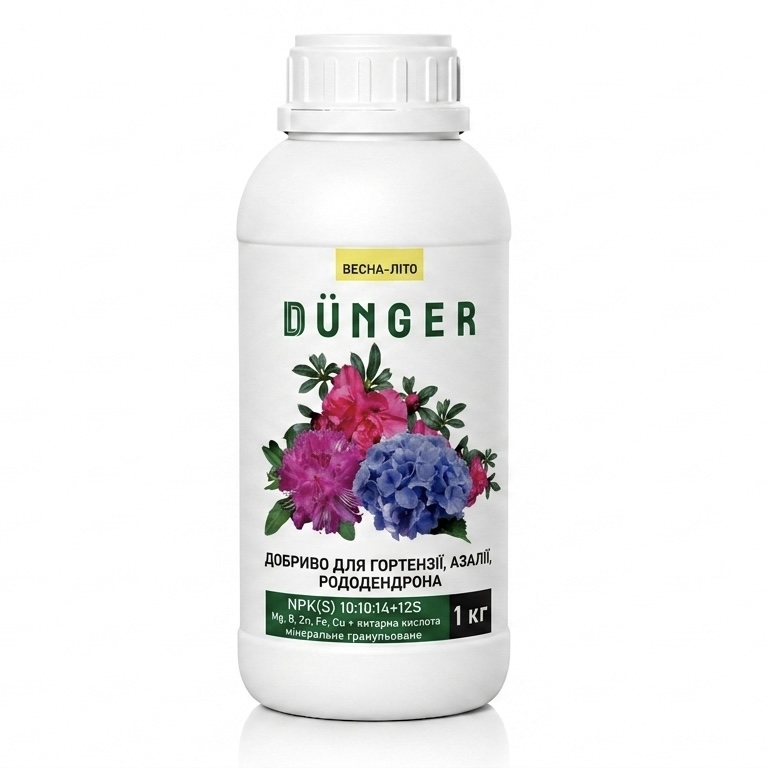
Complex fertilizer for hydrangea, rhododendron, azalea granular
This DÜNGER complex, in 0.5, 1 and 5 kg packs, is an option for hydrangea nutrition. Assess the plant and any feed already present in the growing medium before applying more. Even when preparing a planting site in autumn, follow this product's stated spring and summer period. Its full application method is:
The complex is used in spring and summer, before planting shrubs, as well as for fertilization. The fertilizer is evenly distributed on the soil surface along the stem circle of the plant, departing from it by 15-20 cm or added to the hole during planting. The application rate is determined taking into account the size and age of the bush. The soil should be moist during fertilization. The first feeding is recommended immediately after waking up (after the snow melts), when the shoots appear after spring pruning; subsequent feeding at the beginning of budding.
Mulch and observation after planting
Organic mulch helps retain moisture. Spread it around the shrub while leaving a clear gap at the base. Do not bury the stems, and do not assume that mulching proves the pH has reached your target. Check the soil beneath the mulch when deciding whether to water, particularly when the upper surface of the material looks dry but the root zone may still be moist.
If leaves become yellow or the shrub wilts, check moisture, drainage, the root zone and previous applications. Leaf appearance alone does not reveal a required acidifier dose. Keep photographs and test results for a focused consultation. Replacing the medium with something even more acidic without understanding the cause can leave the actual problem unresolved. Identify the conditions before selecting a correction.
Questions about choosing hydrangea soil
No. Consider the species, cultivar, starting pH and growing objective. Blue flower production applies to particular hydrangeas and is not a universal requirement for every shrub. Compare the actual specifications with the plant you have identified.
Fertilizer supplies nutrients according to its instructions. Compaction, standing water and an unsuitable container need separate attention. Choose nutrition after checking root-zone conditions, rather than treating every problem as a shortage of feed.
Compare each plant's requirements. Sharing a bed does not establish identical acidity and moisture needs. In a mixed container, select companions with similar growing requirements so that one watering and nutrition plan can suit the planting.
