


Assess the original fertilizer application, soil, water and growth stage before feeding potatoes again. Foliage height alone does not determine a dose. Weak plants can have several causes, while abundant green growth does not prove that more nitrogen is needed. First establish the task that additional nutrition should address in this particular planting.
For an existing crop, distinguish feeding from preparation of a planting hole. If a product was applied in spring, include it in the previous nutrition history. Do not restart the calculation from zero at each new stage. A potato designation on a package does not allow unlimited repetitions throughout the season.
Gather information before choosing
Record the cultivar, or at least maturity group, emergence date, plant condition and previous applications. Have the planting area and product names available, rather than only the weight of the most recent bag. Include compost and other materials used before planting. This helps avoid duplicating nutrients already supplied to the ground.
Assess separately any areas with different previous crops or preparation. Do not average a weak wet corner with a dry raised section simply because both belong to the potato plot. For an initial review, see assessing soil before adding fertilizer. Keep the test information connected with the area it actually describes.
Growth stage matters more than a date
Early canopy development, tuber formation and final maturation do not represent identical plant needs. Late in the cycle, keeping foliage green at any cost is not an appropriate goal. More nitrogen may be unsuitable when a cultivar is finishing growth. Consider the crop together with its planting time, maturity and weather during this season.
Counting days from emergence does not explain everything either. Two plantings of the same age can differ after contrasting temperatures, moisture and soil preparation. Avoid prescribing a universal application on a particular day without checking need. Nutrition should follow the plant and site, rather than only a calendar reminder.
Why excessive nitrogen is undesirable
Too much nitrogen can encourage foliage and delay tuber initiation and maturity. Greener plants are therefore not a sufficient feeding objective. If a compound has already been used, review its composition before adding a second product. Fertilizers with different names may supply the same nutrients and should not automatically be combined.
This does not mean potatoes need no nitrogen. They need nutrition appropriate to their conditions. Poor growth also deserves investigation, beginning with obvious water, soil and plant-health concerns. Avoid treating the choice as either no fertilizer or the highest possible amount: establish the need and the selected product's suitable application.
Check water and the rooting area
Drainage and adequate moisture matter during potato growth. Prolonged drying, waterlogging and irregular watering are not corrected simply by another portion of granules. Check beneath the surface and compare several locations. Inspect lower parts of the plot particularly carefully where rainfall collects and conditions differ from the rest of the bed.
Wilting is not automatically hunger. Consider recent rain, irrigation, heat and the root environment. Avoid digging up many plants simply for reassurance; begin with an overall inspection and careful soil checks. Suspected disease needs identification rather than an attempt to treat it with fertilizer. Nutrition and plant protection serve different purposes.
Use the particular product's instructions
The compound below is intended for potatoes. Its instructions describe use before sowing and for fertilization. Keep the precise method and units. A planting-hole amount does not become a watering recipe for an established plant, and an area rate is not the same quantity for each bush.
A compound for the potato plot
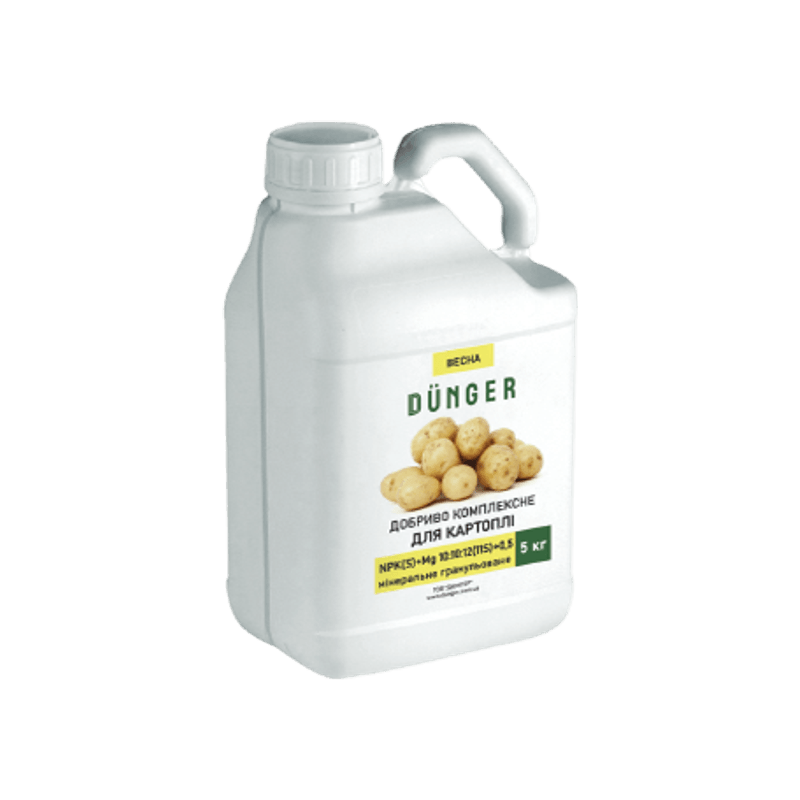
Complex fertilizer for potatoes granular
Match the need to earlier inputs and potato stage. Below is this compound’s own application method. The hole quantity concerns planting; do not use it as an improvised watering dose.
Apply fertilizer before sowing, as well as for fertilization. The complex is evenly distributed on the surface of well-loosened soil, make a scattering on the site at a rate of 20-30 g / m2 or in planting holes (3-5 g / hole ~ 1 teaspoon), taking into account the size and depth.
Potatoes and other root crops (carrots, beets, turnips, colery): 20-30 g/m²
The 5 kg pack contains granules. Choose pack count after identifying the area and task, rather than trying to use the whole bag in one application.
Begin the calculation with the area
Identify the part of the planting requiring the chosen application. The whole vegetable garden and potato area are not necessarily the same size. Prepare separate zones where care histories differ. My Garden can store the crop, zone, measurements and product plan, helping keep potatoes separate from other beds when preparing a purchase.
If the earlier amount is unknown, mention that when seeking advice. Do not replace missing information with an assumption that nothing was applied. Check remaining packages, your own records or details from the person who prepared the ground. Then discuss any additional product and required weight using the information available.
Three situations need different decisions
No fertilizer was added before planting
This is useful background, but not a ready-made dose. Review soil condition, the previous crop, organic inputs and plant stage. Nutrients may have been available without a separate mineral fertilizer package. Choose application from actual need and the complete instructions, rather than compensating for a missed spring job with an arbitrary summer quantity.
The canopy is dense but the crop worries you
Do not add nitrogen simply to maintain a green-looking plot. Review previous applications, cultivar and stage. Foliage size alone does not establish the number of tubers. Feeding cannot guarantee the desired harvest, particularly where weather, moisture or plant health is the limiting factor. Keep your expectations connected with what can actually be checked.
Foliage turns yellow near the season's end
Distinguish normal maturation from premature injury. Consider cultivar maturity, earlier appearance and the pattern of change. Where a problem is suspected, retain an overall view and close details for diagnosis. Additional nutrition is not a universal way to return green colour to plants that are completing their natural growth cycle.
Ukrainian conditions and seasonality
Light soils in Polissia differ from heavier ground or sites with restricted watering. Do not infer a rate from the region's name alone: you need your actual soil, previous care and weather. Early and later plantings also do not reach the same stage on one calendar date. Use local conditions when discussing a plan.
This guide concerns the growing season, not a recommendation to feed potatoes in November. After harvest, review the season and prepare the next planting plan. Starting times are discussed separately in when to plant potatoes. The question here is the nutritional need of an existing crop, rather than repeating the planting process.
Prepare a clear purchase request
Give the exact fertilizer name, area, plant stage and known earlier inputs. Mention if only one section of the plot is being considered. Keep the desired package count separate from the rate: buying a larger quantity does not mean applying it all. Ask about current price and receiving arrangements when ordering, rather than assuming a stored price remains current.
If comparing alternatives, read each product's own method and composition. Do not transfer the potato compound's rate to a different fertilizer merely because both list potatoes. Keep granules in their identified original packaging so that the intended use can be checked again before the next season. An unidentified remainder cannot support a reliable calculation.
Frequently asked questions
Review soil, water, previous applications and stage first. No composition guarantees tuber numbers independently of those conditions. Compare potato fertilizers and their own instructions when choosing a suitable product.
Do not turn a dry application into an improvised liquid feed. Hole, area and water volume describe different tasks. Follow a method explicitly provided for the particular product rather than adapting somebody else's recipe.
No. Consider maturity, water and possible injury. Clarify unexplained symptoms first. More nitrogen without assessment may be inappropriate, especially near the end of growth when maintaining green foliage is not the objective.
This product is supplied as granules in a 5 kg pack. Match the required weight to the chosen application area and confirm current price and receiving arrangements when ordering. A large package is not an instruction to use everything immediately.


