


Feed lavender after assessing need, rather than because a fertilizer bag shows flowers. Established plants in suitably prepared soil often need no additional nutrition. When feeding is justified, choose a product intended for lavender and follow its own method, stage and units. Granules applied to a planted area do not become an arbitrary dose per bush or a homemade watering solution. Start with the plant and the ground before deciding what to buy.
Check conditions before choosing nutrients
Lavender needs sun and a freely draining root environment. More fertilizer cannot create those conditions in shade, a wet hollow or waterlogged heavy soil. Inspect the site after rain and check the drainage of containers. Consider whether nutrition explains the problem. One weak plant in an otherwise healthy row needs individual investigation, rather than an automatic increase in the amount applied to every bush.
Distinguish the natural grey-green foliage of the cultivar from a recent change in colour. Paleness, wilting or missing flowers does not diagnose nitrogen or potassium deficiency. Compare the whole plant, moisture conditions and the history of the site. Adding several products together to cover every possible deficiency makes it harder to understand what the roots have already received. Keep the decision specific enough to check later.
Lean soil does not automatically mean depleted soil
Lavender is adapted to relatively low fertility. A programme used for a heavily fed flower border does not transfer automatically. Excessive nitrogen can favour vegetative growth. This does not mean lavender needs no nutrients at all; it means that a reason for adding them matters. Consider the existing supply and the conditions in which the selected fertilizer will be used.
Review planting amendments, compost, slow-release granules and feeding for neighbouring crops. Soil analysis helps distinguish an assumption from measured need. Use the soil assessment before feeding to prepare your checks. Report recent additions when submitting a sample. A number without the history of amendments can be misleading, particularly when you are comparing recently prepared ground with an established planting.
Young plants, established shrubs and containers differ
For a young lavender, establish the planting date and what is already present in its medium. Do not invent a smaller adult dose for a little seedling. The product below has its own interval after sowing or planting. Moving a pot or watering the plant does not restart that interval. Keep the original information available rather than trying to reconstruct it when the plant looks different.
For an established bush, check need and growth stage. For container lavender, also establish whether you can carry out the stated method and identify the relevant area correctly. Restricted root volume does not authorize a stronger concentration. If the method is unclear for your container, ask before purchasing. Do not turn an area-based instruction into litres of solution or a dose based on pot volume.
Choose timing from conditions and instructions
Consider the species, plant condition, permitted product season and local weather. A cool, wet northern or western Ukrainian site may differ from a sheltered, drier southern position. Even neighbouring sunny slopes and shaded hollows are not equivalent. A region name alone cannot identify the day for feeding. The plant and root environment need to fit the intended use as well.
Do not transfer an active spring or summer programme into late autumn because fertilizer remains in the pack. A plant slowing before cold weather does not need stimulation merely for one final application. The end of flowering is not an automatic instruction to begin another cycle. Use lavender flowering seasons to understand species and flowering differences, while keeping the presence of flowers separate from a diagnosis of nutrient shortage.
A granular complex for lavender
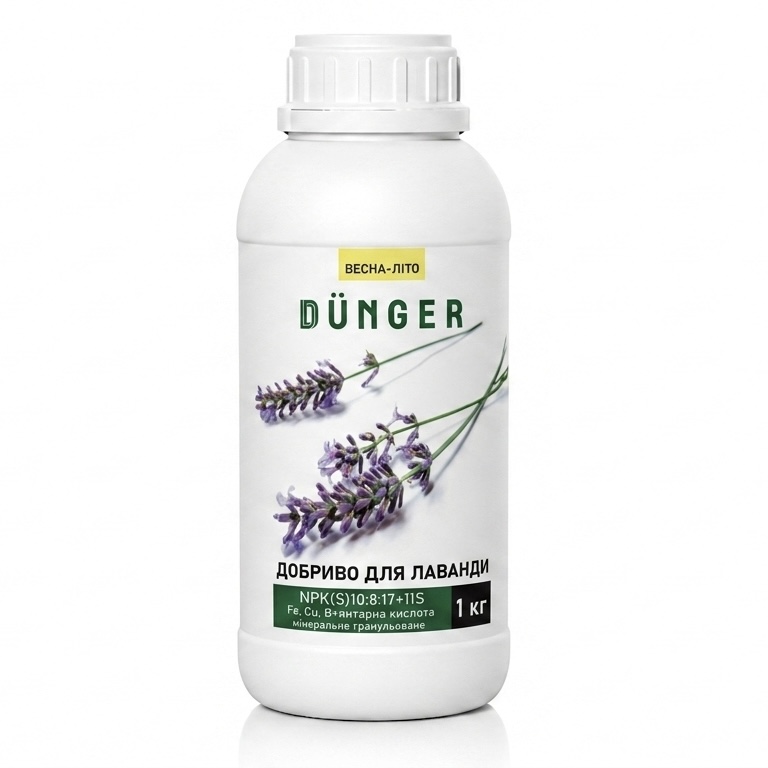
Complex fertilizer for lavender, granular
For a justified application, consider this dedicated compound. The full method and plant-group rate follow. Match them to the actual stage and permitted season rather than treating every newly purchased plant automatically.
Choose the 0.5 or 1 kg pack after measuring the area and establishing the amount for one application. An opened pack does not need to be emptied. This is a soil application, not a homemade dissolved feed. Clarify an uncertain container method before purchasing and check the selected pack when ordering.
Measure the planted area rather than count bushes
Divide a lavender border into manageable sections and measure the area intended for the application. Do not count the entire nearby lawn if it is outside that treatment zone. For an irregular bed, draw a simple plan with dimensions first. Plant numbers describe the planting, but they cannot replace square metres in this product's rate. Decide what you are measuring before opening the fertilizer.
Calculate the amount for one permitted application and compare it with the pack weight. Do not divide a full pack equally between bushes when its weight does not match your area. There is no requirement to use the remainder immediately. Buying a larger pack does not change the rate. A handful is not a reliable measure of mass, even when the granules appear evenly sized.
Prepare one application with the units intact
- Check the product identity, packaging condition and complete instructions.
- Match the lavender's stage to the permitted use and account for previous amendments.
- Identify the area and weigh the required amount with suitable separate equipment.
- Follow this compound's soil application method without homemade dissolving or mixing.
- Keep the label and actual amount in your own notes for the next decision.
In My Garden, define a zone, crop and measurements and prepare a fertilizer plan. Separate lavender from lawn, rhododendrons and vegetables even when they grow nearby. Keep actual application records and observations in your own notes. A purchasing plan should account for products already used, rather than create an obligation to apply everything ordered. Compare the planned area with the actual border before ordering packs.
Assess changes without chasing a rapid result
Do not judge success only by counting new flowers after an arbitrary number of days. Cultivar, light, season and root condition still affect the plant. If it deteriorates, first check for a unit error, duplicated products or standing water. Do not answer an uncertain result with another, stronger dose. Fertilizer is not a treatment for every cause of dying shoots, and changing several conditions at once can make the cause less clear.
More nutrition does not turn old bare wood into a young plant. Treat shape as a separate question using spring lavender pruning. Avoid combining drastic cutting with an experimental feeding dose when the plant's condition is unknown. For neighbouring crops, compare the landscape fertilizer range and read each product's own method. Similar-looking granules need not have the same application instructions.
Prepare the information needed for an order
Have the planted area, the number of young and established plants, the medium name or soil analysis and the products already used available. This supports a comparison of actual products instead of a search for the strongest flower feed. Check the selected pack and availability when ordering. Do not substitute an unrelated liquid product without reading its complete instructions and checking whether it suits the crop and intended use.
Questions about feeding lavender
No. Need may be low in suitable, prepared soil. Check growing conditions, existing nutrition and the plant before deciding whether another application is justified.
The displayed compound uses an area-based rate. Do not replace that unit with plant numbers. Establish the application zone and follow the complete method.
That result is not guaranteed. Excess feeding can be inappropriate, while shade and root problems are not solved by increasing the dose. Keep within the instructions.
The remainder does not determine timing. Consider the permitted season, lavender stage and local conditions. Do not automatically transfer active-growth feeding into preparation for cold weather.


