


Feed clematis after assessing the soil, previous additions and the plant itself. An established vine in fertile ground and a clematis confined to a container do not need identical decisions. For a garden planting, a compound fertilizer with genuine instructions for flowering and ornamental plants is an option. Choose it for its method and an identified need, rather than a promise of immediate flowers. An extra portion cannot repair broken stems, inadequate light or root problems.
Decide what feeding is meant to address
Before buying, identify the reason: the ground has not been assessed, the growing medium's nutrient charge is unknown, a container plant is actively growing, or a soil result indicates a requirement. Wanting more flowers does not identify a missing nutrient. Clematis in fertile open ground does not automatically require regular extra fertilizer. Establish that there is a feeding decision to make before selecting the product.
Find the cultivar name and its expected vigour. Large-flowered and small-flowered types differ, so another grower's generous programme should not be copied to every vine. Overfeeding can also accompany abundant foliage without the display you wanted. Consider plant stage and growing conditions as well as stem length. The tallest plant nearby is not a reliable standard for an unfamiliar cultivar.
Account for what is already in the root area
Check how the planting soil was prepared, whether purchased growing medium contains a starter feed, and whether neighbouring flowers have already received fertilizer. Where several products reach one root area, a different pack name does not make the next portion independent. Account for additions over the same ground. For a recent purchase, ask the seller about the growing medium and recent feeding.
Compost, organic amendments and mineral fertilizers do not have identical properties. Do not subtract an arbitrary amount from a rate because a bucket of unidentified material was added earlier. When the history is uncertain, clarify it and assess the soil rather than layering complete programmes. A separate personal list of previous additions can help you make a more consistent purchasing decision.
Distinguish garden soil from a container
A soil test helps identify feeding needs more precisely than a leaf's appearance alone. Where beds differ in history, imported soil or management, do not assume one result describes the entire garden. Start with the guide to assessing soil before fertilizing. Tell the laboratory which crop grows in the sampled area and follow its sampling requirements.
A container has a restricted root volume, making growing-medium composition and previous nutrient additions particularly relevant. Do not independently convert a square-metre rate into an amount per litre of potting medium. Choose a method with suitable container instructions for a potted clematis. Keep beds and containers as separate zones in the purchasing plan, even where they contain the same cultivar.
Use growth stage and local weather
Plan feeding during active development and according to the chosen product's method. Spring growth beside a warm wall in southern Ukraine may differ from growth on a cool northern or western site. Check the plant and ground rather than copying a date. A neighbour's timetable does not establish whether your own planting is ready for the proposed application.
Do not try to make a vine catch up with summer by feeding late in the season. With heat stress, a dry root ball, waterlogging or damage, address the relevant problem first. If a stem suddenly loses firmness, inspect its integrity and root conditions. Adding several products at once makes the original problem harder to interpret and does not establish that feeding was needed.
Product form determines the method
Granules, liquid concentrate and ready-to-use solution are different forms. Check where each goes, what quantity is measured and the unit to which the rate refers. A quantity per area and an amount per volume of water describe different operations. Do not make a granule solution using another liquid product's recipe unless the granule's own instructions provide that method.
Compare purpose, form and application in the fertilizer catalogue. Universal does not mean an identical rate for every plant group. Likewise, absence of the word clematis from a product name does not rule out suitable instructions for flowering and ornamental plants. Match the actual instruction group with the conditions in your planting.
An option for the ornamental-plant group
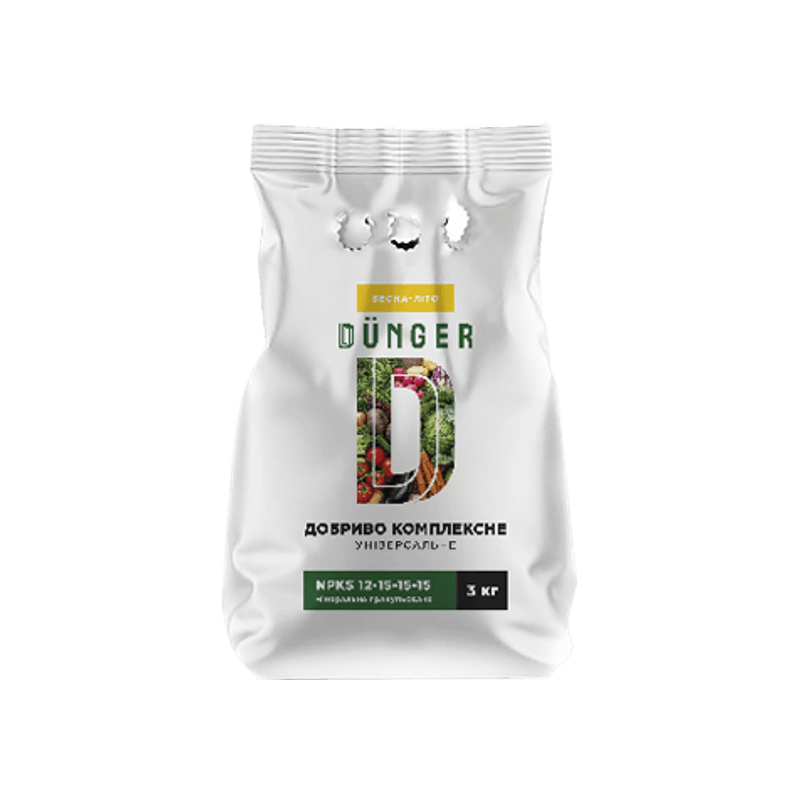
Complex fertilizer universal granular
This granular product has a separate flowering and ornamental crop rate. For garden clematis, that is a group rate, not a special portion per vine. Assess soil fertility and previous additions first. The complete method also covers other uses; seed-row or seedling directions do not replace the relevant adult plant group.
DÜNGER universal compound fertilizer granules for vegetables, legumes, leafy greens and ornamental plants. Available in 3, 4 and 5 kg packs.
Apply fertilizer before sowing or planting, as well as for feeding. Fertilizer is evenly distributed in the aisles or over the soil surface, applied to rows (when sowing seeds - 2/3 g / running meter of a row) or planting holes (for seedlings up to 3g / plant).
Floral and decorative crops: 30-40 gr/m²
Pack options are 3, 4 and 5 kg. The canister contains granules, so its mass is not a concentrate volume. Compare the required amount with the measured ground area and check the selected option on the product page. Do not improvise a pot-volume conversion.
Prepare an application without extra portions
Identify the area covered by the selected rate and measure the required mass separately from the full pack. Divide an irregular bed into manageable areas first. Do not count a strip shared by clematis and neighbouring flowers twice. Directions for seed rows or young seedlings do not become a special portion for an established vine because of its height or age.
Arrange access to the ground without pulling at the stems, and avoid making a heap of granules at their bases. Follow the stated distribution method. Where mulch prevents you from seeing the surface, arrange controlled access before measuring out the application. Afterwards, retain the product identity and keep the remainder in its original labelled packaging, apart from household food.
Choose a pack for the intended area
Compare the required mass for the intended application with available pack options. A larger pack does not change the rate or require the whole contents to be used at once. Confirm pack quantity, collection or delivery and ordering conditions on the product page. Do not buy a season's supply before establishing the area and whether other plants actually need the same product.
My Garden lets you define zones, crops and measurements and create a product plan. The separate guide to clematis care in the garden covers the wider questions of watering, support and growing conditions. Here the purchasing decision is whether an application is needed, whether its method suits the planting, and how much product to obtain for the measured ground.
Questions about feeding clematis
No. Check the cultivar, its normal flowering period, light and previous pruning. Removing the wrong growth can remove future flowers; extra feeding does not automatically replace them. Exceeding the product instructions is not a useful test of the reason for a missing display.
Not necessarily. Its growing medium may already contain nutrients. Ask the seller, assess the root ball and decide where it will grow next. A newly purchased pot is not equivalent to unamended soil, so start with information about the plant rather than an automatic addition.
An unknown composition cannot be equated with a defined fertilizer. Do not convert the specified mass into cups of ash, kitchen scraps or arbitrary infusions. Choose a clear approach based on need and the product's own instructions, without unverified mixtures or doses borrowed from another material.
No. For this product, the canister is a packaging option for granules. Check the exact name, form and pack mass. Container shape does not determine the application method and is not a reason to measure a granular product in millilitres.


