


A single flower bed benefits from a clear care plan; a larger rose garden also needs records for separate areas. Fertilizer should fit that plan. If flowering is poor, establish whether nutrition is the problem. Choosing a formulation does not replace checking light, moisture, root condition and the health of the plants.
Roses differ: identify your growing situation
New plants and established bushes
Before buying, record whether the plants are newly planted or established, their approximate size and age, and what has already been added. A product with a per-bush rate should not be assessed only by the overall size of the flower bed. Instructions may describe planting and later feeding as separate uses, with conditions that must be checked individually.
A new rose needs a suitable position, watering and careful handling of its roots. Do not automatically combine every available starter product. Check whether the growing medium already contained fertilizer and whether an addition was made in the planting hole. Later nutrition must account for that work rather than starting the calculation again whenever another product is purchased.
Once-flowering and repeat-flowering roses
Rose types differ in their growth and flowering habit. Some have one main display, while others repeat. A missing second flush is not by itself evidence of a fertilizer shortage if the variety does not normally produce one. Keep the plant name and its description so that normal development can be distinguished from a care problem.
Groundcover roses also need assessment by the individual plants and conditions. A continuous canopy does not turn several bushes into one plant for feeding calculations. If their number is uncertain, check the planting plan. Do not convert a per-bush instruction into an area rate without appropriate directions for doing so, even when stems spread across the whole bed.
Check soil, watering and the reason for poor flowering
A soil analysis helps establish nutrient supply and acidity. Unneeded phosphorus or potassium does not become useful because a fertilizer has an attractive name. Take earlier mineral fertilizers, compost and manure into account. Where you have test results, ask for an interpretation relevant to roses and the way they are being grown rather than borrowing another garden's programme.
Roses need a suitable position and well-drained soil. Too much shade can reduce flowering, while inadequate or excessive moisture can affect plant condition. Examine the site first. Strong shoots with few flowers do not always indicate a need for more nutrition: excessive fertilizer can also contribute to poor blooming. Assess what the plant is actually showing before buying another feed.
Spots, surface coatings, distorted shoots and leaf damage need separate investigation. Do not label every yellow leaf as a specific nutrient deficiency. Inspect both leaf surfaces, compare neighbouring plants and record when changes appeared and what was recently applied. This information helps determine the next action without layering random products onto a problem whose cause is still unclear.
Mulch and fertilizer serve different purposes
Mulching helps retain moisture and suppress weeds, while organic materials can also influence soil condition. Account for this care alongside plant nutrition. A layer of mulch, however, is not a measured rate of a particular compound fertilizer. Do not assume its composition matches a product with a declared nutrient analysis.
Compost and other organic inputs can contribute nutrients, although the quantities may be uncertain. Record the material and where it was used. Assess the whole management of the bed before introducing another fertilizer. The natural origin of one input does not remove the need to consider the total nutrient supply from all products and materials.
Read the composition without confusing it with the dose
N denotes nitrogen, while P and K denote phosphorus and potassium. Fertilizer declarations commonly express phosphorus as P₂O₅ and potassium as K₂O. Use the same declaration basis when comparing products. Percentages describe the material itself. They do not tell you how much of that material to apply beneath each rose, or how to prepare a solution.
Additional nutrients on a label do not establish a need to duplicate them with a separate product. Begin with the complete composition and a justified requirement. The highest phosphorus percentage does not automatically make a fertilizer the best choice for every rose. Consider nutrition as a whole, including all earlier inputs and the conditions in which the roots function.
Nitrogen supports vegetative growth, phosphorus participates in energy processes and potassium is involved in water regulation and enzyme activity. Plants need an appropriate combined supply. A description of a nutrient's function does not establish that the soil is deficient in it or determine how much fertilizer should be added to your roses.
Granules or liquid: choose around the work
A granular fertilizer may suit a soil application under its own instructions. A liquid concentrate needs accurate dilution, with the method checked separately. The shape of the bottle does not establish its contents: a bottle can contain granules. Read the product-form description and the pack unit before assuming that a container is holding a ready-made liquid feed.
Do not assume every granule is a controlled-release fertilizer. That property must be stated for the particular formulation. Likewise, a liquid product is not automatically suitable for spraying foliage. If you need a particular application method, find it in the complete directions before buying rather than after the pack is open and the work has already begun.
Plan the season around plant development
Care tasks can differ during spring growth, after a flowering flush and towards the end of the season. In Ukraine, local growing conditions and the actual stage of the bush matter. Do not assign the same application date to every region. The intended period and method of the selected product remain the starting point for any plan.
Do not continue a summer feeding programme automatically late in the season. Encouraging soft new growth before cold weather can be undesirable. A seasonal product requires its own composition and instruction checks. The presence of potassium does not make every fertilizer an autumn feed, and a similar purpose does not justify borrowing the rate from a different formulation.
How to grow roses involves more than fertilizer. Watering, soil, appropriate pruning and the variety's characteristics belong together. Record the product, quantity, date and treated area for each application. This is particularly useful when several people maintain a rose garden or when you compare bushes growing in different places. A clear record helps you assess what has actually changed.
A DÜNGER compound fertilizer for roses
Complex fertilizer for roses granular
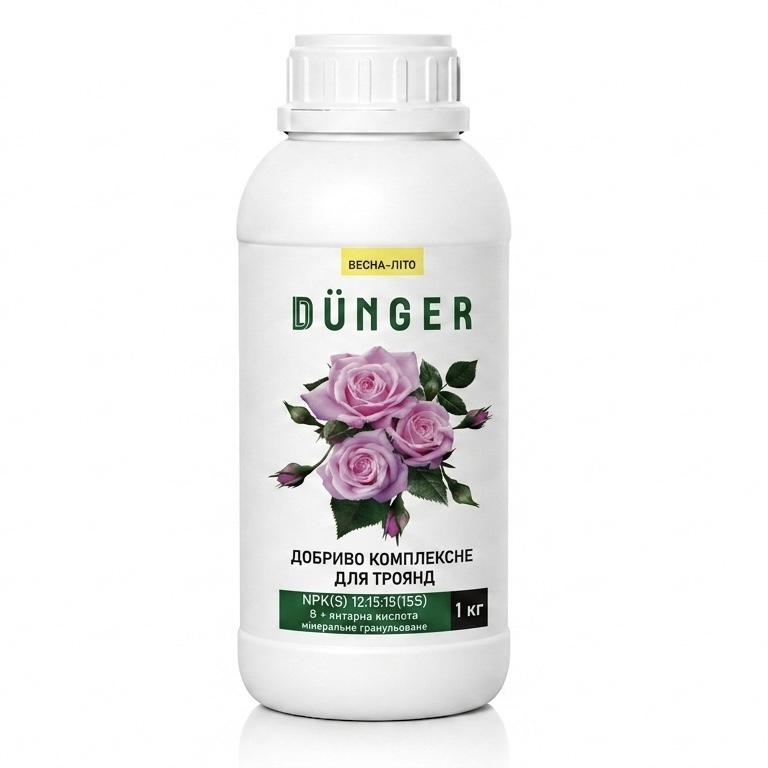
This product is intended for roses and comes in 0.5 and 1 kg packs. Check the full instructions, bush size and age before choosing the quantity. Its declared element list is:
- N - Nitrogen: 12%
- P2O5 - Phosphorus: 15%
- K2O - Potassium: 15%
- S - Sulfur: 15%
- B - Boron: 0.35%
- - Succinic acid: 0.01%
The relevant rose entry in the application-rate table is:
- Roses
- 20-40 g under the bush
Application method and periods:
The complex is used before planting, as well as for fertilization. The fertilizer is evenly distributed on the soil surface in the root zone, or in the hole during planting. Take into account the size and age of the bush when using the tool.
This rate belongs to roses and this particular product. Do not transfer it to another formulation or to a volume of water. Compare other products and seasonal options in the rose fertilizer range, checking each product's instructions separately.
Mistakes that another fertilizer cannot resolve
Another mistake is choosing several programmes and following them as independent tasks. Fertilizer already in the planting medium, added granules and a nutrient solution all contribute to the total supply. Do not assume arbitrary mixtures are compatible. Every product should have a clear purpose, method and place in the overall care plan before you decide to apply it.
Common buying questions
Yes, where the full instructions cover roses or an applicable group and fit the intended growing conditions. The word universal does not replace those checks. Compare composition, method and rate, while keeping the directions for a specialist rose fertilizer attached to that product rather than transferring them to the general-purpose option.
Access to water and nutrients differs between a container and the open ground. Check the medium, earlier fertilizer and drainage. Choose a product with appropriate directions. Do not independently turn a garden per-bush rate into a solution concentration for a pot, or assume that a small container should follow an established landscape bush's programme.
Establish the required mass first, then compare the same amount of product. Pack weight does not change the application rate. For a repeat purchase, check the complete name and fertilizer form rather than relying only on the appearance of the container. Confirm the selected variant when reviewing the basket.


