


Choose autumn lawn fertilizer by the grass's needs, the declared composition and the actual product instructions, then calculate the amount from the area. DÜNGER NPKS 5:14:21:6 specifies lawn application after the final mowing and before frost. This does not mean every lawn needs an identical autumn feed, or that additional granules can correct every kind of summer damage.
What the lawn needs near the end of the season
Summer heat, play and regular mowing can leave uneven turf. Discolouration, moss and bare patches are not one diagnosis, however. Shade, compaction, inadequate moisture, poor drainage and physical damage can all affect a lawn. Feeding belongs within lawn care, alongside suitable conditions for roots.
Consider the kind of cover you want to maintain. A closely managed ornamental lawn and an area deliberately supporting mixed wild plants have different management goals. New grass, established turf and individual repair patches also differ. A sports-field programme should not automatically become the routine for a small garden simply because both surfaces look green.
Why a soil test is useful
Appearance cannot reliably reveal how much phosphorus or potassium is already in the ground. A soil test helps assess these nutrients and soil acidity. If parts of the plot differ in soil or treatment history, explain that when arranging sampling. Follow the chosen laboratory's sampling instructions so an unrepresentative sample does not determine treatment for the entire lawn.
Record the product, area, quantity and date of earlier applications. Returning finely chopped grass clippings and adding organic materials also influence nutrient inputs. They do not automatically eliminate a need for fertilizer, but should be included when considering another compound. The arrival of a new season does not reset the amount already applied.
Reading an autumn fertilizer analysis
Each number in an NPKS analysis relates to a separate component. It is not the number of grams to scatter over a square metre. Percentage composition and the application rate answer different questions: what the fertilizer contains, and how much of the product is intended for a particular use. Compare the two separately.
Nitrogen contributes to growth, phosphorus participates in energy transfer and potassium in water regulation and other physiological functions. A larger proportion of one nutrient does not prove that your grass lacks it. An autumn compound can contain nitrogen. Granular form alone does not establish controlled release or show that a product will remain active throughout the winter.
Measure the area before adding a purchasing margin
Measure length and width for a rectangular section, and divide an irregular shape into simpler parts. A small plan helps prevent counting one strip twice. The area around a house is not all grass: subtract terraces, paved areas, decorative gravel and planted beds. If feeding only part of the lawn, that part is the treated area for this application.
Compare the required mass with available pack sizes after calculating. A larger bag may leave unused product, but that is no reason to extend treatment or exceed the rate. Compare current pack prices on an equal-mass basis, remembering that price per kilogram does not establish the lawn's nutrient needs. Weigh the planned application quantity separately from the amount to be stored.
Why colour alone is not enough
Different grasses and unwanted plants can naturally have different shades of green. Look at the pattern: does damage follow wheel tracks, a shaded boundary, standing water or an earlier spreader pass? These observations guide the next check without proving a particular nutrient deficiency. A localised problem may not justify additional fertilizer across the whole lawn. Photograph the area before work so later observations refer to the same location.
DÜNGER autumn compound for lawns
DÜNGER Universal Autumn Fertilizer NPKS 5:14:21:6 has a separate lawn rate and is intended for dry application. Pack options are 1, 4 and 5 kg. The composition contains nitrogen; it is not a nitrogen-free phosphorus-potassium fertilizer. Compare other options in lawn fertilizers.
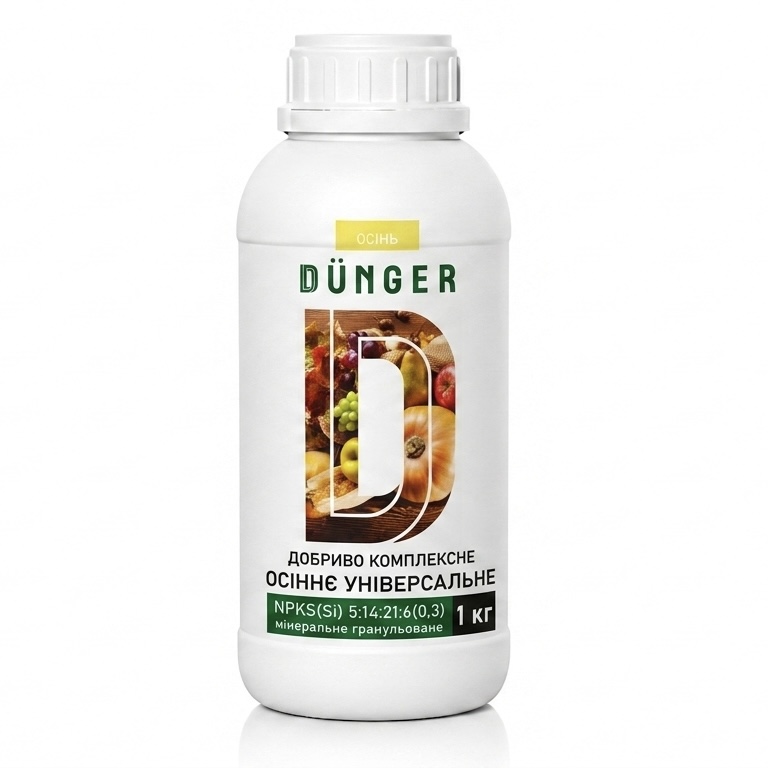
Composition and lawn instructions
Nitrogen 5%; Phosphorus 14%; Potassium 21%; Sulfur 6%; Silicon 0.3%
Lown grass: 30-40 gr/m²
For lawns, use after the last mowing at a dose of about 30-40 gr / m2 (3-4 kg / 100 m2).
The application of the autumn complex must be carried out before the onset of frost, since plants cannot accept nutrients from the frozen soil.
This is the lawn rate for this particular product. Rates for planting holes, trees or bed preparation should not be transferred to turf. Do not dissolve the granules in a bucket of water; calculate the amount from the lawn area.
Timing: follow the site conditions and instructions
For this compound, the lawn method is linked to the final mowing. Plan around the actual end of seasonal management and local weather, rather than one date for all Ukrainian regions. Applying on frozen ground or snow is not a way to catch up on a missed feed.
Do not apply just before forecast heavy rain, which can move nutrients beyond the plot. Avoid feeding turf that is dormant because of winter conditions or marked weather stress. If suitable conditions have passed, a larger quantity will not compensate for lateness. Base the next decision on the grass and product instructions, rather than a wish to finish the bag.
Even spreading without double-dose stripes
First measure out the amount for a defined area. A spreader helps distribute granules more evenly than arbitrary handfuls. A setting from one machine should not be transferred unchecked to another. Granule size and density can alter the output even when the analysis is the same, as can the operator's walking speed.
Check the spreader's instructions and its actual output over a known area. Both the distribution pattern and total mass need attention. If using perpendicular passes, divide the same calculated amount between them and reduce the output accordingly. Two passes do not mean two full application rates. Turns and narrow strips are particularly easy places to create a local excess.
Keep granules off paths, drains, water bodies and neighbouring beds. Collect particles that land on hard surfaces instead of washing them into drainage. Remove a visible spill so it does not remain as a concentrated patch on the grass. Uneven spreading can produce alternating dark and pale strips or damage the turf.
Watering after feeding and checking automatic irrigation
Water helps nutrients move into the root zone, but irrigation needs depend on moisture, soil and weather. Dry application does not mean making a solution in a watering can. Follow the selected product's requirements and avoid creating runoff by heavily watering already wet soil.
Lawn watering should be assessed through root-zone conditions: a wet surface after a brief shower does not always mean deeper soil is moist enough. Check automatic lawn irrigation separately. A timer programmed for summer may continue watering after autumn rain. Review zones, sprinkler overlap and rain-sensor operation; an identical runtime does not guarantee identical moisture across the plot.
A short sequence for autumn work
- Inspect the lawn and distinguish nutrient needs from compaction, shade and water problems.
- Confirm the area and previous inputs, using a soil test where appropriate.
- Check the lawn rate, method and timing for the selected autumn product.
- Weigh the quantity and check spreader settings without doubling the rate on crossing passes.
- Collect stray granules from hard surfaces, assess moisture and keep an application record.
Questions before ordering
No. Aeration addresses the movement of air and water through compacted soil, while fertilizer supplies nutrients. Select work according to the plot. There is no reason to repeat every operation each year simply because autumn has arrived, particularly if grass has limited time to recover from major disturbance.
Fertilizer is not a moss, pest or disease treatment, and cannot replace reseeding or repairing bare areas. Check drainage, light and the cause of damage. Where renovation is needed, plan it as a separate operation suited to the grass's development stage.
No. Application mass depends on area and instructions, not the amount remaining. Keep unused product in its closed packaging under the stated storage conditions. Record the product name and remaining quantity so the next purchase matches an actual requirement.