


For petunias in pots or hanging baskets, choose a light container mix that holds some moisture while allowing excess water to escape and air to reach the roots. Heavy soil taken straight from a garden bed is not an equivalent substitute. In a flower bed, assess the existing soil and the way water leaves the site. Before buying a mix, read its ingredients, intended use and initial fertilizer information rather than relying on the word “universal” on the front.
Start with the growing location
A petunia in a balcony box depends on a limited volume of growing medium. Its roots cannot move beyond the container to find water. A hanging basket also needs an accessible watering position, a support suitable for its filled weight and somewhere for surplus water to drain. Choose the medium, container and position together. Establish whether the decorative planter contains a separate inner pot, has its own drainage holes or uses a designed water reservoir.
In Ukraine, the same mix will behave differently on an exposed sunny balcony and in a cool courtyard under a roof. Wind, sunshine, rain and container volume all affect moisture checks. This is preparation for the warm growing season. Put petunias outdoors after the local frost risk has passed and the soil has warmed, rather than treating the date of a bag purchase as planting time. Northern, southern and elevated sites do not share one reliable outdoor planting date.
What to look for in a ready-made mix
Roots need both water and air. A dense mass of fine particles may remain wet, while a very dry mix can be difficult to wet evenly. Look for a medium intended for container flowers or seasonal bedding plants. Read the description of its structure, components and preparation, including the information on the back of the bag. A seed-sowing medium and a mix for an established summer basket serve different purposes.
Container mixes can contain peat, coir, composted bark, compost, perlite and other ingredients. One ingredient does not determine the quality of the whole product. Its combination with the others, the resulting texture and the manufacturer's instructions matter. A peat-free product can also be suitable for container growing. When changing products, check how the new medium takes up water instead of automatically keeping the watering routine used with the previous bag.
Why garden soil is different
Garden soil can become too dense in a container for satisfactory movement of air and water, especially in shallow boxes. Dark colour or a productive vegetable bed does not establish that the same soil will work well inside a pot. Filling a basket with heavy soil and adding extra fertilizer does not solve the physical problem. Nutrients cannot replace suitable pore spaces or an open route for water to leave.
A flower bed requires a different assessment because the roots grow in a continuous soil layer. Organic matter can improve the structure of heavy soil and help light sandy soil retain moisture. However, putting a bag of potting mix into one hole is not a universal repair for a waterlogged bed. Use the garden soil assessment guide before deciding what to change, particularly where water remains after rain.
Check drainage before filling the pot
A normal planting pot needs drainage holes that packaging or a tightly fitted saucer does not block. If a decorative outer planter has no holes, use a separate inner pot and check the space beneath it. After watering, confirm where the excess water actually goes. A dry-looking surface does not tell you whether the base is standing in water hidden inside the outer pot.
A thick gravel layer underneath the mix is not a substitute for holes and is not a necessary drainage improvement. It also occupies space that could hold growing medium for the roots. Concentrate on a suitable mix and free drainage. A self-watering container has a designed reservoir and overflow system; follow its own filling instructions rather than converting an ordinary closed pot into an improvised reservoir.
Match container volume to the variety
Compact and vigorous trailing petunias need different amounts of space. Identify the cultivar or series and check the plant supplier's container recommendation. One litres-per-petunia figure cannot describe every variety and planting arrangement. The useful volume inside the pot matters more than the outer diameter of a decorative shell. An insert, reservoir or thick walls can substantially change the space available for roots.
A larger volume generally dries more slowly than a small one, but a tiny plant does not need an arbitrarily enormous mass of wet medium. Match the container to the rootball, growth habit and number of plants. Avoid crowding a basket solely for an immediately full appearance. Measure the actual inner container before buying the mix. Litres of growing medium and litres of prepared fertilizer solution are separate quantities.
Read the initial fertilizer information
Some commercial mixes already contain a nutrient charge. Find the fertilizer information, stated duration and advice on later feeding, where supplied. Do not automatically add several products just because the petunia is flowering. Keep the bag label so that you can check what was already present in the root zone when reviewing the feeding plan. A familiar bag colour is not a record of its contents.
Read the pH information too. Poor growth is not a reason to start acidifying the medium with an improvised household recipe. First assess light, moisture, drainage and previous applications. Testing the medium is more useful than guessing from leaf colour alone. Petunias need a bright position, so replacing the mix cannot provide the same flowering conditions in deep shade. Diagnose the growing conditions before buying a corrective product.
Prepare the medium and check the first watering
- Confirm that the container has suitable space and a working exit for water.
- Read the medium preparation instructions, particularly if the mix is dry or needs moistening first.
- Moisten it evenly as directed, avoiding large dry pockets.
- Position the rootball and fill the gaps without heavily compressing the mixture.
- After watering, check moisture around the root zone and remove water collected in the decorative outer container.
Water running quickly from the bottom does not always prove that the entire rootball is wet. In a dry mix, water may follow a few routes through it. Check the actual medium rather than responding with extra fertilizer. Conversely, a container that stays heavy and wet calls for a drainage and watering review. The two situations need different decisions, so one automatic daily amount is a poor substitute for inspection.
Keep checking moisture during the season
A small hanging basket has a limited water reserve. Assess it separately from plants in the ground, particularly in hot or windy weather. Its needs may change again during cool, cloudy conditions. Check the medium and the weight of the container, and consider whether rain actually reaches it. A fixed daily or weekly schedule without inspection will not fit all Ukrainian growing situations.
If foliage droops, establish whether the medium is dry or wet before adding water. Similar outward symptoms do not give a complete diagnosis. Inspect drainage holes, the outer planter and, where the problem continues, the roots. Suspected root disease or damaged roots need a separate assessment. A new bag of medium or concentrated feeding cannot be presented as a guaranteed recovery treatment.
Plan nutrition after checking the medium
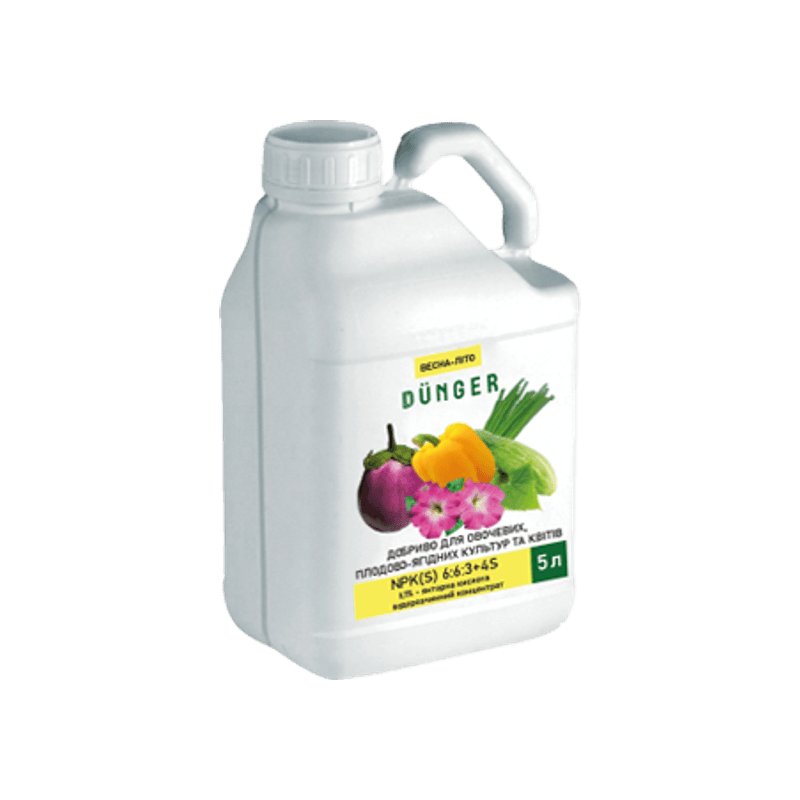
Complex fertilizer for vegetables, fruit and berry crops, and flowers
The instructions for this liquid concentrate cover flowers and application to soil or substrate. It comes in a 5 L canister. Consider it during plant growth after checking any existing nutrient charge; it is not a growing-medium replacement. The instructions distinguish mature plants from seedlings.
Used throughout the entire period of plant development and growth. For root feeding into the soil/substrate, dilute 50 ml of fertilizer in 10 L of water (100 ml of solution per 1 plant) and use at intervals of 10-12 days. For foliar treatment (spraying), dilute 25 ml in 10 L of water and apply with a sprayer, ensuring even coverage.
For treating seedlings, halve the concentration of the working solution!
Feed plants with fertilizer in the morning or evening, avoiding hot weather. Fertilize the seedling substrate for the first time 10-14 days after pricking out or at the stage of 4 true leaves.
Remember that the solution for seedlings should be half as concentrated as the solution for mature plants. Do not use products whose instructions specify the same dosage.
Pack size, concentrate volume and prepared solution volume mean different things. Determine your need and read the full instructions before ordering. Compare flower fertilizers and organise zones, crop, measurements and the product plan in My Garden.
Frequently asked questions
The name helps you find a product, but check its actual intended use, texture and initial nutrient charge. A suitable container medium for seasonal flowers can also work. A flower picture on the packaging does not establish those properties.
It may have lost structure and nutrients. Assess its condition and history and remove plant residues. Do not retain medium associated with root disease for a new planting. Adding fertilizer alone does not establish whether reuse is appropriate.
Check drainage and roots first. Feeding cannot replace the air missing from a saturated mix. Plan the next application around the instructions, plant condition and existing nutrient charge rather than using it to dry the container.
Explore more guides in Flowers and ornamentals.


