


Feed petunias according to their growing position, the nutrients already in the potting mix and the plant's condition. For established petunias in baskets or flower beds, consider a fertilizer whose instructions cover flowers. Begin with previous feeding, watering and light. Wilting or a reduced flower display does not automatically mean that a stronger dose is needed.
A common source of confusion is the difference between concentrate, prepared fertilizer solution and ordinary watering. These are separate quantities. The water needed to moisten a basket does not determine fertilizer concentration, and a full watering can is not an application rate for one plant. Read the complete relevant row and method before starting.
Find out what is already in the pot
Keep the growing-mix packaging or find its description in your order. It may contain starter nutrients or a slow-release fertilizer. Establish what the nursery used and what was added after purchase. If those details are unknown, avoid starting several flowering products together. First identify the conditions from which you are working.
Compare plants under similar conditions. A hanging basket, a pot beside a hot wall and an open flower bed receive and lose water differently. Limited rooting volume makes attention to moisture and nutrients particularly useful in containers. Repeated watering can leach nutrients, but that does not justify doubling the concentration by guesswork.
The physical growing medium is a separate issue. If water does not pass through or the roots remain constantly wet, investigate the container and drainage first. For choosing the medium itself, use the guide to soil for petunias in pots and hanging baskets. Feeding does not repair an unsuitable physical root environment.
Inspect before each planned application
Check moisture within the rootball, not just the surface appearance. Look at drainage openings and the saucer. Retained water should not leave roots in saturated conditions for prolonged periods. If a petunia wilts during hot weather, assess its water status first. Concentrated feed is not a response to every form of wilting.
Look at fresh growth, leaves and flower distribution. Petunias need a well-lit position: shade can produce stretched growth and fewer flowers. Compare the light reaching different containers before changing fertilizer. A pot beneath a canopy and a neighbouring pot in sunshine are not equivalent growing situations.
Conditions differ between a southern Ukrainian balcony, an exposed terrace and a cool western courtyard. Inspect again after cold nights, during hot spells and following prolonged rain. Avoid carrying an unchanged greenhouse calendar onto an outdoor balcony. Consider the product's stated interval alongside suitable conditions and feeding already supplied.
Baskets and beds need different information
| Growing situation | What to check |
|---|---|
| A new basket with ready-made mix | Starter nutrients, mix details and previous feeding. |
| An established hanging plant | Even moisture, drainage and actual growth condition. |
| A bed in garden soil | Earlier inputs across the area, drainage and soil condition. |
| A mixed container | Plant numbers and suitability of the product for every crop. |
| Young seedlings | Growth stage and the specific seedling instructions. |
For a flower bed, begin with a soil assessment before feeding. In containers, also examine the growing mix and its initial nutrient charge. Similar leaf colour can have different causes, so avoid trying to make every plant look identical with one stronger application.
A product whose instructions cover flowers
The vegetable, fruit, berry and flower compound includes root and foliar application instructions. For petunias, use the flower group and appropriate plant stage. Do not transfer a lawn, tree or ornamental-shrub rate. A flowering claim on another product does not make two different concentrates interchangeable.
Liquid compound for flowers
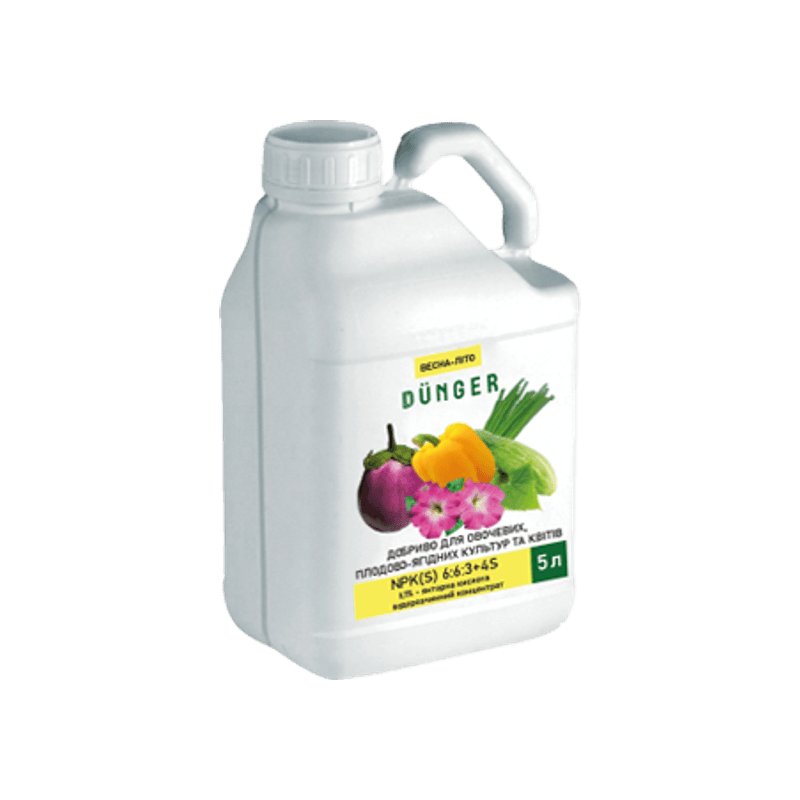
Complex fertilizer for vegetables, fruit and berry crops, and flowers
For petunias, select the flower application appropriate to the growth stage. Root feeding and spraying have different concentrations; the complete product directions follow.
Used throughout the entire period of plant development and growth. For root feeding into the soil/substrate, dilute 50 ml of fertilizer in 10 L of water (100 ml of solution per 1 plant) and use at intervals of 10-12 days. For foliar treatment (spraying), dilute 25 ml in 10 L of water and apply with a sprayer, ensuring even coverage.
For treating seedlings, halve the concentration of the working solution!
Feed plants with fertilizer in the morning or evening, avoiding hot weather. Fertilize the seedling substrate for the first time 10-14 days after pricking out or at the stage of 4 true leaves.
Remember that the solution for seedlings should be half as concentrated as the solution for mature plants. Do not use products whose instructions specify the same dosage.
Pack size: 5 L. Check the concentrate details and the quantity needed before ordering.
The instructions distinguish application methods and concentrations. Do not automatically combine both methods on one day. Decide which operation is needed and account for nutrients already supplied. Prepared fertilizer solution does not replace all subsequent watering: assess water requirements separately from weather and the condition of the growing medium.
Prepare a single application
- Identify whether you are feeding established petunias or seedlings.
- Check the mix label and your own records of previous applications. Select one clear plan.
- Inspect moisture, drainage and weather. Feeding does not replace investigation of severe wilting.
- Read concentration, solution quantity and interval together in the complete product instructions.
- Measure concentrate with suitable measuring equipment. Avoid using an arbitrary cap whose capacity is unknown.
- Prepare the solution for the planned number of plants and apply by the chosen method. Do not add homemade infusions or other products without verified compatibility.
- Record the application in your own notebook and assess the plants before the next planned feeding.
If you have several similar baskets, count the plants in each one. Two containers of the same external size can contain different plant numbers. Identify the containers and agree who is feeding them when several people share their care. This helps avoid a second application simply because the first one was not communicated.
When the flower display declines
Assess light, moisture and shoot condition. Removing spent flowers can be part of care for large-flowered and double petunias, while many smaller-flowered cultivars are self-cleaning. Check the particular series you grow. The shared name petunia does not mean every plant needs the same deadheading routine.
Where shoots have become stretched or bare, consider shape management separately from feeding. Do not remove all green growth and expect a stronger solution to replace it immediately. Widespread decline calls for inspection of the plant and its root environment first. Fertilizer is not a treatment for pests or every type of leaf damage.
Young plants need separate attention. Use the guide to choosing seedling growing media when assessing their starting mix. A recently pricked-out petunia is not equivalent to a large flowering plant simply because both are growing in similarly coloured pots.
Buying and organising plant groups
Before ordering, check product form, pack size and the amount of concentrate needed. A five-litre canister contains concentrate, rather than a ready-made portion for one planter. Confirm the price and receiving arrangements for the selected product. Avoid buying several different feeds together without knowing which operation each is intended to serve.
In My Garden, define zones, the crop and measurements for a fertilizer plan. Keep application dates and observations about the flowers in your own journal. Practical information for other plants is available in Flowers and ornamentals.
Questions about feeding petunias
Do not do this automatically. Ordinary watering frequency depends on weather and the container, while fertilizer has its own instructions. More frequent watering in hot weather does not authorise a proportional increase in nutrients.
Start with light, water, cultivar and previous feeding. The balance between leaves and flowers does not identify a precise deficiency by itself. Avoid adding more concentrate without checking the growing conditions.
This product has separate seedling instructions. Check the stage, application method and solution quantity. Do not use the mature-plant programme by default on recently pricked-out plants.
No. Applying fertilizer solution and maintaining suitable moisture are separate jobs. Inspect the growing medium so the plant is neither left dry nor kept standing in a continuously flooded saucer.


