


Choosing lawn feed starts with understanding what your grass needs. Pale colour, slow regrowth and bare patches do not always mean a nutrient shortage. Shade, drought, standing water and repeated traffic can produce similar symptoms. Inspect the site, review earlier applications and identify the grass's growth stage before deciding whether to buy fertilizer.
Decide what kind of lawn you want
A dense, regularly cut grass lawn and a flower-rich patch have different purposes. The first needs to recover from use and maintain suitable growth; encouraging vigorous grass in the second may be undesirable. Separate the main lawn from the meadow corner and the ground beneath trees. Using the same mower does not make their feeding requirements identical.
If you still have the seed packet, check the grass mixture. Species, shade, access to water and the amount of wear affect nutrient demand. Sowing a lawn, restarting growth in spring and feeding established turf are different stages. Match the product directions to the actual situation rather than assuming that every green area needs the same treatment.
Check why growth is poor
Look at the whole lawn before examining individual leaves. General weakness and a narrow worn path suggest different questions. Compare open ground with tree shade and the top of a slope with a wet hollow. A problem following foot traffic, the edge of irrigation or an earlier spreader pass needs investigation before another application. Extra fertilizer cannot replace that investigation.
Check moisture beneath the turf rather than judging only the surface colour. Brown grass during drought is not automatically hungry. Moss alone does not prove a nutrient deficiency either: damp conditions and poor drainage can be more important. Consider mowing, compaction and recovery alongside lawn care through the season, while making the feeding decision separately.
Use a soil test to narrow the choice
A soil test helps distinguish a shortage from an excess. Acidity, organic matter and phosphorus and potassium status are useful when selecting fertilizer. Ukrainian chernozem is not uniformly supplied with every nutrient, and every sandy plot does not need the same compound product. Imported soil around a new house may differ substantially from the older garden beside it.
Ask the laboratory how to sample your lawn. Keep clearly different management zones separate, such as a frequently fed lawn and newly imported topsoil. Explain earlier fertilizer use and the kind of lawn you want. The result should guide a purchase, rather than justify a bag already bought. Leaf colour is not a sound basis for adding phosphorus or lime.
Include earlier inputs in your decision
Use your own records to gather product names, application dates and actual quantities. Include compost and other organic materials spread on the area. An unknown earlier application is a reason to clarify the history, rather than restart the calculation from zero. Applying different compound fertilizers on top of one another to obtain colour faster makes it harder to control nutrient inputs.
Whether you remove grass clippings matters too. Removing them takes nutrients away; returning suitable fine clippings changes that balance. This does not authorise an improvised replacement rate for a labelled product. It helps explain why two apparently similar lawns may need different decisions after soil testing and a review of maintenance.
Read the purpose as well as the analysis
Nitrogen supports leafy growth, but choosing the highest number is not a complete feeding strategy. Compare the whole analysis with the soil's needs. A compound product containing phosphorus and potassium is appropriate when those nutrients are needed too. Pack weight describes the amount of fertilizer, rather than pure nitrogen or an area that it will always cover.
Distinguish nutrition from weed or moss control. Fertilizer does not replace identifying the problem and selecting suitable care. Do not make your own mixtures with plant protection products. Compare purposes and packs in the lawn fertilizer range, then use the selected product's own application stages and directions.
Wait for suitable growing conditions
Consider active growth, soil conditions and your ability to complete the watering instructions. Do not feed frozen, snow-covered or saturated ground. Postpone application during heat and drought, and before heavy rain that could wash granules away. Cool, moderately moist conditions and an even application are preferable to trying to catch up during unsuitable weather.
Spring growth resumes at different times in southern Ukraine, Polissia and foothill districts. Shade and open ground can behave differently within one garden. A neighbour's date is not a national schedule. As growth comes to an end, do not continue a summer feeding approach; see the separate guide to choosing autumn lawn fertilizer for that seasonal decision.
A granular option for the matching stage
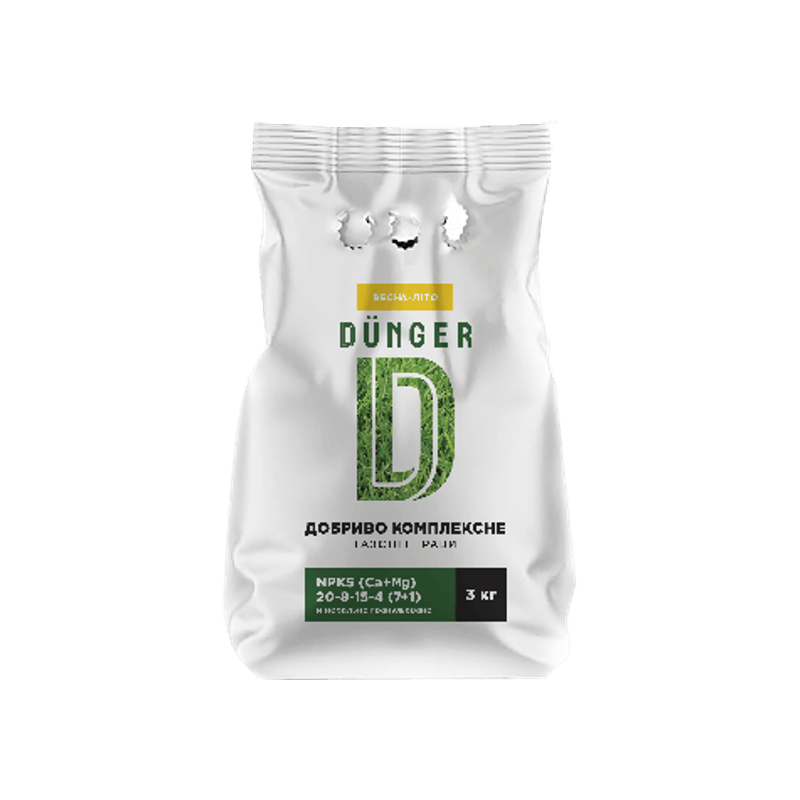
Complex fertilizer lawn grass granular
This product is intended for lawn grasses. For an established, actively growing lawn that needs nutrition, use the relevant section of its instructions. The stages below are separate uses, not simultaneous tasks; the establishment rate does not replace established-turf directions.
Packs are a 1 kg bottle, a 3 kg bag and a 4 kg canister. Each contains granules. Compare the required mass with the pack and confirm current price and delivery. In My Garden, set a zone, crop and measurements to organise a product plan.
Measure the area and spread accurately
Measure the grass itself, excluding paths, beds and paved areas. Divide an irregular outline into simpler shapes and add their areas. Calculate product quantity using the rate for the relevant stage. A handful or a cap from another fertilizer is not a weighing measure for these granules. Prepare the measured quantity before starting, so you can avoid casually adding more.
Check spreader settings for the actual granules: one dial setting does not give the same output for every fertilizer. Watch your passes and overlap, particularly along narrow edges. Never empty leftovers into a heap on the lawn. Collect granules from paving and paths instead of washing them into drains. Complete the product's watering instructions and clean the equipment after use.
Prepare useful details before buying
Have the lawn area, known grass mixture, soil results and earlier applications ready when asking for advice. Specify whether you mean sowing, regrowth or established turf. This helps you check the proposed product and pack against the actual job. Receiving an order does not mean that the conditions are suitable for immediate application.
Compare the cost of the required quantity, not simply the cheapest package. Check the full name, selected weight and delivery arrangements. Avoid buying an extra compound feed to apply at the same time just in case. One justified application is easier to control than several open packs with an unknown combined nutrient input.
Questions about choosing lawn feed
Wait for growth to resume and check moisture, light and the grass's condition first. If feeding is needed, choose the matching application stage in the directions. Colour alone cannot determine either composition or rate, especially where soil is waterlogged or turf has suffered damage.
No. Directions describing application after mowing do not authorise application every time you mow. Consider earlier inputs, current condition and the full instructions. Do not turn your mowing frequency into an invented fertilizer frequency.
Measure the area and identify the application stage before comparing packs. Check the calculated quantity against the available pack sizes, and confirm current price and shipping arrangements. A larger pack is not a reason to increase the rate. Store any remaining product according to its packaging instructions.
Do not use feeding as a substitute for identifying the cause. Check light, drainage, compaction and turf condition. Unwanted plants require their own appropriate management. Do not add herbicide or a home-made mixture to the fertilizer without a directly authorised instruction for that use.


