


That task might be spring feeding of berry or ornamental shrubs, care of perennial flowers or autumn soil preparation. Each has its own requirements. This guide explains how to compare nutrient declarations, assess the need for feeding and use a particular product's instructions. A rate belonging to one fertilizer should stay with that fertilizer and its stated use.
Reading P, K and the numbers on the pack
P is the chemical symbol for phosphorus and K for potassium. Fertilizer labels commonly declare these nutrients using P₂O₅ and K₂O. When comparing products, check that the figures use the same basis. A percentage expressed as P₂O₅ cannot be compared directly with a figure for elemental P. The same distinction applies to K₂O and elemental K.
A PK designation helps identify a phosphorus-potassium formulation. NPK also includes nitrogen. A product described as an autumn fertilizer can still contain nitrogen, even if its proportion is relatively small. Read the complete nutrient declaration when you are looking specifically for phosphorus and potassium. A season printed on the bag does not answer that question by itself.
The declared nutrient percentage and the application rate describe different things. One describes the material in the bag; the other tells you how much material to use for a stated operation. A higher nutrient figure does not mean you should apply a larger handful. Match the formulation to the requirement, then follow its own rate and method.
What phosphorus and potassium do in plants
Phosphorus participates in the transfer of energy inside cells and is important for normal growth. Potassium is involved in enzyme activity, the movement of substances within plants and the regulation of water exchange. These functions explain why plants need the nutrients. They do not establish that your particular garden needs an additional application of either one.
Feeding belongs alongside suitable watering, a functioning root zone and appropriate growing conditions. It cannot correct every reason for poor growth. If roots are damaged or soil remains waterlogged, investigate those problems instead of assuming that another fertilizer application will solve them. Fertilizer also cannot replace the diagnosis and management of a pest or infectious disease.
Check the need before choosing a fertilizer
Use soil information and the history of the bed
A soil analysis helps assess available phosphorus and potassium as well as soil acidity. The two nutrients need not be equally low. A garden can need potassium while already containing enough phosphorus. Ask for an interpretation related to the plants you grow. Avoid adding phosphorus repeatedly with every potassium application when the soil information does not support it.
Tell the person interpreting the results what has grown in the bed and which fertilizers, composts or manures you have added. Organic materials also contribute nutrients, although their precise contribution may be uncertain. Your previous applications belong in the assessment. The newest bag should not be considered in isolation from everything already supplied to that area.
Take the sample from the soil where the plants actually grow. Follow the chosen laboratory's directions for sampling depth, collection and packaging. Soil from a path does not stand in for soil from a cultivated bed. Where two areas have received different treatment, label them separately and ask how to submit representative samples for each one.
Visible symptoms are a reason to investigate
Slow growth, changes in leaf colour or browning along leaf edges may prompt a check of plant nutrition. Similar symptoms can have different causes, and more than one problem may occur at once. A photograph alone cannot determine the required phosphorus-potassium dose. Look at the whole plant, its surroundings and the condition of neighbouring plants.
Check moisture, drainage, roots and pH before increasing the feed. Potassium uptake is influenced by soil moisture, aeration and temperature. Phosphorus availability is also affected by soil conditions and chemical reactions. Poor growth in a saturated bed therefore does not prove that the fertilizer rate was too low. Establish what is limiting the plant's growth first.
Granules and soluble feeds have different instructions
Choose a physical form that suits the work. A granular product may be intended for spreading on soil, use at planting or incorporation during digging. A soluble fertilizer has its own preparation and application instructions. The phrase phosphorus-potassium does not tell you whether a product can be dissolved, watered onto the roots or sprayed onto leaves.
Check the method before making the purchase. If you need a liquid feed, select a product whose instructions cover that use. Do not create an improvised solution from soil granules. Rates per unit of ground, per plant and per volume of water are different instructions. Products containing the same nutrients can still require very different handling and quantities.
Plan timing around the product and the plants
Start with the season covered by the chosen instructions, then consider the stage of the plant and the actual conditions. Gardens across Ukraine should not be assigned one universal feeding date. Check the local condition of the soil and planting against the stated use. The arrival of autumn does not make every application suitable until the beginning of winter.
Spring and autumn uses of the same fertilizer may differ in placement, purpose and units. They should not automatically become two compulsory treatments for every plant. Choose the operation you need first. In a perennial flower bed, the end of flowering may also determine whether autumn feeding is appropriate when the product instructions specify that condition.
A DÜNGER phosphorus-potassium option for the garden
Phosphorus-potassium fertilizer for all types of crops, granules
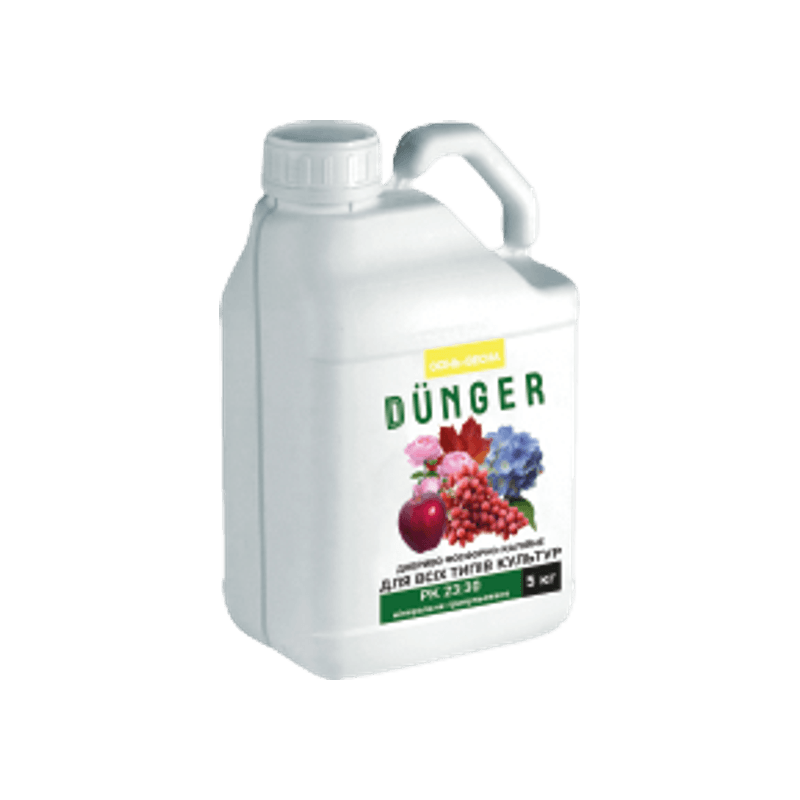
DÜNGER PK 23:30 is supplied in a 5 kg pack for spring and autumn uses covered by its instructions. Its declared element list is:
- P2O5 - Phosphorus: 23%
- K2O - Potassium: 30%
Select the relevant season and operation before applying it. The complete application method and periods for this product are:
Feeding in the autumn period
At the end of the vegetation cycle (approximately from September), apply fertilizer at the rate of 30-40 g/m2. When digging, apply fertilizer at the rate of 35-60 g/m2. Flowerbeds with perennials are fertilized in autumn only after flowering. Fertilizer is spread over the surface of the soil after watering, early in the morning, when the soil is wet from dew or after rain. It is important to feed before the first frosts.
Feeding in the spring period
In the spring, apply fertilizer at the rate of 30-40 g under berry bushes, decorative shrubs in the root zone on moist soil. For perennial flowering plants, add 30-40 g under the plant in early spring. When planting fruit and ornamental plants, add fertilizer in the planting hole from 20-30 g per plant.
These rates belong to this product and the operations described. A digging rate does not become an amount for one shrub, and the spring shrub application should not automatically be carried over to autumn. To compare other formulations and packs, browse the fertilizers for garden crops category.
Calculate the purchase and keep an application record
First identify the area that you will actually treat. A rectangular bed requires a length and width measurement. A per-plant instruction requires the number of plants in the stated group. Exclude paths and areas receiving different care. Once the units and boundaries are clear, it is easier to check the required mass and the number of packs.
Record the product name, the date, the treated bed, the amount used and the application method. This is useful next season and when several people look after the garden. Do not repeat a treatment simply because granules are no longer visible. Their appearance on the soil surface is not an instruction to apply another dose.
Check the other products in your feeding plan separately. Complete nutrition also involves trace elements in soil, but that does not justify adding them without a reason. Assess potassium humate by its own composition and intended use. The word potassium in two product names does not establish that the products can replace one another for the same task.
Questions about buying and applying PK fertilizer
No. The decision depends on soil supply and plant requirements. If only one nutrient is needed, assess that specific requirement. A combined PK formulation is useful when there is a reason to supply both components and its instructions fit the intended planting, season and operation.
A broad intended use does not make every application method identical. The DÜNGER PK 23:30 instructions above distinguish spring applications, autumn feeding and digging. Match the operation to your plants first. Then use the corresponding rate, unit and method without borrowing a different product's directions.
You can plan a purchase before the work begins. Check the quantity and pack size you need, together with the storage directions on the packaging. Buying in autumn does not mean the product must be applied immediately. Carry out the work during the period and under the conditions stated for the fertilizer.
Increasing the rate without a reason is not a reliable solution. Excess fertilizer can harm plants and the environment. If a plant continues to struggle, review the cause, the root-zone conditions and any analysis results. Fertilizer is not a treatment for pests or infection, and applying it does not guarantee a harvest.
