


Growing seedlings at home starts with a plan: where and when they will be planted out, how much space is available under lights and whether you can maintain suitable moisture. Sturdy young plants need light, an appropriate growing medium, drainage and conditions suited to the crop. Fertilizer supplements nutrition when needed; it cannot compensate for a dark windowsill or roots kept permanently wet.
Work back from the intended planting date
There is no universal sowing day for tomatoes, peppers, cabbages and cucumbers. Check the time needed to produce transplants on the seed packet and relate it to a realistic planting date in your locality. A greenhouse and an open bed provide different conditions. For tender crops, frost risk matters more than the name of a calendar month.
Sowing too early can leave large, stretched plants waiting for outdoor conditions to improve. Allow space for potting up: the same plants occupy more room in individual pots than in a small cell tray. Providing light for an appropriate number is more useful than crowding every seedling onto one windowsill. Label the crop, cultivar and sowing date so later comparisons refer to the same batch.
Containers and seedling growing medium
Germinating seeds need a lightweight, porous mix that holds moisture while allowing excess water to drain. Ordinary garden soil can be too dense in a small container and may introduce weed seeds and pathogens. When choosing a prepared medium, check its intended use and whether nutrients have already been added. A seed-starting mix and a material sold to improve outdoor soil are not necessarily interchangeable.
Every pot or cell tray needs drainage holes. A tray collects water but should not become a permanent bath for the roots. Remove old material and wash previously used containers; where disinfection is needed, use an appropriate product according to its instructions. Leaving old lumps of soil in tray corners and covering them with fresh mix does not remove the underlying sanitation issue.
Individual cells help reduce tangled roots. For crops sensitive to root disturbance, such as cucumbers, plan to avoid unnecessary separation of seedlings. Match container size to the time the plant will spend in it. Keeping a seedling in a tiny cell for too long is not corrected by more frequent fertilizer.
Sowing and conditions before emergence
Moisten the mix before sowing and allow excess water to drain. Check planting depth and whether the crop needs light for germination. Some tiny seeds germinate in light, making a blanket instruction to bury everything more deeply unhelpful. Apply water gently so seeds are not washed away and the surface is not disturbed.
A transparent cover can retain moisture before germination, but should not remain as a permanently closed enclosure once seedlings emerge. Air access and changing growing conditions matter. Germination temperature and subsequent growing temperature can differ. If using bottom heat, monitor the medium as well as room air: overheating and drying are hazards too.
Light after emergence: why stems stretch
Insufficient light is a common cause of long, thin stems and leaning towards a window. A room that looks bright to you may not provide enough light for seedlings. A windowsill can be cold at night and very hot by day. Examine the whole tray: plants in the middle and at the edges need light without neighbouring leaves shading them.
If natural light is inadequate, provide supplementary lighting. Choose the distance according to the fixture type and its guidance, check leaf heating and raise or reposition it as plants grow. A distance recommended for fluorescent tubes should not be applied to a powerful LED fixture without checking. A timer supports a repeatable routine, but continuous round-the-clock light is not a universal solution.
Water without drying out or waterlogging
Check moisture regularly using the mix surface and container weight together. Small seedlings can lose water quickly, yet constant saturation restricts oxygen around roots. Watering frequency depends on container size, plant development, warmth and light. An identical compulsory daily watering routine cannot account for all those differences between trays.
Water gently from above or allow the mix to absorb water from a tray, then discard drainage water. Do not leave roots standing in it. Wilting does not always mean the medium is dry: check first. If it is already wet, more water or nutrient solution can worsen the situation. Compare the affected pot with neighbouring plants and inspect the stem base.
When to prick out or pot up
Cotyledons are the initial seed leaves; true leaves appear later. For many seedlings in a shared tray, true-leaf development is a useful reference for moving them once they are large enough to handle. Do not wait for roots to become tightly interwoven. The need to pot up also depends on the crop and its initial container.
Prepare the new container and moist mix first. Support the root ball and avoid squeezing a delicate stem; handle small seedlings carefully by a leaf. Do not bury every crop more deeply simply because tomatoes can be treated that way. Water gently after moving and assess recovery before adding another feed.
When seedlings need fertilizer
Check whether the prepared medium contains starter nutrients and how long the plants have been growing in it. Additional feeding is not automatically needed from the first day. Equally, an uncharged medium will not support unlimited growth with water alone. Consider development, root condition and previous inputs. Young plants are sensitive to excessive fertilizer, especially under moisture stress.
Understanding uneven emergence
Different crops and seed batches do not all germinate together. If one row is green and another remains empty, check labels and the expected conditions for each seed first. Review seed freshness, actual medium temperature, moisture and planting depth. A tiny seed buried too deeply may not have enough reserves to reach the surface. Additional fertilizer cannot shorten that distance or restore a nonviable seed.
Distinguish failure to emerge from the death of seedlings that had already appeared. The first calls for seed history and germination checks; the second calls for examining plants, stem bases and water in the containers. Record the location of damage. One persistently wet cell or cold tray edge requires a different investigation from an entire batch uniformly stretching.
Avoid turning over the whole sowing simply to find seeds, since this can damage those already germinating. Start with accessible condition checks and crop guidance. If resowing becomes necessary, prepare a clean container and correct the identified issue instead of repeating the same method with stronger feed.
A DÜNGER compound for seedling nutrition
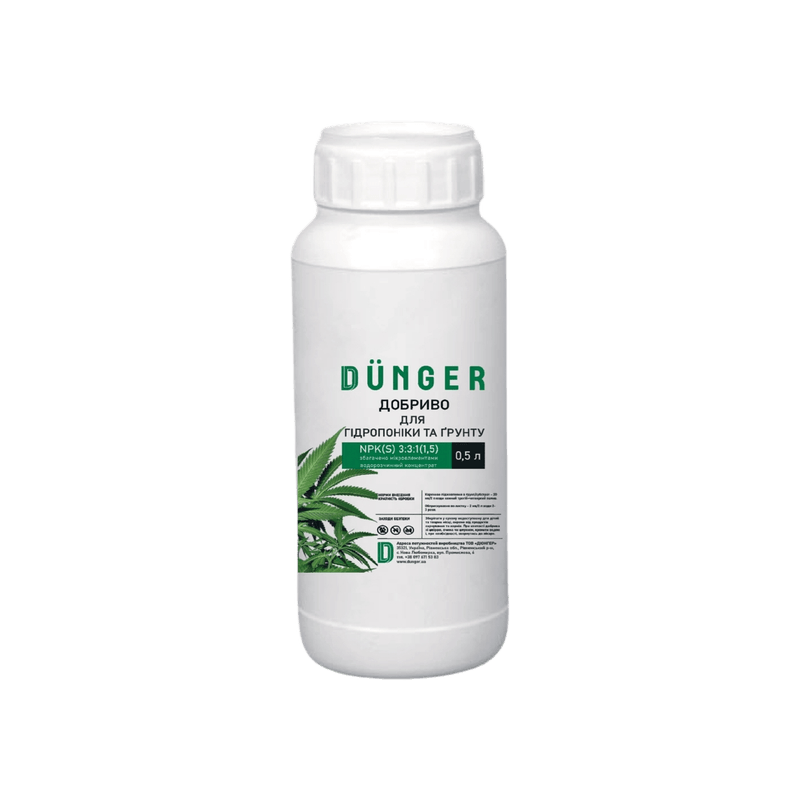
COMPLEX FERTILIZER FOR HYDROPONICS AND SOIL covers all types of seedlings and provides separate root-feeding and foliar methods. Its 0.5 L bottle contains concentrate. For young plants in pots, use the soil or substrate instructions; the product name does not require you to change to hydroponic growing.
Composition
Nitrogen 3%; Phosphorus 3%; Potassium 1%; Sulfur 1.5%; Calcium 1%; Magnesium 1%; Zinc 6%; Copper 0.1%
Application method
It is used during the whole period of plant development and growth. When root feeding in soil / substrate, dilute 20 ml (1 cap) in 2 liters of water, use with every third or fourth watering. When processing (spraying) on a leaf - to dissolve 2 ml in 2 l of water, and to carry out processing 2-3 times.
An important limitation
Do not exceed the recommended doses of fertilizer, as this can lead to injury or death of plants. Keep in mind that plants in hydroponic systems do not constantly absorb nutrients. It depends on the size of the plant, light, temperature and humidity. It is necessary to properly adapt the diet to the specific conditions and characteristics of plant varieties.
Do not substitute foliar spraying for root feeding at the same concentration. An interval based on watering events is not an instruction to water daily for the sake of fertilizer. Establish watering and feeding needs first, then measure concentrate and water separately. Damaged roots require investigation rather than a larger quantity of feed.
Hardening off before planting outside
Indoor-grown seedlings need gradual adjustment to stronger light, wind and different outdoor humidity. Begin with short periods in a sheltered, shaded position, then increase time and exposure progressively. Do not put newly moved trays straight into exposed midday sun. Watch the forecast and return tender plants to protection before damaging cold arrives.
Hardening off does not mean deliberately allowing plants to wilt or freeze. Preserve the root ball at planting, follow the depth appropriate for the crop and water gently. A cloudy day or a period without intense sun helps ease the change. If weather prevents planting, review space and containers for continued indoor care rather than trying to stop growth by drying plants out.
A daily tray check
- Read the label: crop, cultivar, date and current stage.
- Check light, heat and stem leaning; space plants out where needed.
- Assess moisture and drainage rather than watering only by the clock.
- Inspect stem bases and roots and decide whether potting up is needed.
- Then consider nutrition and preparation for planting out.
Questions from home growers
A seed has reserves for its initial development. First provide suitable moisture, temperature and sowing depth. Spraying or watering with concentrate does not replace these conditions and is not a universal way to improve germination.
Start with light, crowding and temperature. Adding nutrients without improving the growing conditions does not automatically strengthen stems. Also check the sowing date and container volume so the same problem is less likely in the next batch.


