


Choose blueberry mulch to conserve moisture, suppress annual weeds and maintain suitable conditions around shallow roots. Aged bark or woody material with known properties is often easier to assess than miscellaneous compost. No surface cover, however, automatically corrects unsuitable soil, persistent waterlogging or unsuitable irrigation water. Inspect what is already beneath the bushes before buying another bag.
Mulch and planting medium have different roles
Mulch lies on the surface, while roots grow in the prepared medium below. Do not mix a thick new layer of wood into the soil beside a living bush as though that were routine topping-up. You could injure shallow roots and change decomposition conditions. If the planting medium itself is unsuitable, start with choosing a blueberry soil mix.
In an existing row, cover the rooting area rather than building a tall cone around every stem. Bushes occupy more space as they develop, so the small first-year circle may not cover an older group adequately. Keep access for inspection, irrigation and labelled applications. A clear row edge also distinguishes the planted strip from the path, which need not be included in every calculation.
Bark and wood chips
Consider materials with suitable acidity, including composted or chipped pine bark. The word bark alone does not describe particle size, contamination or aging. Ask what is in the bag, particularly when buying cheap material of uncertain origin. Wood treated with paint or other chemicals is not equivalent to clean garden mulch.
Coarser particles generally retain their structure longer; fine material may compact more readily. Check whether water passes through your layer and whether wind scatters lighter pieces. For a small planting, assess the material in an accessible section before covering every bush. An attractive colour does not demonstrate suitability for an acid-loving crop.
Sawdust: freshness and placement matter
Sawdust is used around blueberries, but fresh fine wood does not behave exactly like aged bark. Decomposing microorganisms can temporarily immobilise available nitrogen. This does not establish one extra dose for every bush after every kind of sawdust. The material, previous nutrition, plant condition and whether the mulch remains on the surface all matter.
Do not replace assessment with an automatic doubled feeding. If growth declines after changing mulch, check water, acidity and roots first. Record when and how much material was added. This supports discussion of the actual circumstances rather than treating sawdust as an abstract problem. Avoid digging the shallow rooting area to accelerate wood decomposition while topping up.
Needles, leaves and compost
Needles and leaf materials can also provide organic cover. They may break down quickly or mat into a layer that is difficult to irrigate. Inspect the actual structure. A pine scent is not an acidity measurement. Surface material may help maintain conditions without guaranteeing a particular root-zone pH. That needs a separate blueberry soil acidity check.
Compost is not universally safe simply because it is mature. Blueberries' acidic root environment is not compatible with every alkaline or salty material. Assess manure-based and mushroom composts particularly carefully. If considering a specific product, obtain information about its properties and suitability rather than relying on the word organic. Do not bury weak young plants in it on the assumption that richer always means better.
Assess total depth before adding more
Measure the complete existing layer at several points: the row edge, centre and near a bush. Fresh material adds to the old layer even when the surface has darkened. Suitable depth depends on particle size, planting age, water and site conditions. One number from a commercial overseas row should not become a prescription for a young plant in heavy Ukrainian soil.
Top up where cover has actually decomposed, moved or exposed the ground. Deal with weeds requiring separate removal first. Mulch reduces emergence of many annual weeds; it does not automatically kill living perennial rhizomes. Keep space for inspecting cane bases. After spreading, check that material has not formed piles against stems.
Does water reach the roots?
Inspection after watering matters more than the appearance of damp mulch. Part the cover at several accessible points and check the soil beneath. With drip irrigation, compare the emitter area with a position between emitters. Avoid deep excavation for each check. After changing material, assess water movement through it again.
In the dry Ukrainian Steppe, mulch reduces moisture loss but creates no water. On heavier Forest-Steppe sites after prolonged rain, check excess moisture as well as drying. Persistently wet ground does not become healthier beneath another thick layer. The separate guide to water for blueberries helps distinguish water quality from mulch selection.
If using woven groundcover with organic material, retain the ability to open it for inspection and care. Water must reach roots instead of running into the path. Check irrigation placement and access before closing it. Neatly stretched fabric without access can conceal a problem precisely when bushes begin responding to insufficient water.
Nutrition is separate from mulch inspection
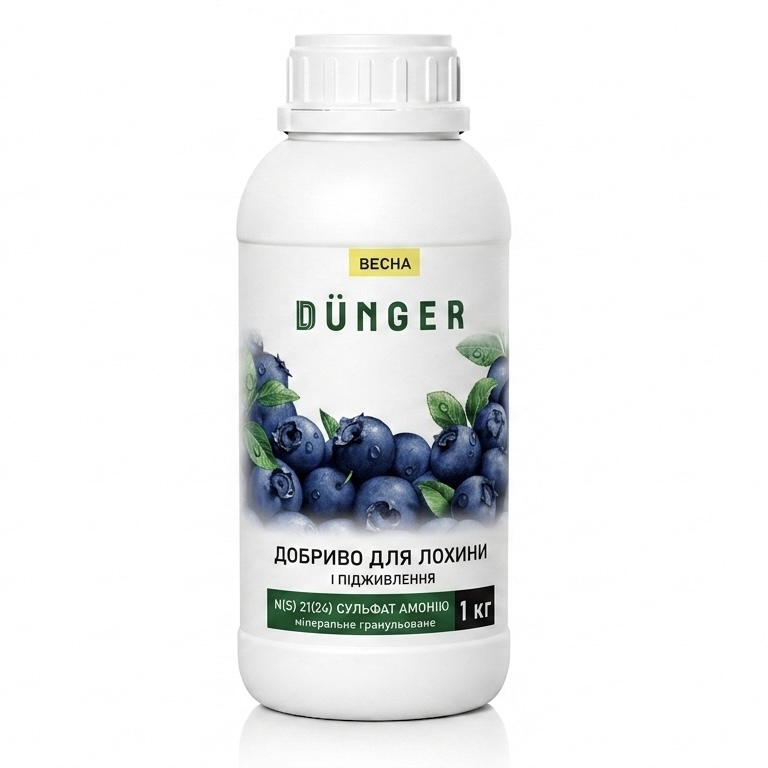
Nutritional complex for blueberries I fertilization granular
For healthy blueberries with a verified need matching the first-feeding composition, consider this DÜNGER complex. Its instructions specify early spring during bud swelling. Renewing mulch at another time does not change that stage. The quoted rate is this product's crop group, not sawdust quantity or an automatic allowance after wood. Follow the complete method with access to the rooting zone and suitable moist, not saturated, soil.
The 1 and 5 kg packs contain granules. Account for age, size, previous inputs and remaining first-feeding product. Calculate only for plants needing this care. Save the zone in My Garden and plan fertiliser mass separately from mulch volume.
Blueberries, other acidophilic cultures
20-30 g/bush
Calculate a material purchase
Measure the strip that actually needs renewal and assess the missing part of the layer. Check whether the supplier states litres, cubic volume or weight. Wet, heavy bark does not necessarily cover more useful area. Compare equivalent materials and units. Retain a brief batch description so a later order does not supply a very different particle size under the same name.
Do not budget for complete annual replacement if the old material still performs its role. Equally, avoid hiding an unsuitable compacted layer beneath more bags. For autumn work, consider weather and ground access. Preparing blueberries for winter involves more than mulch alone. Surface cover should not be expected to compensate for every weakness of the site.
A simple before-and-after record helps with maintenance: note what material was retained, where it was replenished and whether water reached the soil after the work. Photograph the same row section rather than only the fresh surface. If growth changes, you can compare a known change with watering and previous inputs. Keep a sample label or supplier description, especially when buying material for several separate garden areas.
Frequently asked questions
No such result is guaranteed. Mulch properties and root-zone pH are different matters. Measure conditions around the roots and plan correction separately from replenishing the cover.
Not automatically. Fresh material may affect nitrogen availability, but need depends on the whole situation. Include plant condition, previous inputs, water and the permitted stage for the chosen product.
Yes, if it remains suitable, conceals no problem and the combined depth is appropriate. Check depth, water penetration and the crown first, then add only what is missing.


