
[Flowers and ornamentals](https://dunger.ua/en/blog/categories/flowers-and-ornamentals)
# When to plant lavender: young plants, soil and early care
Published
3 hours ago
Updated
3 hours ago
To read
7 min
Choose a lavender planting date from cultivar hardiness, workable soil and the care available for new roots. Start by checking the plant and its site.
Spring is usually the most practical starting point for planting a new lavender, once the ground is workable, no longer waterlogged and there is time for roots to establish. Consider autumn more cautiously: cultivar hardiness, the quality of the young plant, drainage and approaching cold all matter. One calendar date cannot serve every garden in Ukraine. A flowering pot offered for sale does not mean the plant should go into open ground immediately, whatever the weather.
## Identify the lavender before choosing a date
Lavenders differ in their tolerance of winter. English lavender, Lavandula angustifolia, and suitable cultivars are generally a more useful starting point for a cold climate than tender species. Lavandin, Lavandula × intermedia, also needs assessment by cultivar. The decorative tufts above a flower head do not demonstrate that a plant will survive in your border. Ask for its botanical name and the conditions in which it is intended to grow.
Check eventual width and how the plant has been raised. A border needs predictable mature dimensions rather than matching flower-stem heights at purchase. A small rooted plug requires different attention from an established container plant. Ask whether protected young stock is ready for outdoors; do not treat it as an established, acclimatised shrub.
## Find the right spring planting window
Use the ground and forecast to guide the decision. Soil should have thawed and stopped behaving like a sticky, saturated mass. Check the future root zone as well as a sunny patch beside a wall. If squeezed soil remains a dense wet lump, postpone preparation; working saturated ground can make its structure less suitable.
A cool garden in northern Ukraine or a foothill location may become suitable later than a sheltered southern plot. Yet a low-lying southern bed may remain wet longer than a raised border elsewhere. Examine the actual location. After sudden warmth, check the risk of returning cold, especially where the young plant has just arrived from protected production. Local exposure and the condition of the plant are more useful than a nationwide timetable.
**Postpone planting when** the soil is frozen or saturated, the site is unfinished, the species or cultivar is unknown, or nobody can check the new plant's moisture afterwards. A discounted purchase does not change those conditions. Arrange suitable accommodation and aftercare before choosing the working day.
## Assess autumn planting more cautiously
A well-rooted plant of an appropriate cultivar may be considered in autumn where favourable establishment conditions remain. A few mild days, however, say little about the winter ahead. Cold combined with wet soil is particularly unhelpful for a new plant. In heavy ground or a place that collects meltwater, changing the planting date does not solve the underlying site problem.
A universal instruction to plant a fixed number of weeks before frost cannot account for root condition or local weather. A tender species bought late needs a suitable protected overwintering arrangement first. A container also leaves roots less insulated than a mass of garden soil. Decide where the plant can be kept and what that location provides instead of leaving an unfamiliar lavender on an exposed balcony.
## Prioritise sunshine and drainage
Choose a sunny site from which excess water can escape. Avoid putting lavender where lawn sprinklers or the watering needs of moisture-loving neighbours will repeatedly wet it. Watch the bed after rainfall. Standing water at the intended base of the plant is a reason to change the position or planting arrangement. Fertilizer cannot provide drainage or replace sufficient light.
Consider a raised bed, raised row or suitable container where the existing site is difficult. Improving a small pocket within continuously wet clay is not the same as preparing a suitable root environment. Evaluate the whole location before buying a bag of growing medium. The guide to [assessing soil before choosing fertilizer](https://dunger.ua/en/blog/soil-assessment-before-fertilizing) helps separate soil questions from feeding decisions. Lime and other changes to soil reaction should follow the needs of the actual ground rather than being added automatically for every lavender.
## Inspect the plant and prepare its position
Look at the stem bases, foliage and root ball. Ask whether the plant has rooted into its container or was only potted shortly before sale. Check drainage openings, standing water and an excessively dry root ball. Lack of open flowers is not itself a fault. For a new planting, suitable identity, healthy material and root condition matter more than an immediately colourful display.
Before removing the pot, set spacing from the eventual width of the cultivar. A compact English lavender and a large lavandin should not automatically receive the same arrangement. Leave access for care without stepping on plant bases. For an edging, stand the pots in position first, check the shape and access, then plant. This is easier than discovering afterwards that the purchased number will not fit the usable area.
The root ball should fit without being forced into a narrow opening. Retain its previous planting level rather than burying the stem bases beneath a deep layer of soil. Water carefully after planting and check that water reaches the root zone and drains away. Do not leave a hollow that will repeatedly collect rain around the base.
## Help a new lavender through its first season
Drought tolerance in an established lavender does not mean a small new plant needs no attention. Check moisture in the original root ball and surrounding soil. Their properties may differ, so a dry bed surface or a wet strip nearby does not necessarily describe the roots. Weather, soil and plant size determine when another inspection is needed.
Heat and drying wind call for closer observation, not permanently saturated ground. Assess a container separately from a garden bed: roots have a limited volume to explore and water must not remain trapped in a decorative outer pot. If a plant wilts, check moisture, drainage and the stem base before increasing both water and feed. A symptom alone does not show that fertilizer is missing.
## Assess feeding after the site and plant
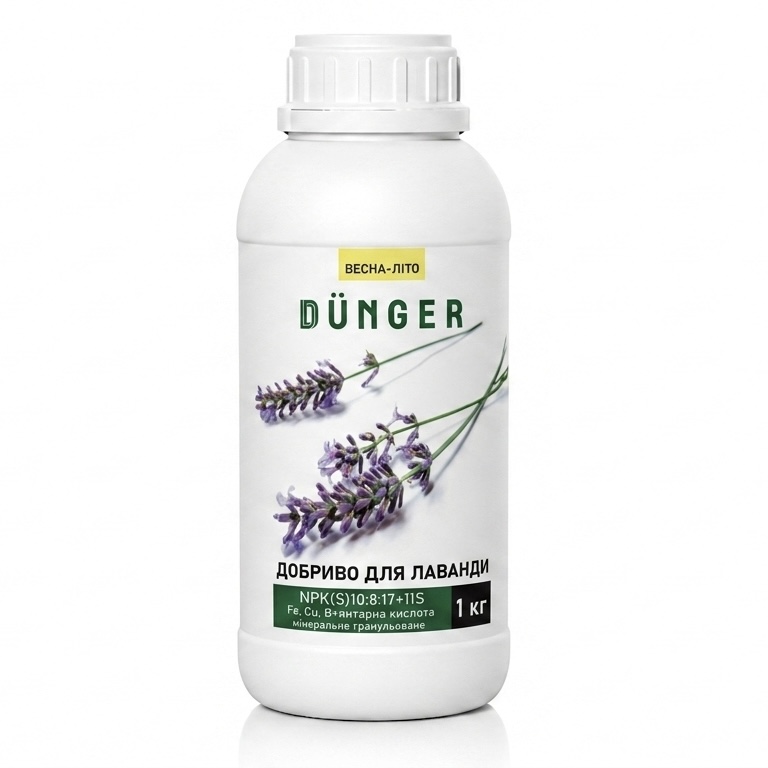
### [Complex fertilizer for lavender, granular](https://dunger.ua/en/mineral-fertilizers/small-packaging/for-landscape-design/complex-fertilizer-for-lavender)
Lavender does not need rich soil to be fertilized automatically. Where feeding is needed, compare previous additions with this specialist product and its stage instructions.
DÜNGER mineral granules with NPK(S) 10:8:17(11), copper, boron, iron and succinic acid. For soil feeding of lavender and the crops listed in the instructions. Rate: 30 g/m². Pack sizes: 0.5 and 1 kg. Do not dissolve in water.
8 to 10 weeks after sowing seeds/planting a seedling, fertilize at a rate of 30 g/m2. Also, fertilize during the flowering period of the bushes - 30 g/m2. Apply the fertilizer in a scattering on the loosened soil.
Choose the 0.5 or 1 kg pack from the area to be treated. An area rate is not a portion per bush. Late planting does not itself justify feeding before cold weather. Compare options in [lavender fertilizers](https://dunger.ua/en/lavender-fertilizers).
[Plan your purchases in My Garden](https://dunger.ua/en/my-garden)
## Plan the rest of the purchase
Work out plant numbers after measuring the space and checking mature cultivar dimensions. My Garden lets you specify zones, crops, measurements and a product plan. Keep a separate list for containers or materials needed at the chosen site. Buy a number of suitable plants whose aftercare you can manage.
Shaping an established shrub is a later task, rather than a reason to cut a new arrival hard immediately. For a rooted garden plant, see the separate advice on [spring lavender pruning and retaining living growth](https://dunger.ua/en/blog/spring-lavender-pruning). Planting new nursery stock also differs from moving an old woody shrub. Root disturbance, the work involved and the uncertainty are different, so do not use one operation as a template for the other.
## Questions about planting lavender
###
Assess a container plant by its condition and the site, but remember that strong heat makes establishment harder to manage. Where nobody can check moisture and provide a suitable position, choose a more favourable period. Flowers on the plant are not a reason to put it into dry, unprepared ground.
###
###
###
Share this article
## Related Posts

[Flowers and ornamentals](https://dunger.ua/en/blog/categories/flowers-and-ornamentals)
### Feeding clematis: assessing need, choosing fertilizer and applying it
Clematis feeding starts with need and root conditions. Compare previous additions, fertilizer form and the rate for the appropriate plant group.
2 hours ago
•
7

[Flowers and ornamentals](https://dunger.ua/en/blog/categories/flowers-and-ornamentals)
### Potted lisianthus care: light, watering and flowering
Care for a purchased flowering lisianthus by checking light, root-ball moisture, drainage and the need for feeding.
16 hours ago
•
7

[Flowers and ornamentals](https://dunger.ua/en/blog/categories/flowers-and-ornamentals)
### Clematis care: site, support, watering and everyday growing
Check your established clematis’s support, light, root-zone moisture and feeding needs through the growing season.
17 hours ago
•
7
Order & Inquiry
## Get in touch

Order mineral and organo-mineral fertilizers directly from the manufacturer. We will help you choose the right product for your garden, farm or landscape.
2 hours
response time
Free
product advice
Personal
manager
Easy
to get in touch
Step 1 of 425%
### Hello!
Let's get acquainted and help you
Tell us what you are interested in?
Press Enter to continue
By clicking the button, you agree to [privacy policy](https://dunger.ua/en/privacy)