
[Flowers and ornamentals](https://dunger.ua/en/blog/categories/flowers-and-ornamentals)
# Can established lavender be moved? Transplanting and dividing risks
Published
3 hours ago
Updated
3 hours ago
To read
7 min
Decide whether to move established lavender, preserve its rootball and understand the risks of splitting an old woody base.
An established lavender can be moved with its rootball, but successful establishment is not guaranteed. Splitting an old woody bush in half is not a reliable way to obtain two new plants. First decide what you need: more space, a better growing site or additional plants. Each objective calls for a different decision. Sometimes the sensible choice is to leave a healthy bush in place and grow or buy a young plant for the new position.
## Moving, dividing and propagating are different
Moving aims to preserve one plant and as much of its root system as possible. Division separates parts that must have suitable roots and shoots of their own. Lavender has a woody base; a dense appearance does not prove that the bush consists of independent plants. Avoid transferring a technique that worked well on a clump-forming herbaceous perennial to an old lavender simply because both occupy a broad patch.
A branch that has already rooted where it touched the ground differs from a piece chopped off the old base. If you cannot identify its own roots, do not tear off a section at random. Consider [propagating lavender from cuttings](https://dunger.ua/en/blog/propagating-lavender) when the objective is additional plants. Digging up the parent, splitting its base and cutting its crown back hard together is a substantial intervention, not a shortcut with a dependable outcome.
## Deciding whether moving is justified
Establish what is causing difficulty. Building work may require clearing the site; shade from a neighbouring tree or standing water needs investigation. If the only concern is an untidy old shape, moving will not automatically restore a young compact plant. A woody bush may retain the same appearance in its new position while also suffering root damage. Compare the reason for moving with the condition of the plant you hope to preserve.
Assess whether you can lift and transport a substantial rootball without breaking it apart. Large plants require more preparation and help than young ones. Age, condition of the base, earlier damage and access to roots matter more than the wish to save the plant at any cost. Where paving blocks excavation or many roots must be cut away, compare the risk with creating a replacement planting.
## Check the destination before lifting
Lavender needs sunshine and drainage. Moving it from one wet depression to another does not remove the underlying problem. Watch the destination after rain, check whether lawn irrigation reaches it and consider future shading by neighbours. On a heavy wet site, solve the position or raised-planting question first. A small planting hole in surrounding saturated clay does not establish that the new root environment will be suitable.
Identify the lavender and its hardiness. The name covers plants with different cold tolerance, and a sheltered border cannot make every cultivar suitable for every Ukrainian winter. If its identity is lost, seek clarification before changing conditions. The destination must accommodate the mature crown and future access, rather than only the dimensions of the rootball on the day of the move.
## Selecting a suitable weather window
Do not set one date for all Ukraine. In spring, consider thawed and workable soil, severe frost risk and approaching heat. A cool or wet garden needs particular attention. Consider an autumn move only where conditions genuinely allow roots to re-establish before winter. A brief warm spell alone does not demonstrate that opportunity. The plant, site and expected conditions must be considered together.
Avoid moving during heat, drying winds or when soil is frozen or saturated. A calm cloudy day helps protect exposed roots from moisture loss. Prepare in advance when the job can wait. Where repairs dictate an inconvenient date, recognize the additional risk and arrange a replacement option. A required building schedule does not make establishment certain, even when the moving technique is careful.
### Prepare before starting
- The destination and an estimate of rootball size.
- A spade and sharp tools for necessary clean root cuts.
- Material and transport that support the rootball.
- Help to lift a heavy plant safely.
- Access to check moisture after planting.
## Preserving the rootball
Use careful exploratory digging to establish the spread of roots. The visible crown edge is not an exact template for either depth or width. Work around the plant while retaining as much rooted soil as possible. If an individual root must be severed, use a suitable sharp tool instead of pulling it apart. Do not lift the weight of the plant by its woody stems.
Support the rootball from underneath with appropriate carrying material. Cover exposed roots against sun and wind, then transport and replant without unnecessary delay. Shaking soil away merely to reduce weight works against preserving the rootball. If the lifted bush is heavier than you can safely carry, obtain help or another transport arrangement. Pulling abruptly on the base is not a substitute for support.
## Replant at the appropriate level
Prepare the destination around the actual rootball dimensions. The previous soil mark helps avoid planting too deeply. Do not bury bare woody stems to disguise the plant's age. Fill around the rootball carefully and establish soil contact without breaking it apart. After watering, check for settlement and confirm that excess water can drain away. A finished-looking surface does not reveal the condition underneath.
Base further watering on moisture in the rootball and the surrounding ground. The drought tolerance of an undisturbed established lavender does not mean a root-damaged transplant needs no attention. Persistently wet soil also hinders establishment. Avoid assigning every moved bush a fixed number of litres or an unchanging interval. Check after rainfall and in dry weather, accounting for the properties of the new position.
## Avoid combining relocation with drastic rejuvenation
Lavender does not reliably make new growth from old bare wood. Cutting hard to its woody base is not a compulsory compensation for root loss. Retain suitable green growth and postpone further shaping decisions until its condition is clearer. If replacing an old plant is the main objective, compare that risk with [planting a new lavender](https://dunger.ua/en/blog/planting-lavender) rather than assuming relocation will also solve its appearance.
## Moving several bushes
Label plants and destinations first, especially where cultivars differ. Prepare a clear carrying route. Do not lift an entire row if you can promptly replant only one bush. Compare the cost of help, transport and aftercare with replacement plants, considering whether preserving these particular old bushes is essential.
Photograph the base and crown before moving and after planting. Keep cultivar and site information for later advice. These details help distinguish existing damage from subsequent changes and describe the problem more accurately.
## Lavender feeding at a permitted stage
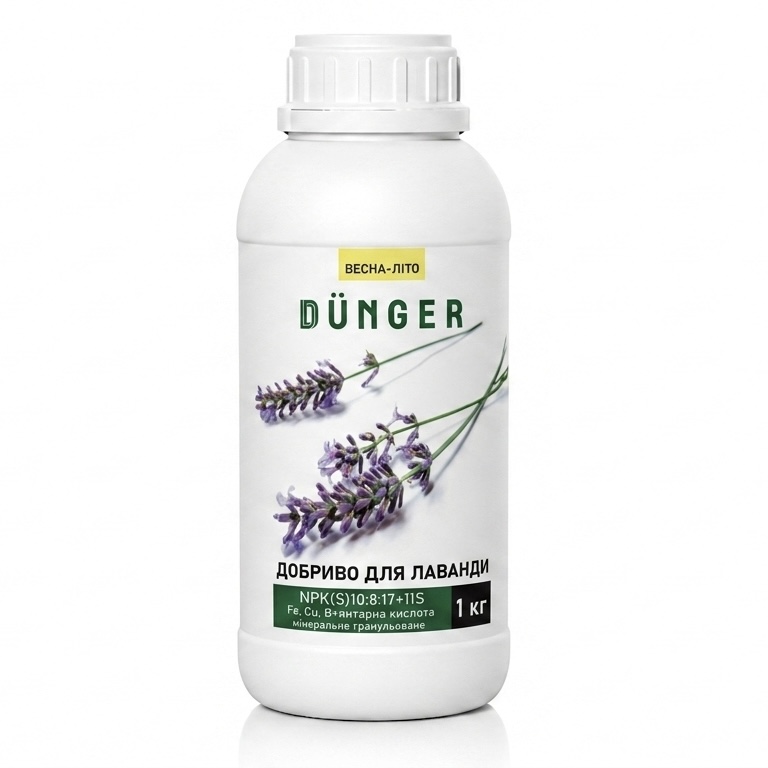
### [Complex fertilizer for lavender, granular](https://dunger.ua/en/mineral-fertilizers/small-packaging/for-landscape-design/complex-fertilizer-for-lavender)
This granular complex includes lavender in its instructions. Choose 0.5 or 1 kg packs by the area of the intended application. Moving an established bush does not call for automatic granules in the hole. Do not independently restart the stated seedling/sowing countdown for a relocated adult.
8 to 10 weeks after sowing seeds/planting a seedling, fertilize at a rate of 30 g/m2. Also, fertilize during the flowering period of the bushes - 30 g/m2. Apply the fertilizer in a scattering on the loosened soil.
Lavender, pervoxia, caryopteris, oakmoss, sage and Mediterranean herbs: **30 g/m²**
For later feeding, first assess recovery, need, season and the permitted stage, including flowering. Root loss is not a reason to increase the rate. Check packs and purchase terms on the product page; compare [lavender fertilizers](https://dunger.ua/en/lavender-fertilizers). Measure the planted area when planning the required mass.
[Plan your growing zone and purchases in My Garden](https://dunger.ua/en/my-garden)
## Frequently asked questions
###
Do not regard this as a dependable method for an old woody lavender. A useful separated plant requires its own roots and shoots, which two pieces of woody base do not establish. When you want more bushes, first consider cuttings or young plants instead of treating the existing plant as a readily divisible clump.
###
###
###
Share this article
## Related Posts

[Flowers and ornamentals](https://dunger.ua/en/blog/categories/flowers-and-ornamentals)
### Sowing annual asters outdoors: seeds, beds and seedlings
Direct sowing annual China asters: choose seed and variety, assess spring soil, water gently, thin seedlings and plan early care.
1 hour ago
•
7

[Flowers and ornamentals](https://dunger.ua/en/blog/categories/flowers-and-ornamentals)
### Feeding clematis: assessing need, choosing fertilizer and applying it
Clematis feeding starts with need and root conditions. Compare previous additions, fertilizer form and the rate for the appropriate plant group.
6 hours ago
•
7

[Flowers and ornamentals](https://dunger.ua/en/blog/categories/flowers-and-ornamentals)
### When to plant lavender: young plants, soil and early care
Choose a lavender planting date from cultivar hardiness, workable soil and the care available for new roots. Start by checking the plant and its site.
7 hours ago
•
7
Order & Inquiry
## Get in touch

Order mineral and organo-mineral fertilizers directly from the manufacturer. We will help you choose the right product for your garden, farm or landscape.
2 hours
response time
Free
product advice
Personal
manager
Easy
to get in touch
Step 1 of 425%
### Hello!
Let's get acquainted and help you
Tell us what you are interested in?
Press Enter to continue
By clicking the button, you agree to [privacy policy](https://dunger.ua/en/privacy)