
[Flowers and ornamentals](https://dunger.ua/en/blog/categories/flowers-and-ornamentals)
# Feeding peonies in spring: soil, buds and application
Published
7 minutes ago
Updated
7 minutes ago
To read
7 min
Spring peony feeding after checking group, age, soil and previous applications. Use the dedicated granular complex according to its exact method and area rate.
Spring feeding for peonies starts with plant group, soil condition, previous applications and actual development. A dedicated granular complex has its own spring and summer instructions. However, a young planting in well-prepared ground and an older clump elsewhere do not automatically need the same decision. Check conditions first, choose the method and measure the product in its stated units. The aim is an appropriate application, rather than the largest possible dose.
## Identify the peony group before working
Herbaceous peonies lose their above-ground shoots at the end of the season and produce new growth from the base. Tree peonies retain a permanent woody framework. Identify intersectional or Itoh plants correctly too, rather than deciding from flower colour alone. Keep the cultivar name. Spring tidying and bud assessment should not become an identical ground-level cut for every plant called a peony.
The complex below covers all peony types, but this does not make shoot care identical. Treat feeding and pruning as separate decisions. Use [when to cut back peonies](https://dunger.ua/en/blog/when-to-cut-back-peonies) for appropriate handling of the above-ground parts. A larger fertilizer dose cannot compensate for accidentally removing living framework. Identify what is alive before clearing around the plant for an application.
## Review what the soil has already received
Before buying another product, review planting amendments, organic materials, granules and liquid feeds used previously. A peony does not begin spring in an empty growing medium. Separate areas that received different products. Do not apply the same collection everywhere simply because all the clumps are in your garden. Clarify an unknown previous product instead of adding another one at random to cover a presumed gap.
If fertility or weak growth is unclear, soil analysis can be useful. Use the [soil assessment before feeding](https://dunger.ua/en/blog/soil-assessment-before-fertilizing) for preparation. Report recent additions and follow sampling instructions. Nutrient supply, physical structure and drainage are different properties. Rich ground that remains waterlogged can still be unsuitable. Knowing that compost was added does not establish that every subsequent nutrient application is needed.
## Distinguish new planting from an established clump
Establish when the plant was planted or divided and how the ground was prepared. A small young peony should not receive an invented stronger programme to hasten maturity. Missing flowers after a recent move may reflect establishment. That does not prove an immediate need for another complete nutrient dose. Check the plant's history before interpreting a quiet first season as a feeding failure.
For an older planting, consider previous growth, light and competition. Nearby trees can increase shade over time, and water conditions can change. Years in the ground do not alone prove depletion. If a purchased plant is still in a container awaiting planting, do not automatically transfer the method for a shrub established in open soil. Identify the present task and root environment before selecting the application.
## Spring stage matters more than a month name
Match renewed growth and emerging shoots with the selected product's permitted use. Do not scatter fertilizer over frozen or saturated ground because the calendar says spring. Check root-zone access, shoot condition and the forecast. A warm sheltered position can develop differently from a cool hollow even within one town. Treat these as actual observations, rather than reasons to copy a date from elsewhere.
In southern Ukraine, assess drying and early weather changes. In northern and western areas, consider delayed warming, retained moisture and returning cold. These are local checks, not uniform descriptions of every garden in each region. Bud development also varies with group and cultivar. Compare the stage of the particular plant rather than forcing all peonies into one application day regardless of their condition.
## A dedicated granular peony complex
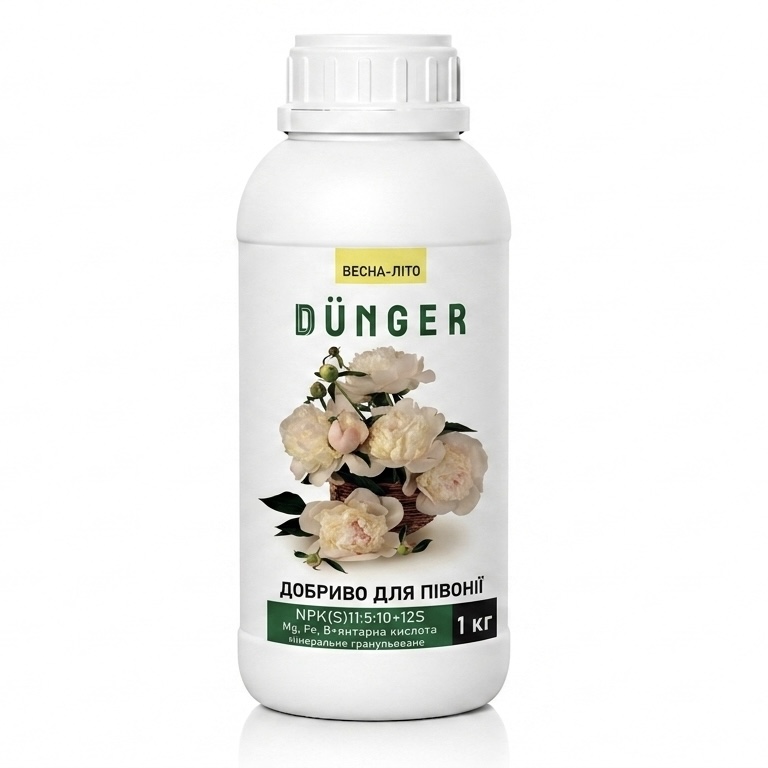
### [Complex fertilizer for peonies, granules](https://dunger.ua/en/mineral-fertilizers/small-packaging/for-landscape-design/complex-fertilizer-for-peonies)
For an established nutrition need, consider this product for all peony types. Match its complete method to the actual stage and retain the rate units.
In early spring, as well as before flowering, fertilize at a rate of 20 g/m2. Also fertilize during the flowering period of the bushes - in summer 20 g/m2. Apply the fertilizer in a scattering around the circumference of the bush, avoiding contact with leaves and flowers. The application rate can be increased depending on the size of the bush.
**Peony, rose, other flowering shrubs**
20 ≥ g/m²
The complex comes in 0.5 and 1 kg packs. Select a pack after establishing area and need for the intended application. Pack weight is not a seasonal allowance per bush. Clarify uncertain use before ordering; do not create a homemade liquid formulation.
[Plan fertilizers in My Garden](https://dunger.ua/en/my-garden)
## Measure the area rather than count flowers
Identify the ground you intend to treat and record its dimensions. This product uses an area-based rate. Bushes, shoots and buds cannot substitute for square metres. Do not divide a pack equally between plants when that amount does not fit the selected area and full instructions. In a mixed bed, mark the boundaries of the planting you actually intend to feed before weighing granules.
Measure granules by mass using suitable equipment. A handful or an uncalibrated full cap is not a precise unit. Do not transfer spoons or portions from another fertilizer. An opened pack need not be used at once. Compare the calculated requirement with pack size and store the remainder according to the label. The convenience of a purchase does not change the plant's application instructions.
## Follow a consistent application sequence
- Identify group, condition and stage, and check previous products.
- Read the complete instructions for the selected pack and establish the area.
- Measure the required mass and access the soil without injuring young shoots.
- Carry out the stated soil method, keeping its leaf and flower precautions.
- Keep the label and actual amount in your own records before another decision.
Do not turn a granular compound into a homemade spray. A liquid product needs separate selection and its own instructions; a shared crop name does not make forms interchangeable by dose. Do not combine fertilizer with a plant-protection product or household additive without verified compatibility. One justified application does not require trying several new methods simultaneously. Keep the selected method simple enough to carry out accurately.
## Moisture and foliage still need attention
Check the root environment during growth and budding. Dry conditions and persistent saturation are different problems that one extra nutrient dose cannot solve. Do not set watering from a universal interval for every soil. Compare new and established plants, weather and actual moisture. Avoid covering the plant centre with a thick layer of material during spring care. Adding bulk around emerging shoots is not the same as supplying measured fertilizer.
Healthy foliage after flowering is not unwanted residue. Do not remove all green growth merely to make feeding or tidying easier. If spotting or dieback appears, investigate and choose appropriate action first. Another fertilizer is not a universal treatment for damage. Coordinate nutrition, root condition and handling of the above-ground parts rather than treating one as a replacement for another. Keep the existing pruning guide separate from the feeding calculation.
## When buds are few or do not open
Check age and recent moving, light, planting conditions, moisture and possible damage. Fertilizer cannot guarantee correction of every cause. Use [peony flowering and bud development](https://dunger.ua/en/blog/peony-flowering-and-buds) for a separate assessment. Do not repeat applications after every change in bud appearance. Rapid dieback or unusual spots need investigation rather than a search for the strongest compound. A healthy-looking leaf canopy does not by itself establish why flowering is limited.
In [My Garden](https://dunger.ua/en/my-garden), define peonies as a separate zone, enter crop and measurements and prepare a fertilizer plan. Keep actual application records with the label in your own notes. Compare products for neighbouring shrubs in the [landscape design category](https://dunger.ua/en/mineral-fertilizers/small-packaging/for-landscape-design) using their own methods. Check the selected pack when ordering rather than purchasing a reserve in expectation of guaranteed rapid flowers.
## Questions about spring peony feeding
###
No. Account for planting, soil preparation and previous applications. A young clump should not be pushed with an arbitrary larger dose.
###
###
###
Share this article
## Related Posts

[Flowers and ornamentals](https://dunger.ua/en/blog/categories/flowers-and-ornamentals)
### Trailing begonias: caring for hanging baskets through the season
Outdoor trailing tuberous begonias: position and hanging access, brittle shoots, moisture checks, flower feeding and frost-free tuber storage.
37 minutes ago
•
7

[Flowers and ornamentals](https://dunger.ua/en/blog/categories/flowers-and-ornamentals)
### Feeding lavender: need, timing and the correct rate
Decide whether lavender needs feeding, check soil and plant stage, and select a granular product without turning its area rate into a dose per bush.
2 hours ago
•
7

[Flowers and ornamentals](https://dunger.ua/en/blog/categories/flowers-and-ornamentals)
### Sowing annual asters outdoors: seeds, beds and seedlings
Direct sowing annual China asters: choose seed and variety, assess spring soil, water gently, thin seedlings and plan early care.
4 hours ago
•
7
Order & Inquiry
## Get in touch

Order mineral and organo-mineral fertilizers directly from the manufacturer. We will help you choose the right product for your garden, farm or landscape.
2 hours
response time
Free
product advice
Personal
manager
Easy
to get in touch
Step 1 of 425%
### Hello!
Let's get acquainted and help you
Tell us what you are interested in?
Press Enter to continue
By clicking the button, you agree to [privacy policy](https://dunger.ua/en/privacy)